
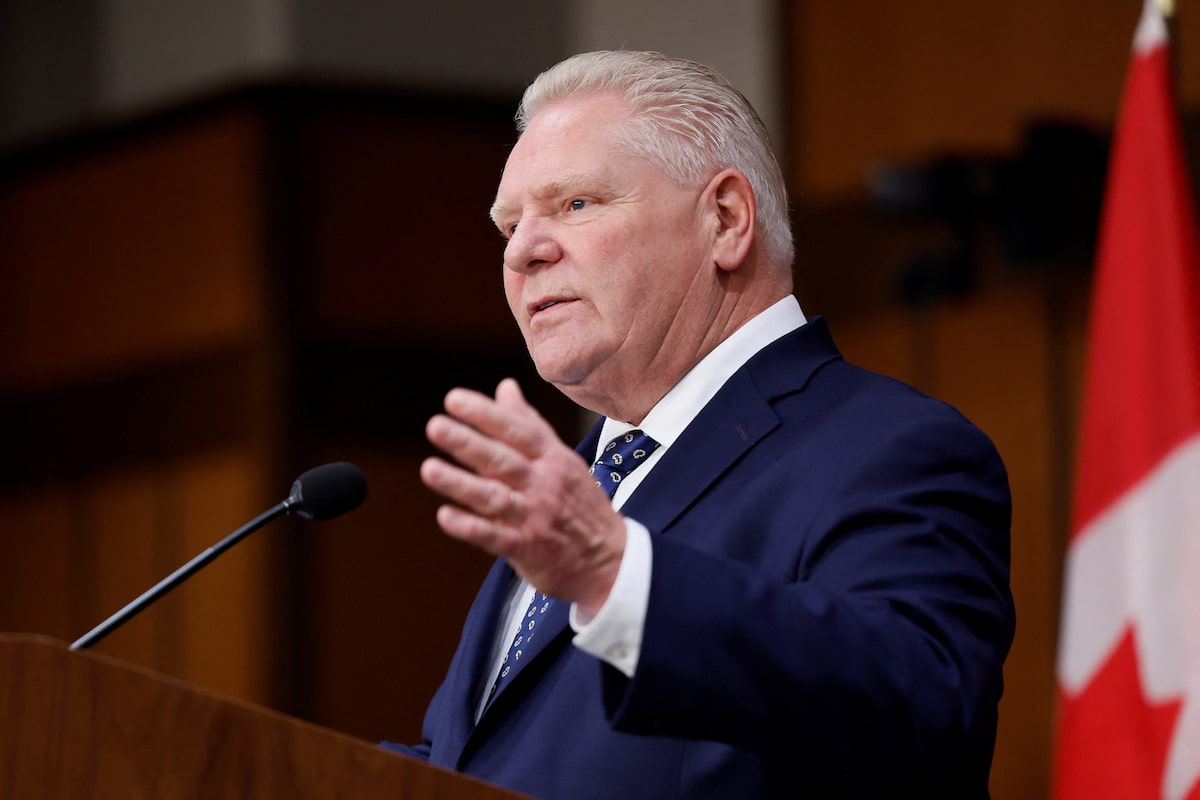
Ontario Premier Doug Ford said this week that ‘the walls are closing in on’ President Donald Trump after the U.S. Supreme Court struck down the legal justification for some of his tariffs.Blair Gable/Reuters
Ontario Premier Doug Ford is once again ratcheting up his involvement in Canada-U.S. relations, with plans to meet with key Republicans and Trump allies, including the Texas governor, ahead of a high-stakes review of the North American free-trade pact.
Mr. Ford is set to travel to the southern U.S. and Utah this spring and summer to meet in-person with governors and American lawmakers as part of a renewed charm offensive to advocate against tariffs and for a strengthened economic partnership between the two countries.
The meetings are taking place at a critical time, as Prime Minister Mark Carney prepares for a review of the United States-Mexico-Canada Agreement (USMCA), amid reports that U.S. President Donald Trump may be looking to exit the deal. The USMCA review is set to begin in July.
FedEx joins other U.S. companies in seeking a refund after Trump tariffs ruled illegal
Mr. Ford, who last year spearheaded a group representing the premiers, positioned himself as a “Captain Canada” figure as the federal Liberals were plunged into disarray with former prime minister Justin Trudeau’s resignation last January.
Once a supporter of the U.S. President, Mr. Ford has morphed into an outspoken critic of the Trump administration, even threatening at one point to cut off electricity to northern states as a result of the trade war. He also appears occasionally on U.S. television networks to lambast Mr. Trump and launched his own anti-tariff commercial, which the U.S. President cited as the reason for cancelling trade talks with Canada last fall.
Hannah Jensen, a spokeswoman for Mr. Ford’s office, said Tuesday that Mr. Trump’s tariffs cost billions to the economy and families on both sides of the border.
“As he has for the last year, in the lead-up to the renegotiation of CUSMA, Premier Ford continues to meet directly with lawmakers, both Republican and Democrat, at both the national and state levels, to build relationships and share his vision for Fortress Am-Can,” she said, referring to Mr. Ford’s proposal for closer economic co-operation between America and Canada.
No countries pulling out of trade deals over tariffs, U.S. trade chief says
Mr. Ford told reporters at Queen’s Park this week that “the walls are closing in on President Trump” after the U.S. Supreme Court struck down the legal justification for some of the tariffs on Canada and other countries. However, Mr. Trump hit back with the promise of a new tariffs, which came into effect at 10 per cent Tuesday, after the court struck down a central pillar of his protectionist agenda.
On CNN on Monday, Mr. Ford told host Wolf Blitzer that the President’s tariffs will have an impact on the November midterms. “I’ve never seen so many Canadians all cheering on the Democrats,” Mr. Ford said. (A spokesperson for U.S. Ambassador Pete Hoekstra declined to comment Tuesday on Mr. Ford’s remarks.)
Mr. Ford is also making calls to U.S. senators, after the House of Representatives voted earlier this month to rescind Mr. Trump’s tariffs on Canada, a vote that included six Republicans. The victory is symbolic, because Mr. Trump can veto the resolution, but Canadian officials hope that the U.S. President continues to feel pressure from within his own party to rethink his tariff strategy.
“I’ve always said a tariff on Canada is a tax on the U.S., and I’m going to be spreading that message,” Mr. Ford said Monday.
Mr. Ford, who has appeared alongside Democratic governors in the past, will meet in the coming months with key Trump allies who potentially hold more sway in the upcoming trade review.
The Premier is set to travel to Texas at the beginning of April, his office said, where he is to meet with Governor Greg Abbott as well as business and political contacts. Mr. Abbott previously criticized Canada’s use of countertariffs under Mr. Trudeau, warning that the Texas economy “is larger than Canada’s. And we’re not afraid to use it.” Mr. Abbott’s office did not immediately respond to a request for comment about the upcoming meeting.
How Trump plans to continue his trade war with Canada without IEEPA
At the end of June, Mr. Ford will travel to the 2026 Southeastern United States-Canadian Provinces Conference in Greenville, S.C. The organization represents six southeastern U.S. states: Alabama, Georgia, Mississippi, North Carolina, South Carolina and Tennessee. All but one, North Carolina, are represented by Republican governors. The provinces represented at the conference are Ontario, Quebec, New Brunswick, Nova Scotia, Newfoundland and Prince Edward Island, with a focus this year on energy, mobility and life sciences.
And in early July, Mr. Ford plans to attend the Western Governors’ Association annual meeting in Deer Valley, Utah, which brings together governors from across the western United States to collaborate on trade, infrastructure, energy, health care and broadband.
Utah Governor Spencer Cox visited Mr. Ford at Queen’s Park last April, and the two leaders are expected to sign a memorandum of understanding on energy and trade at the meeting.
Interim Ontario Liberal leader John Fraser, however, criticized the Premier’s planned travel to the U.S., calling it “performative politics.” He said Mr. Ford’s interventions – such as the anti-tariff advertisement – “were not helpful” and designed purely for domestic consumption.
“I just think that in Ontario right now, we’ve got some really big problems that the Premier’s not focused on, and that’s our schools, and our hospitals, and our health care,” he said in an interview.