
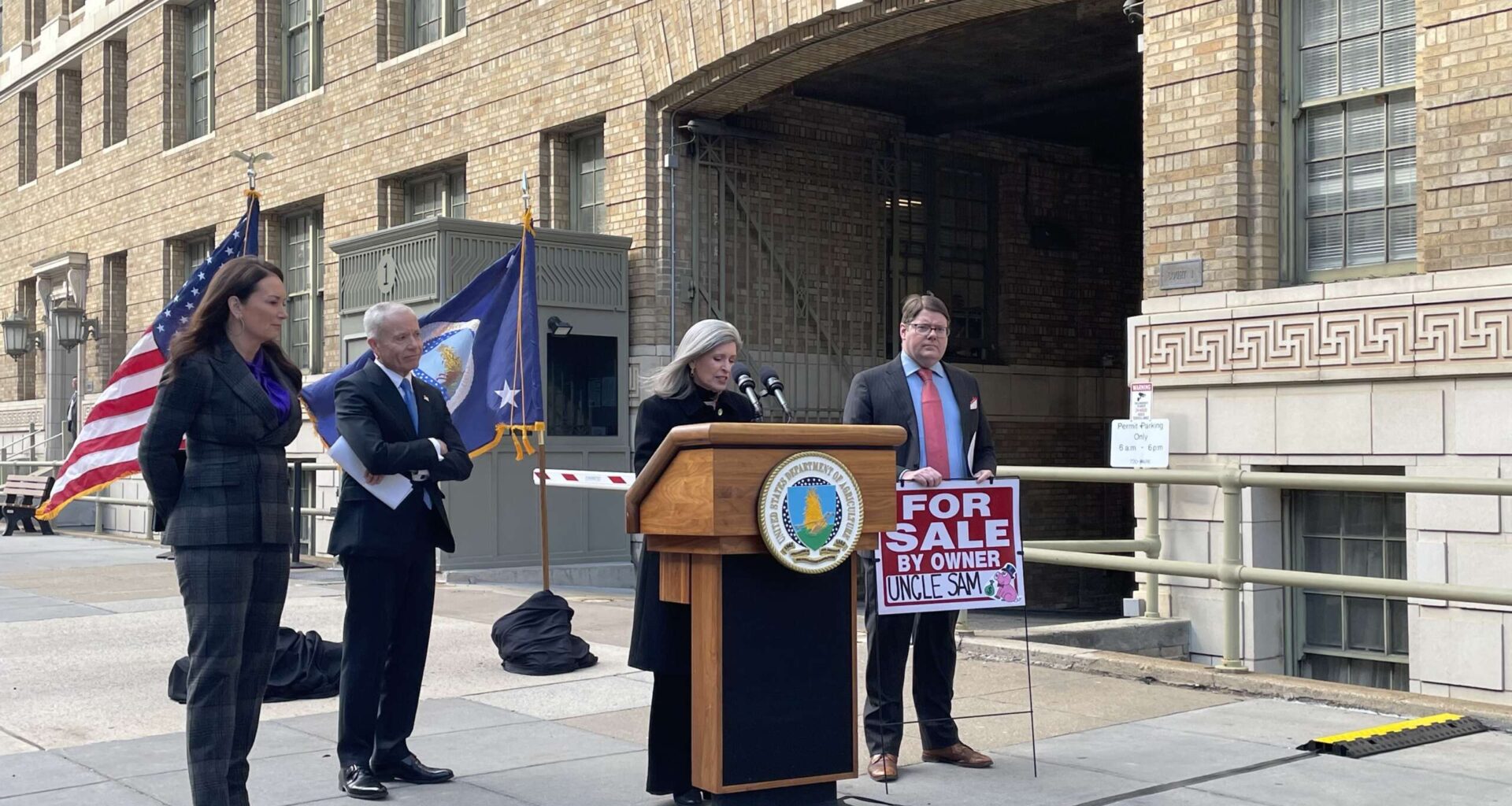
The Agriculture Department is planning to sell one of its headquarters buildings, as part of an ongoing agency reorganization that will relocate more than half of its workforce in Washington, D.C. to regional hubs across the country.
USDA announced Wednesday that it is turning the department’s South Building over to its landlord, the General Services Administration, which plans to sell the building.
Agriculture Secretary Brooke Rollins said more than 70% of seats in the building remain unoccupied on any given day, and that is currently stands as a “former shell of what it once was.”
“If you were to walk in the South Building today, here’s what you would find: empty office, after empty office, after empty office,” Rollins said at a press conference Wednesday held outside the building.
]]>
USDA officials did not share details on where USDA South Building employees will go, but said they will soon have more information for impacted staff.
The department announced last summer that more than half of its D.C. employees will be relocated to five hubs across the country — Raleigh, North Carolina; Kansas City, Missouri; Indianapolis, Indiana; Fort Collins, Colorado; and Salt Lake City, Utah.
USDA Deputy Secretary Stephen Vaden said USDA will be making “mission-area-by-mission-area announcements” in the coming weeks on where employees working in the South Building will be going.
“We will work to empty this building by the end of the year, and have them in our new hub and other locations throughout the country,” Vaden said.
USDA looks to complete its agency reorganization by the end of this year.
“We’re taking our employees into account. We know many of them have school-aged children. We want them to make the move to our new hub locations across the country,” Vaden said. “Our goal is to have our employees complete the school year here in Washington, D.C., and be in place in their new hub locations at the time school starts in those new hub locations.”
GSA Administrator Edward Forst said the USDA South Building faces $1.6 billion in “delinquent” maintenance costs, and is the single largest liability in GSA’s real estate portfolio.
]]>
The Trump administration made shrinking the federal government’s real estate portfolio a top goal of the President’s Management Agenda.
“The president has set a bold agenda to shrink the federal real estate footprint and transform what was once a fiscal drain of empty space into an engine of economic opportunity. And this is GSA’s mission,” Forst said.
Several other agencies are also shedding office space. The Department of Housing and Urban Development is moving out of its downtown D.C. headquarters and taking over the Alexandria, Virginia, headquarters of the National Science Foundation. Impacted NSF employees will relocate to nearby leased office space.
The IRS is also looking to move out of office space that is now underutilized, after more than a quarter of its employees left or retired from the agency last year.
The Public Buildings Reform Board, a bipartisan panel created by Congress to advise GSA on underutilized buildings it should sell, told lawmakers in December that the agency would need $50 billion to fully address its extensive repair and maintenance backlog. Members of the board said GSA cannot realistically expect Congress to provide that level of funding, and that it needs to offload buildings it owns, but cannot afford to operate.
Once GSA sells the South Building, Forst said USDA would achieve an 80% utilization rate for its buildings in the national capital region — well above a 60% utilization rate set governmentwide last year. Under the USE IT Act that former President Joe Biden signed into law, all agencies must be able to show that their buildings meet at least a 60% utilization rate, or come up with plans to relocate.
Sen. Joni Ernst (R-Iowa), chairwoman of the Senate DOGE Caucus, who has long criticized the federal government’s underutilized federal office space, applauded the decision to sell the USDA South Building.
“We have one federal government building down,” Ernst said. “We’ve got many, many unused buildings yet to go.”
Rollins said USDA’s reorganization plan is meant to bring employees closer to the communities they serve, and will reduce spending on a workforce that grew by thousands of employees under the Biden administration.
]]>
Under the previous administration, USDA grew its workforce by 8%. During that same period, salaries grew by nearly 15%.
Rollins said there was “no realistic way to pay them,” and that the surge in employees led to no “tangible increase in service to USDA core constituencies.” Likewise, she said the largely vacant South Building is wasting taxpayer dollars.
“This entire city block in bricks and mortar is what government that has grown too big, too bloated and too disconnected from its citizens looks like,” Rollins said.
Vaden said USDA is also moving Food and Nutrition Service employees out of their leased office space in Alexandria.
USDA will return that leased office space to GSA, and FNS employees will be relocated to buildings that currently house the Forest Service and the Agricultural Research Service. Vaden said FNS staff have complained about the building for years, and he saw the state of the building when he attended a Christmas party there last year.
“I couldn’t use the elevators. They were blocked off by caution tape, which is an everyday headache that details what our employees are being asked to deal with,” Vaden said.
The department’s relocation plans are much broader in scope than what happened under the first Trump administration. In 2019, USDA sought to move several hundred employees in its research bureaus from the D.C. area to Kansas City, but most impacted employees chose to leave the agency, rather than relocate.
Vaden told lawmakers last summer that said he expects “more than a majority” of employees who receive relocation notices this time around will agree to move, in part because mass layoffs across the federal workforce are making the job search much more challenging in the Washington, D.C. metropolitan area.
If you would like to contact this reporter about recent changes in the federal government, please email jheckman@federalnewsnetwork.com, or reach out on Signal at jheckman.29
Copyright
© 2026 Federal News Network. All rights reserved. This website is not intended for users located within the European Economic Area.