
Federal agents with the Department of Homeland Security apparently lied their way into a Columbia University dormitory and arrested a student there, the university’s acting president Claire Shipman said in a statement Thursday morning.
The agents entered her campus housing in Morningside Heights at around 6:30 a.m., Shipman said. “Our understanding at this time is that the federal agents made misrepresentations to gain entry to the building to search for a ‘missing person.’ We are working to gather more details.”
While Shipman did not name the arrested student, Columbia student Ellie Aghayeva filed a habeas corpus petition asking a federal judge to order her release later on Thursday morning.
Aghayeva, who is from Azerbaijan, is an undergraduate studying neuroscience and political science who came to the United States on a visa 2016, according to her petition. Her lawyers didn’t immediately respond to a request for comment.
DHS officials “represented that they did not have a warrant for Petitioner,” the filing reads. The agents instead “represented they were searching for a missing person to gain entry.”
In the early hours of Thursday morning, Aghayeva had pushed out an urgent Instagram story.
“Dhs illegally arrested me. Please help,” the post read.
In a statement from an unnamed DHS official, the department confirmed ICE had arrested Aghayeva, calling her, “an illegal alien from Azerbaijan, whose student visa was terminated in 2016 under the Obama administration for failing to attend classes.”
“The building manager and her roommate let officers into the apartment. She has no pending appeals or applications with DHS,” the statement read. It did not address Shipman’s contention that the officers had misidentified themselves to gain access.
Aghayeva’s name, and her Instagram post, were first reported on by the Columbia Spectator. Unlike the students targeted in Trump’s earlier crackdown on Columbia last year for their activism against Israel, Aghayeva’s account, which has more than 100,000 followers, is mostly about her life as a student at Columbia.
Shipman noted in her statement that “all law enforcement agents must have a judicial warrant or judicial subpoena to access non-public areas of the University, including housing, classrooms, and areas requiring CUID swipe access. An administrative warrant is not sufficient.”
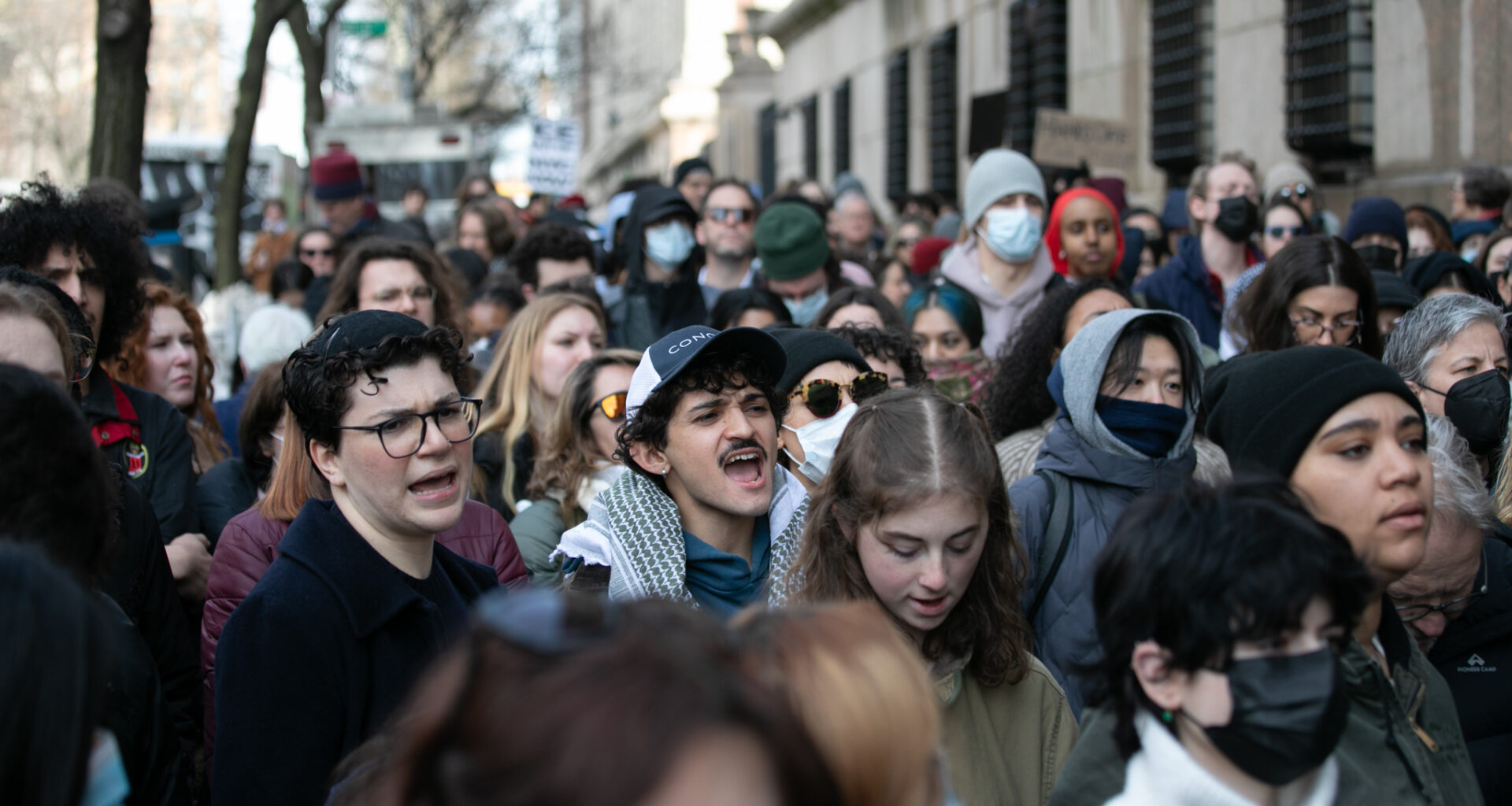
But as news spread of Aghayeva’s arrest Thursday, a crowd of angry faculty, students and other demonstrators gathered outside Columbia’s gates to decry the arrest and the university’s response to it.
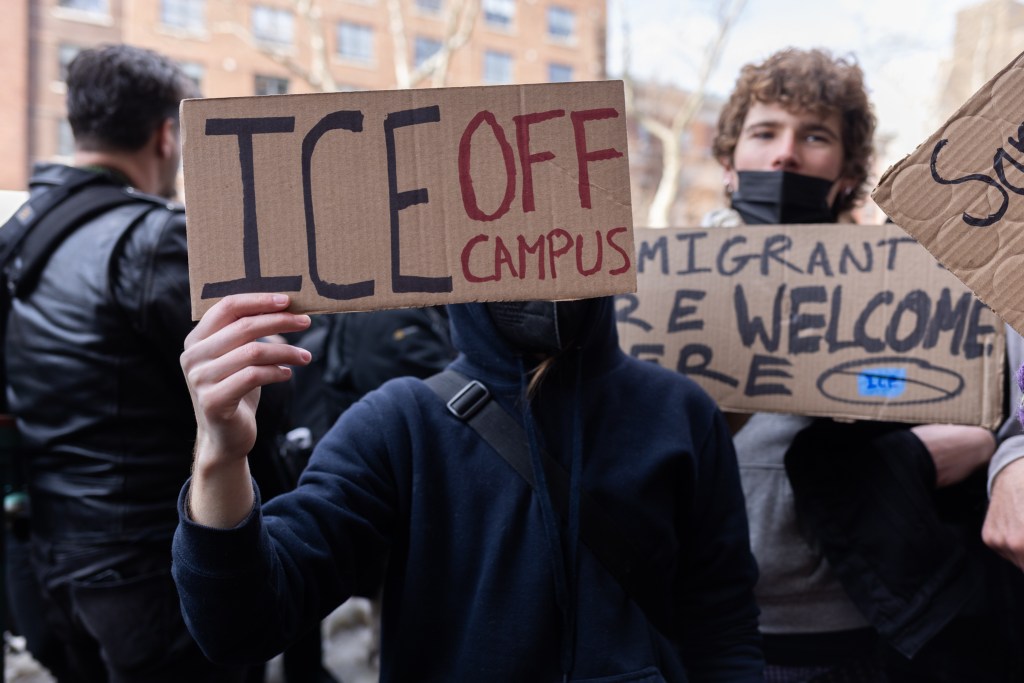 Columbia University students and faculty protested outside the main campus after federal agents detained an international student at her student housing, Feb. 26, 2026. Credit: Ben Fractenberg/THE CITY
“I’m pretty appalled that they were even able to get on our campus because they’re always insisting that our safety is their number one priority and we have pretty crazy security on campus, so I just don’t understand how they were able to get on campus,” said an undergraduate student named Hope, who declined to provide her last name.
“This should not have happened,” she said.
Melanie Wall, a professor of biostatistics who joined the demonstrators, said faculty had been pressing administration for more safeguards for international students since the ICE arrests last year targeting student activist to no avail.
“Everybody who’s done any ICE watch training knows that they’re going to lie. Our security can’t ask the right questions and actually check for ID?”
“We don’t let people on campus without a warrant, blah, blah, blah,” Wall said, referring to Shipman’s statement about the arrest. “That’s literally what happened. So it’s just classic gaslighting.”
The latest arrest came after a string of them last year in which DHS and ICE agents targeted students and others who’d participated in campus encampments protesting in 2024 against the war in Gaza.
ICE agents entered Mahmoud Khalil’s campus housing and arrested him last march. He then spent 104 days in ICE detention before a federal judge ordered his release while his immigration case continues.
Khalil became a prominent figure in the 2024 campus protests where he acted as a lead negotiator between student activists camped out on a campus lawn calling for the university to divest from Israeli interests amid the ongoing war in Gaza and campus administrators.
One targeted student, Ranjani Srinivasan, fled to Canada, while another, Yunseo Chung, went into hiding until her arrest was blocked by a federal judge.
Another person who participated in the protests, Leqaa Kordia, is still in ICE detention in Texas. Kordia, who never attended Columbia, was arrested for remaining in the country with an expired visa after her sealed protest arrest record was shared with the Department of Homeland Security by the NYPD.
New York elected officials swiftly slammed the arrest.
“ICE has no place in our schools and universities,” Council Speaker Julie Menin and Majority Leader Shaun Abreu wrote in a joint statement. “These activities do not make our city or country safer, but rather drive mistrust and danger. As Columbia College alumni, our hearts are with the community there, and we have been in contact with the University to offer our assistance.”
Mayor Zohran Mamdani, who traveled to Washington on Tuesday to meet with President Trump, didn’t immediately comment on the arrest.
Katie Honan contributed to this report.
Related