
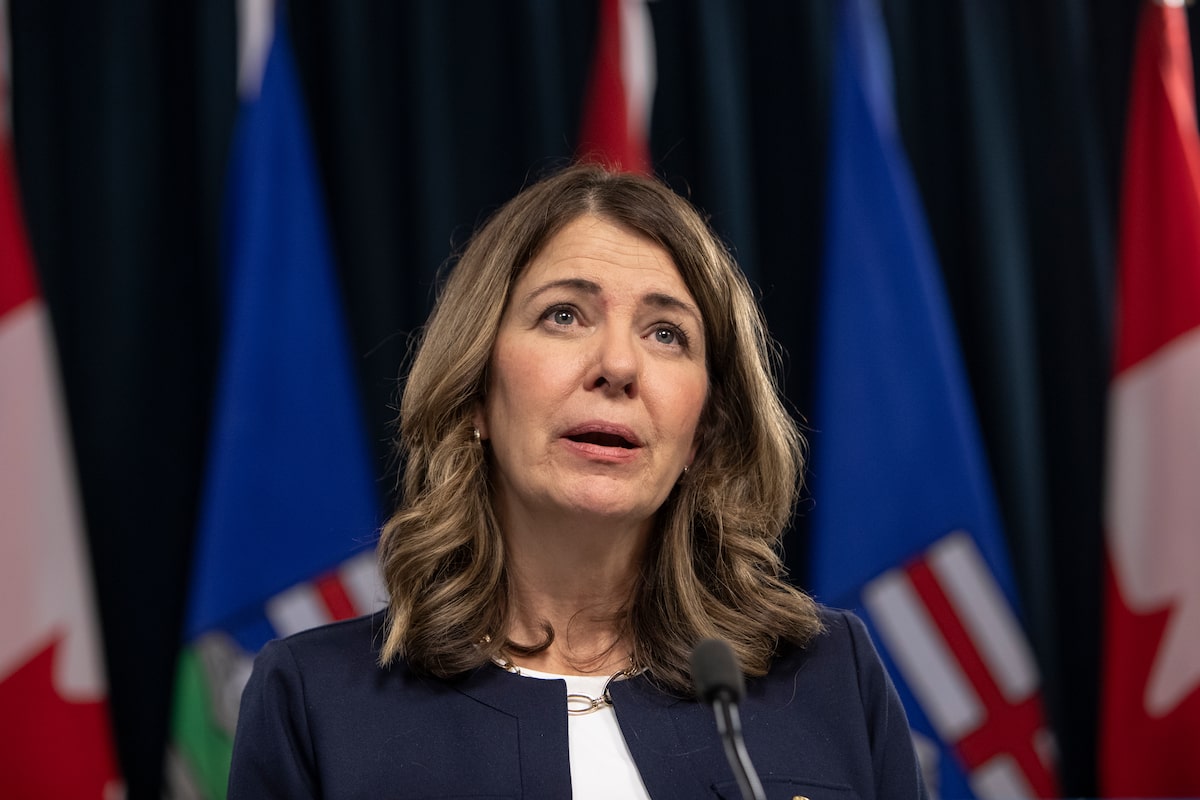
The Alberta budget will break a law implemented by Premier Danielle Smith’s government three years ago prohibiting deficits except under exceptional circumstances.AMBER BRACKEN/The Canadian Press
Coming off a year of depressed oil prices, Alberta is forecasting a deficit that would rival some of the steepest shortfalls of the past decade.
Alberta Finance Minister Nate Horner on Thursday tabled the province’s budget for the 2026-27 fiscal year with a projected $9.37-billion deficit, his second-consecutive budget to put the province in the red after several years of large surpluses.
The budget will break a law implemented by Premier Danielle Smith’s own government three years ago that aimed to control government spending.
At the same time, the province is expected to post record spending of $83.9-billion after a tough year of public-sector bargaining and significant bumps to its education and health portfolios.
The budget arrived one week after Ms. Smith telegraphed tough financial times were coming in the province’s fiscal outlook.
Province paints rosy oil price forecast despite resource-driven shortfall
In her primetime address last Thursday evening, the Premier foisted much of the blame on sagging oil prices and the strain that high immigration has had on the province’s social services, although her government has not produced concrete figures on precisely how much newcomers cost those programs. She announced an October referendum that she said would allow Albertans to weigh in on that and other issues.
Provincial governments have been dealing with faltering economies as the country remains engaged in a trade war with the United States. Alberta’s economy is among the least exposed in Canada to U.S. tariffs, which have hit auto, steel and aluminum sectors the hardest.
Many provinces have indicated that financial shortfalls are expected this year, and the few that have tabled their budgets so far have posted significant deficits.
Last week, British Columbia said its deficit would reach $9.6-billion in the year ending in March and forecast a record-breaking $13.3-billion shortfall in the coming year. Nova Scotia announced it would have a deficit of $1.2-billion next year as it dealt with its own stagnating economy. Ontario’s fiscal watchdog said earlier this month that Queen’s Park isn’t on track to deliver on its promised balanced budget by 2027.
Mr. Horner said he expects Alberta to be in the red until 2029. The Finance Minister’s budget also expects increased annual spending, rising to $88.4-billion in 2028-29, almost $5-billion higher than the coming fiscal year.
“When it comes to fiscal management, I think we’re doing a good job and trying to constrain ourselves in the most reasonable way possible, while protecting the services that matter most to Albertans,” Mr. Horner told reporters on Thursday afternoon.
Mr. Horner’s ministry spent much of the past year locked in negotiations with public-sector unions, ratifying agreements that added new spending to the government’s balance sheet.
Last fall’s nearly month-long teacher’s strike was the highest-profile labour dispute, which ended with Ms. Smith’s government preventing court challenges by embedding the federal Constitution’s notwithstanding clause in back-to-work legislation.
In the months since, Ms. Smith has announced new education funding to address teachers’ core concerns – such as growing class sizes and students’ complex learning needs – that were not addressed in the collective bargaining agreement. This year’s budget earmarks $10.8-billion for education, a 7-per-cent hike from last year.
Alberta Premier defends fall referendum plans
The budget line for Alberta’s health care system, which under Ms. Smith has been severed into four new agencies, is $34.4-billion, up $1.9-billion from the current fiscal-year estimates.
The consecutive deficits and their size will break a law created to prohibit future deficits, which was passed in 2023, shortly after the United Conservative Party introduced its first budget under Ms. Smith with a significant surplus.
Mr. Horner suggested on Thursday that the province is looking to amend the law later this year. Among other financial constraints, it currently limits deficits to no more than three in a row.
“We created these rules and I’m breaking them. It bothers nobody more than me,” said Mr. Horner.
The current rules do not come with ramifications for failing to balance budgets.
“I want to find some rules that continue to constrain us but allow us the flexibility to do what Alberta needs,” he said.
The hit to Alberta’s finances comes largely from depressed oil prices. Global benchmarks fell by almost 20 per cent in 2025 – the biggest annual loss since the height of the pandemic in 2020.
The budget estimates that royalties from non-renewable resources, such as bitumen, crude oil and natural gas, will reach $13.2-billion in the 2026-2027 fiscal year – roughly 18 per cent of the province’s total revenues. That’s $8.8-billion less than the sector brought in during the 2024-2025 fiscal year and $3.1-billion below the province’s previous forecast.
Royalties from the oil sands are estimated at $9.7-billion in 2026-27, and conventional oil at $2.1-billion. The government projects that conventional oil royalties will increase to roughly $2.6-billion in 2028-29, as WTI prices improve.
Analysts expect weakened oil prices to drag through 2026 and perhaps into 2027. However, Alberta’s benchmark oil price forecast is much higher than those of industry, forecasting agencies and most banks.
In 2026, Alberta expects West Texas Intermediate oil (the North American benchmark) to sell for US$60 a barrel, compared with the private market average of US$58. The difference between the province and the market widens even further in 2027. While private forecasts average US$60.50, Alberta reckons WTI will hit US$66.
The U.S. Energy Information Administration, for example, said this month that it expects global benchmark oil prices to fall further in 2026 and remain under US$60 a barrel in 2027, due in large part to a massive global supply glut. It forecasts that the WTI price will fall to US$53 this year and US$49 in 2027.
Provincial coffers take an approximately $680-million hit for every $1 drop in the price of oil, according to this year’s budget.
Asked how confident he is about Alberta’s own oil price estimates, Mr. Horner said he has “a lot of trust” in the province’s chief economist.
“It’s a pretty educated forecast. I’d say she’s got a better track record than industry,” he said.
Mr. Horner, in his budget speech Thursday, said this year will require “tough choices,” but pledged to not make substantial program cuts. “Some of them won’t be popular, but all of them will be necessary to face the challenges ahead.”
He also said he’s had conversations with the Premier about finding ways to increase revenue.
“I think we’ll see if Albertans are more tax-averse or debt-averse in the days and months ahead,” Mr. Horner said.
Alberta NDP Leader Naheed Nenshi in a statement said the provincial government “has done something no Alberta government has; they’ve wasted a boom during the boom.”
Around the corner for Albertans is the referendum on immigration, constitutional issues and potentially separation from Canada that Ms. Smith has scheduled for Oct. 19. As a result, the budget for Elections Alberta is set to double, to about $52-million from $26-million.
Most of that new money is earmarked for elections and “electoral events.”