
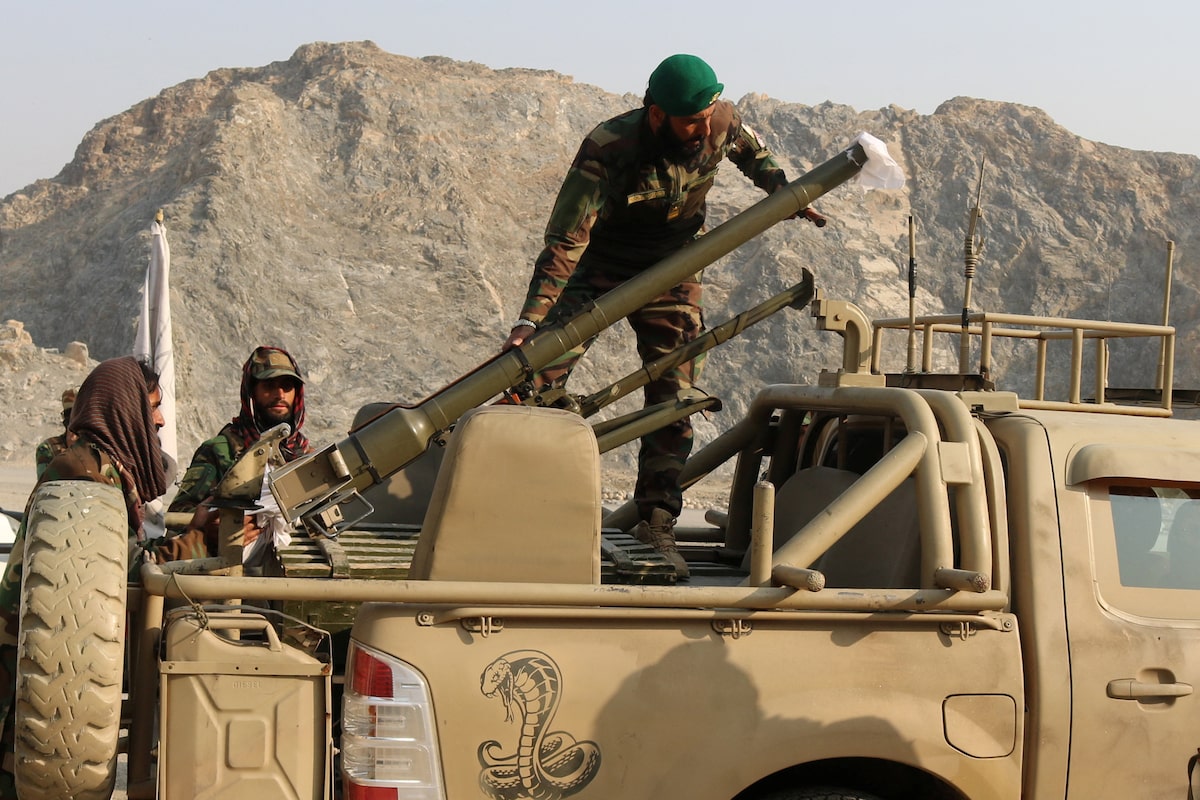
Taliban soldiers load a rocket launcher in a vehicle following exchanges of fire between Pakistan and Afghanistan forces, near Torkham border in Afghanistan, on Friday.Stringer/Reuters
Pakistan carried out air strikes on Afghanistan’s two largest cities on Friday, striking Taliban government targets in Kabul and Kandahar, as a simmering border conflict exploded into what Pakistan’s defence minister termed “open war.”
Islamabad has long accused Kabul of harbouring terrorists it blames for attacks inside Pakistan, and earlier this week bombed several targets linked to Tehreek-e-Taliban (TTP) – a group also known as the Pakistani Taliban, which has been waging a bloody war against Islamabad for years – prompting a retaliatory attack by Afghan forces on Friday.
As well as the strikes inside Kabul and Kandahar, home to Taliban supreme leader Sheikh Haibatullah Akhundzada, there were also reports of further fighting along the 2,600-kilometre border, with numerous casualties on both sides.
Writing on social media, Pakistani Defence Minister Khawaja Muhammad Asif accused the Taliban of gathering “all the terrorists of the world” inside Afghanistan and “exporting terrorism.”
An injured Pakistani girl receives treatment at a hospital.FAZAL RAHMAN/AFP/Getty Images
Promising a “decisive response,” Mr. Asif said, “Pakistan’s army did not come from across the seas. We are your neighbours; we know your ins and outs.
“Our cup of patience has overflowed,” Mr. Asif added. “Now it is open war.”
In comments that could complicate Prime Minister Mark Carney’s trip to New Delhi this week, he also claimed the Taliban had “turned Afghanistan into a colony of India” and accused Kabul of being a “proxy for India” in attacking Pakistan.
New Delhi had yet to comment on Friday, but did condemn Pakistan’s strikes on Afghanistan earlier this month, with foreign ministry spokesman Shri Randhir Jaiswal reiterating India’s “support for Afghanistan’s sovereignty, territorial integrity and independence,” and accusing Islamabad of attempting to “externalize its internal failures.”
Zabihullah Mujahid, a Taliban spokesman, confirmed that Pakistan had carried out air strikes in parts of Kabul, Kandahar and the border area of Paktia, but did not indicate how Afghanistan would retaliate. Kabul has long denied hosting or supporting the TTP, arguing that Pakistan’s security problems are an internal matter.
Residents stand on the roof of a mosque damaged in Bajaur, Khyber Pakhtunkhwa province.FAZAL RAHMAN/AFP/Getty Images
Friday prayers are held inside the damaged mosque damaged during overnight cross-border fighting between Pakistan and Afghanistan in Bajaur, Khyber Pakhtunkhwa province.FAZAL RAHMAN/AFP/Getty Images
Writing on social media, former Afghanistan President Hamid Karzai – who has remained involved in Afghan politics even after his successor, Ashraf Ghani, was ousted by the Taliban in 2021 – said his countrymen “will defend their beloved homeland with complete unity in all circumstances and will respond to aggression with courage.”
“Pakistan cannot free itself from the violence and bombings – those problems it has created itself – but must change its own policy and choose the path of good neighbourliness, respect, and civilized relations with Afghanistan,” Mr. Karzai said.
International and regional officials called for calm and an immediate de-escalation, with the UN Special Rapporteur for Afghanistan, Richard Bennett, saying this was “essential” to avoid risk to civilian life.
Residents of Kabul were jolted awake early Friday by sounds of bombs and gunfire as Pakistan launched air and ground strikes on Taliban targets across Afghanistan.
Reuters
After smaller clashes last year, negotiations brokered by Qatar, Turkey and Saudi Arabia did lead to a ceasefire in October, but that truce was barely holding even before Friday’s escalation.
Both Russia and China, close allies of Pakistan which are also among the few countries to have recognized the Taliban government, expressed concern on Friday, with Moscow offering to mediate in order to bring about an end to the renewed fighting. Iranian foreign minister Abbas Araghchi said his country could assist with such efforts, urging Pakistan and Afghanistan to respect the holy month of Ramadan and refrain from further violence.
While the Taliban successfully fought a decades-long insurgency against the U.S.-backed government installed after September 2001, resulting in its overthrow 20 years later, in any conventional war, Afghan forces would be vastly outgunned by nuclear-armed Pakistan, which has a far larger and more sophisticated air force and has shown itself able to conduct strikes inside Afghanistan with relative ease.
With files from Reuters
Taliban soldiers carry a rocket launcher in a vehicle.Stringer/Reuters