
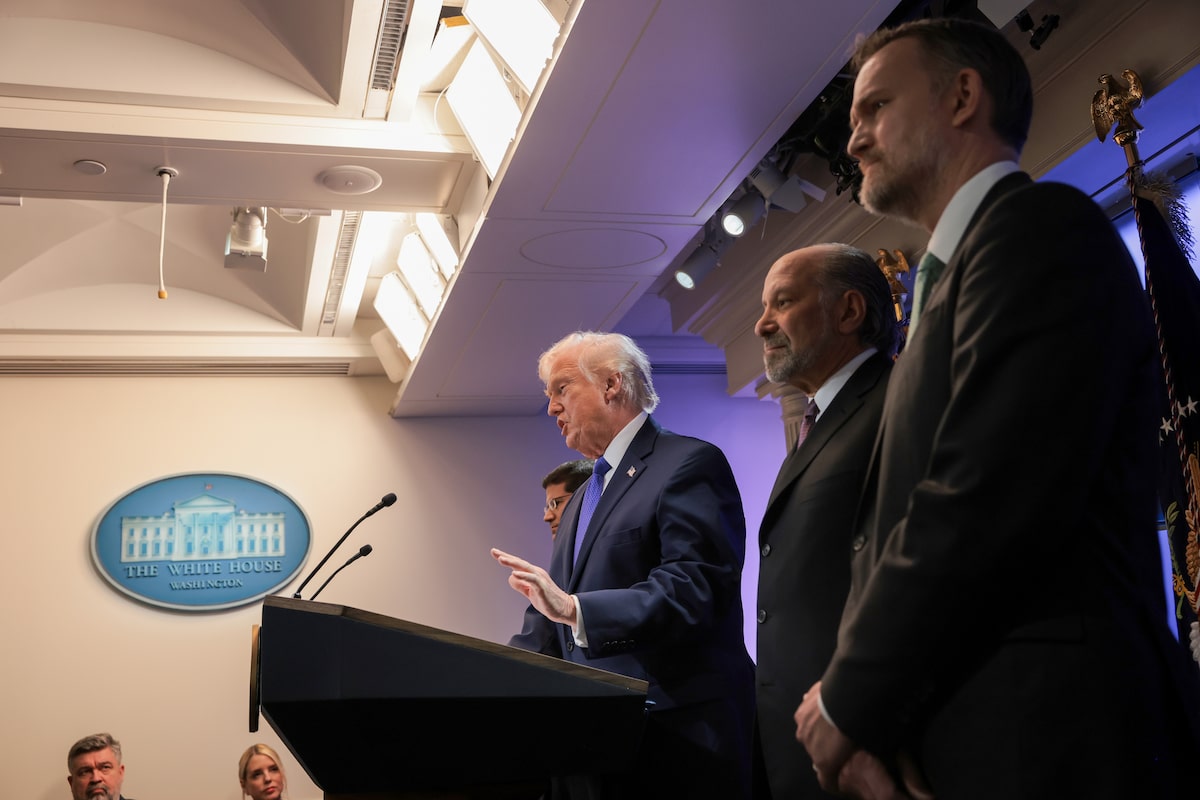
U.S. President Donald Trump speaks alongside Secretary of Commerce Howard Lutnick, centre, and U.S. Trade Representative Jamieson Greer, right, during a press briefing at the White House on Feb. 20.Anna Moneymaker/Getty Images
Trade negotiations used to be underpinned by an unspoken assumption: that trade barriers were lose-lose propositions. All sides could gain something if they mutually disarmed.
Each country would agree to lower its tariffs, a little or a lot, in return for others doing likewise. Trade negotiations were always about how much tariffs and other walls would go down, not how much they would go up.
When Canada and the United States made a free-trade deal in 1988, mutual disarmament was the name of the game. The shared belief was that if we took down most of our trade barriers, and they took down most of theirs, both sides would be better off. To win, nobody had to lose.
Opinion: Trump’s tariff defence at the State of the Union shows a weak hand and an era ending
On Tuesday night, after U.S. President Donald Trump’s State of the Union address, United States Trade Representative Jamieson Greer was asked by the CBC about the state of trade negotiations with Canada. His response sums up the Trump administration’s break with the postwar trade consensus.
Mr. Greer, one of the more competent and thoughtful senior members of Team Trump, said that the administration is “focused on reshoring supply chains related to automotive, steel, aluminum … If Canada wants to come in and participate in this type of reshoring we’re trying to do, we’re happy to have those discussions.”
Asked what “participating in reshoring” means, he said: “When we go to other countries and we make a deal with them … they agree that we can have a tariff on them, that we can have a protective tariff to protect our industries as we try to reshore. And they open their markets to us.
“If Canada wants to agree that we can have some level of higher tariff on them, while they open up their markets to us in things like dairy and other things, that’s a helpful conversation.”
The Editorial Board: Canada can’t drop its guard on U.S. tariffs
The U.S. wants higher tariffs at home, and lower tariffs abroad.
The old give-and-take is now take-and-take.
Imagine boarding a flight and being asked to give up your seat, and pay extra for the privilege. Or walking into a store and being told to surrender your coat – plus a $100 clothing-confiscation service fee.
The European Union, Britain and a number of countries acceded to this shakedown last year. They accepted new U.S. tariffs – 10 per cent on most British goods, 15 per cent on the EU, and so on – while promising not to raise their own levies. Some also agreed to greater access for U.S. goods, along with vague promises to funnel hundreds of billions of dollars of investment to the U.S.
The Trump administration’s trade policy aims to extract unreciprocated concessions. They may settle for a win-win, but it’s not the goal.
The challenge for Canada, as I wrote a year ago, on the day Mr. Trump was sworn in for the second time, is that his constant talk of “reshoring” could target Canada as “the low-hanging fruit in a plan to lure more manufacturing back to the U.S.”
That’s because “persuading a multinational to move a factory from Guangdong to Michigan is hard. Persuading it to move from Ontario to Michigan is less so.”
Prior to the second Trump administration, Washington was trying to be selective in its protectionism. The main target was China, and the U.S. wanted to work with allies to build common protections against Chinese dumping. The common 100-per-cent tariffs on Chinese electric vehicles, imposed by both Canada and the U.S., were an example.
But the partnership approach is long gone. The White House respects the strongest – that would be China – while leaning on erstwhile allies.
Mr. Trump has repeatedly singled out Canadian industries. His cabinet members have echoed him, saying that they don’t understand why the U.S. is buying cars, steel or other manufactured goods from Canada.
Tony Keller: In dealing with Tariff Man, Canada’s best bet is to keep on ragging the puck
Mr. Greer underlined that in interviews this week.
Asked on Fox News about trade talks with Canada, he said that the goal is “we really want to focus on reshoring here. We want to have production here. We don’t necessarily want to be dependent on China, Canada or anybody else for things like cars.”
Asked by Bloomberg News about the future of the United States-Mexico-Canada Agreement, he said, “I’m having separate negotiations with Canada and Mexico,” and that at the end of the day “maybe we’ll have separate protocols with Canada and Mexico that we tack on to USMCA.”
He cited the auto sector as “a big problem” because “we want to be making those things here.”
Buckle up.