
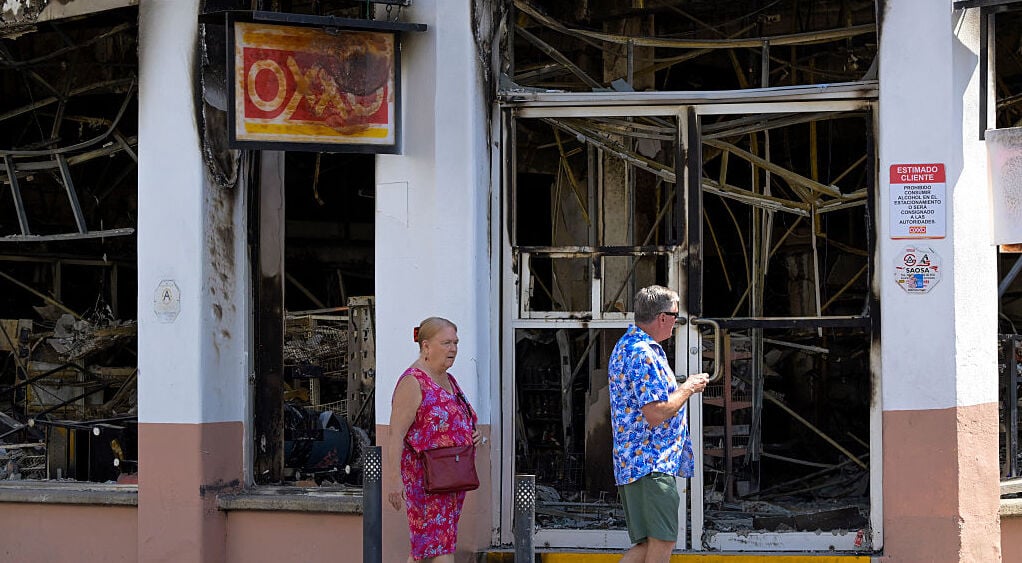
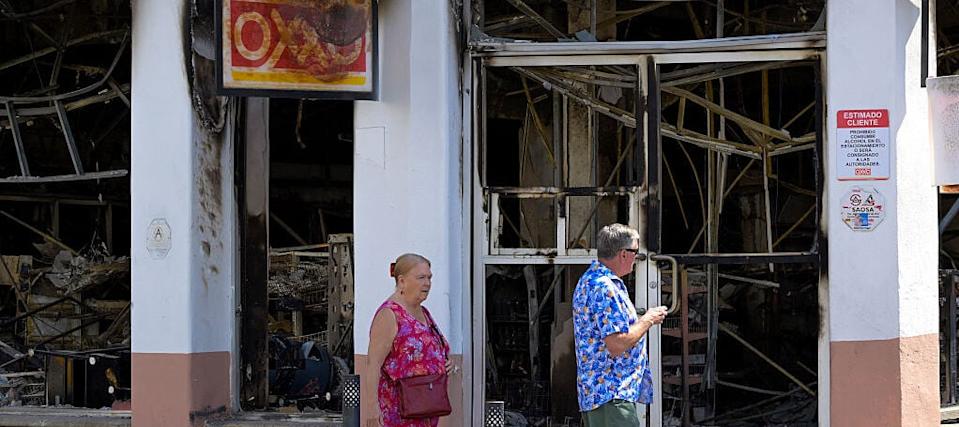
 Tourists walk past a burned shop in Puerto Vallarta, Jalisco State, Mexico, on February 24, 2026
When a military operation killed Mexico’s most powerful cartel boss in late February, thousands of Canadians on vacation in Puerto Vallarta woke up to a very different kind of morning. Flights were cancelled, roads were blocked, hotels went into lockdown — and the tab kept growing.
According to Global Affairs Canada (1), an estimated 18,703 Canadians were in Mexico at the time, with 4,672 in the Jalisco State (where the vacation area of Puerto Vallarta is located). Almost immediately, Air Canada, WestJet, Porter and Flair suspended flights, leaving travellers with no clear path home and an uncomfortable question: Who’s paying for this?
The answer, for many of them, may be: You are.
Mexico is not a fringe destination for Canadians. It’s arguably the country’s favourite warm-weather escape. A record 2.8 million Canadians visited Mexico in 2025 (2) — making Canada the second-largest source of tourists after the United States.
Puerto Vallarta, Cancún, the Riviera Maya: These are places Canadians fly to in significant numbers every single week of the year, and the popularity of these Mexican destinations has climbed sharply in the last few years. The number of Canadian arrivals to Mexico jumped 11.4% year over year in the first 10 months of 2025 (3), partly driven by a choice to not support U.S. tourism, amid Trump tariffs and an ongoing global trade war. As a result, more Canadians are in Mexico, more often, spending more money — which means more Canadians stand to be caught financially off guard if — and when — things go sideways.
While most people will watch for natural disasters or prepare for a personal health emergency, the current situation in Mexico shows that ‘going sideways’ can extend beyond the expected to the unexpected. In this case, a military operation, a cartel response and a political flashpoint that results in Canadians stranded, looking for a way home.
While the current situation wasn’t an event that many Canadians could have predicted, planned around or prevented, it serves as a reminder that a little bit of emergency planning before you leave Canada can go a long way.
To understand the cost of an unforeseen emergency while travelling, let’s consider what a typical Mexico vacation package costs a Canadian family. Flights, resort accommodation, excursions, travel extras — the average Canadian vacation budget sits around $4,012, according to an Allianz Global Assistance Canada survey conducted by Ipsos (4). For households earning $100K or more, that number climbs to $5,481.
When flights are grounded due to a security event, those costs don’t disappear. Extended hotel stays at resort prices, meals outside an all-inclusive plan, rebooked flights, missed connections, emergency transportation — all of it lands on the traveller’s credit card even if you have travel insurance. That’s because travel insurance works as a reimbursement, so you must pay for the costs and submit the claim and the receipts to be repaid. And not all costs are covered.
Worse, if the Canadian government’s travel advisory escalates to a formal ‘avoid all travel’ level, many standard travel insurance policies stop paying out entirely (5).
That’s a trap that trips up a lot of Canadians, and it matters even if you’re not currently sitting on a beach in Mexico.
Read more: Here are 4 major investments worth making right now to help your net worth skyrocket
Here’s the uncomfortable truth about Canadian travellers and insurance: Many assume they’re covered when they’re not.
Only 46% of Canadian travellers hold travel insurance (6), and a TD Insurance survey conducted by The Harris Poll Canada in 2025 found that only 51% of Canadians planning domestic travel planned to purchase travel insurance, and just 42% intended to buy emergency travel medical coverage (7).
For international trips, coverage rates are higher, but the policies themselves are riddled with fine print.
Many policies exclude trip interruption coverage if a government travel advisory was already in place before you purchased insurance — and Canada’s advisory for Mexico had been sitting at ‘exercise a high degree of caution’ for some regions long before this week’s events. If your policy was written to exclude coverage in those zones, or if the advisory level escalates after the fact, you may be left holding the bill.
Trip interruption insurance — the coverage that kicks in when you’re already on your trip and something forces a change of plans — is also frequently overlooked. It’s a separate product from trip cancellation insurance (which only covers cancellations before you leave), and many travellers don’t know the difference until it’s too late (8).
In the chaos of an evacuation or civil unrest, luggage is often the first thing left behind or lost. To help, here are the most common scenarios and coverages.
For instance, if your luggage is stolen or lost during the unrest — perhaps it’s left in the hotel lobby during a hasty departure or taken from a vehicle — then travel insurance that includes ‘baggage and personal effects’ coverage will apply. Most policies offer $500 to $1,000 per person, with ‘per item’ caps (often $300 to $500 for these capped items).
If you carry higher-value items, like a professional camera or a high-end laptop, you’ll want to check your insurance coverage limits. If the per-item is too low, you’ll want to add a rider, which is extra insurance that specifically covers those items. (Keep in mind, though, you’ll pay extra for this added coverage.)
One final consideration is how you report the loss. Insurers often deny claims if bags were left unattended in a public place. However, if they were stolen from a locked hotel room or a secure luggage storage area during the crisis, in general, you should be covered.
If your bags are stuck at an airport (like Puerto Vallarta or Mazatlán) while you are sheltering elsewhere or have been rerouted, then your coverage should cover your costs for purchasing essentials. For most plans, the coverage is limited to $200 to $500 for the purchase of essentials, such as basic toiletries and a change of clothes, but only if your bags are delayed for more than six to 12 hours. Just be sure to keep all your original receipts, as you’ll need to submit to be reimbursed.
If you ‘lose’ your personal belongings or luggage because you had to evacuate and leave them behind, then coverage for your baggage enters a grey area. Some comprehensive plans treat the loss of possessions during a government-ordered evacuation as a covered expense under Trip Interruption or specialized Security Evacuation clauses.
If travel insurance denies the claim, you can claim the loss using your home insurance policy. Most homeowner policies cover the loss or theft of personal belongings even if you are away from home. The deductible is usually higher, and it will count as a claim on your home insurance, but it can offset a large loss if you left behind expensive items.
If documentation, such as a passport or Nexus card, is stolen or lost during an emergency abroad, you can get the costs paid to replace these items covered by your travel insurance. Not only can you claim the cost of the documents, but also travel costs associated with going to the nearest Canadian consulate for help. Coverage is usually capped at $500.
The Puerto Vallarta situation is a useful moment to stress-test your own travel financial plan.
Here’s where to start:
Read your policy before you travel, not during a crisis. Check specifically for travel advisory exclusions, what level of advisory triggers a coverage void, how trip interruption differs from trip cancellation, and whether political unrest or security events are covered causes.
Consider ‘Cancel for Any Reason’ (CFAR) coverage. CFAR is an optional add-on that allows you to cancel your trip for any reason not listed in a standard policy and receive a partial reimbursement — typically 50% of non-refundable costs. It’s more expensive upfront, but it eliminates the guessing game over whether your situation qualifies.
Don’t assume your credit card has you covered. Credit card travel insurance varies enormously between products and issuers. Before you travel, call your card provider and specifically ask about trip interruption and evacuation coverage — not just medical.
Register with the Government of Canada before you leave. The Registration of Canadians Abroad service is free and allows Global Affairs Canada to contact you in an emergency. It won’t pay your hotel bill, but it does put you in the system when consular assistance is being organized.
Check the travel advisory before you buy insurance. If a ‘avoid non-essential travel’ advisory is already in effect for your destination when you purchase your policy, you likely have no trip cancellation or interruption coverage for events related to that advisory. At this point in time, this includes trips to Cuba and the Jalisco coast of Mexico, or any other destination on Canada’s advisory list — check travel.gc.ca before you click purchase on your travel insurance policy.
The broader lesson here isn’t that Mexico is uniquely dangerous or that Canadians should stop travelling. It’s that the financial safety net most of us assume is there — isn’t always. The Canadians sheltering in Puerto Vallarta this week aren’t just dealing with a scary situation. They’re negotiating with airlines, calculating hotel extension costs and trying to figure out if their insurance policy covers any of it.
That’s a conversation worth having before you board the plane — not after flights are grounded.
We rely only on vetted sources and credible third-party reporting. For details, see our editorial ethics and guidelines.
Global Affairs Canada: Travel advisory — Mexico (1); Government of Canada: Canada-Mexico relations (2); Travel Market Report (3); Insurance Business Canada: Canadians prioritizing travel, seeking travel insurance in 2025 (4); Government of Canada: Trip interruption and travel health insurance (5, 8); HelloSafe: Travel insurance barometer 2026 (6); The Travel: Canadians are avoiding travel insurance for the wrong reasons (7)
This article provides information only and should not be construed as advice. It is provided without warranty of any kind.