

Life will be worth living again as the sun begins to set later and later in Canada, thanks to the return of daylight saving time.
After four months of long and dark winter nights, Canadians can say goodbye to standard time and hello to daylight saving time.
On March 8, those in regions that observe daylight saving time will either welcome the spring forward or begrudgingly change their clocks.

Danita Delimont/Shutterstock
Since 2019, there has been a petition to stop the time change altogether, and it makes its rounds every year.
In a week, Canadians will unfortunately lose an extra hour of sleep, but have longer summer nights to look forward to.
This year, daylight saving time returns in parts of Canada on Sunday, March 8.
This time change impacts six time zones across the country: Pacific, Mountain, Central, Eastern, and Atlantic. Newfoundland DST is also 30 minutes behind Atlantic time.
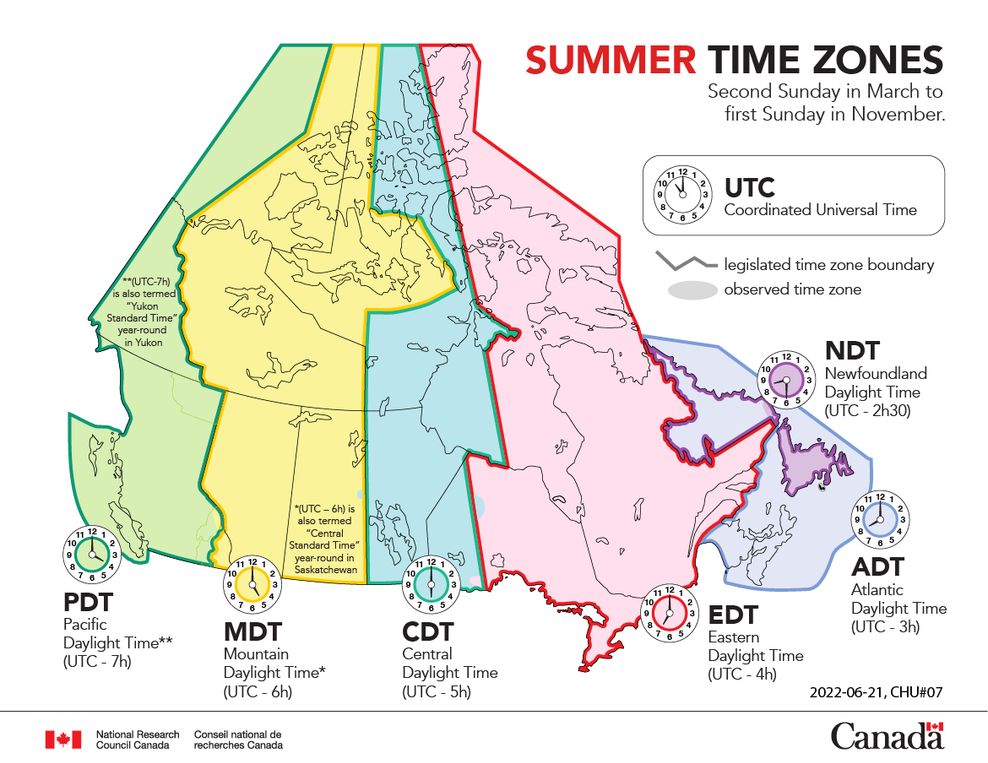
Government of Canada
According to timeanddate.com, Canadians in the affected time zones should set their manual clocks forward one hour to 3 a.m. at 2 a.m. local time on March 8.
Digital devices connected to Wi-Fi, like smartphones and smart watches, should automatically update, but it doesn’t hurt to double-check that they’re set to the right time when you wake up.
“Sunrise and sunset will be about 1 hour later on March 8, 2026, than the day before. There will be more light in the evening and less light in the morning,” reads the website.
Parts of Alberta have already seen their first 6 p.m. sunset of the year.
Regions in Canada that don’t observe daylight saving time include most of Saskatchewan, some parts of Quebec and B.C., all of Yukon, and Nunavut’s Southampton Island.
According to a report submitted to the Canadian Sleep Society, daylight saving was introduced a century ago during the First World War to save energy.