
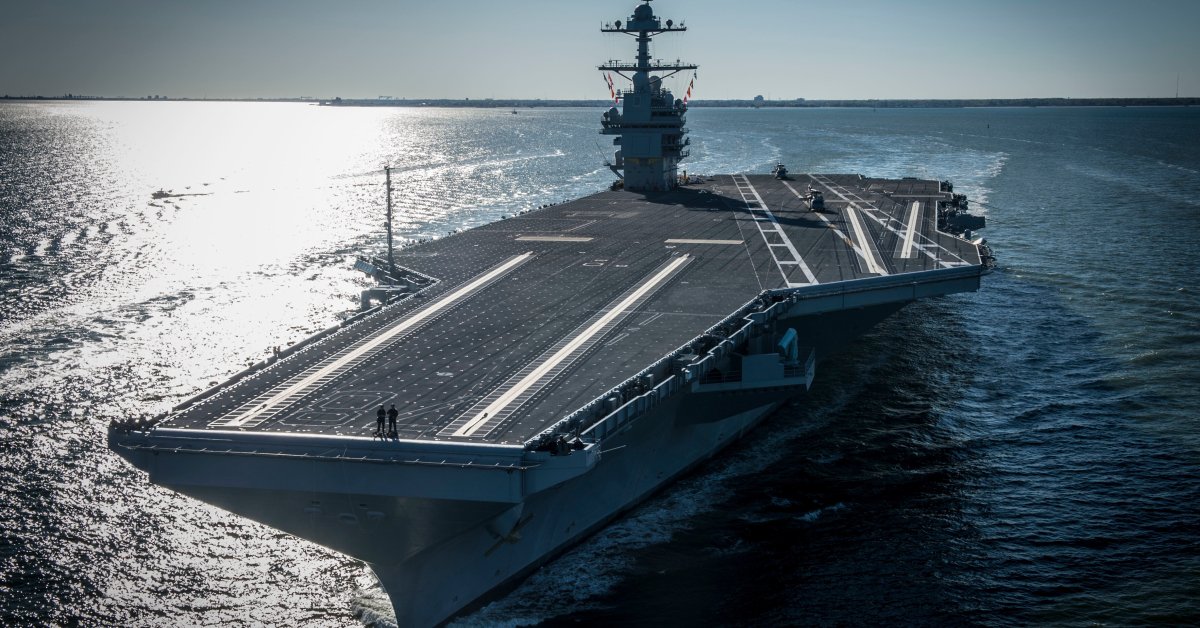
The United States and Israel launched a sweeping military campaign against Iran on Saturday that killed Supreme Leader Ayatollah Ali Khamenei, dramatically escalating tensions in the Middle East and raising urgent questions about the President’s war powers.
President Donald Trump said the operation would be a “massive and ongoing” campaign aimed at dismantling Iran’s military and nuclear capabilities. He announced Khamenei’s death in a post on Truth Social, framing it as a turning point for Iran’s leadership.
The strikes followed a long buildup of U.S. military force in the Middle East over the last few weeks and have drawn harsh criticism from inside and outside of the President’s own party.
Before and after the outbreak of war, TIME asked an expert about the legality of strikes on Iran.
David Janovsky is the Acting Director of The Constitution Project at the Project on Government Oversight, and researches and develops policy reforms on the separation of powers.
Are Trump’s strikes on Iran legally justified?
DJ: The short answer is no. There’s no indication that there’s any sort of circumstance that would give the President the unilateral authority to order military action. It’s true that presidents have some inherent authority to deploy the military as Commander in Chief, but that’s really limited to true emergency circumstances where there is an attack underway that needs to be repelled, or maybe an extremely clear imminent attack. But there’s no suggestion that that’s the case today—that would make the strikes illegal.
What steps would the White House need to have taken for military action to be legally above board?
DJ: Most simply, the administration would need to go to Congress. This is a contemplated attack against a sovereign state, and that, in simplest terms, is an act of war. And the Constitution gives the exclusive power to declare war to Congress, not the president. So this is something that would need a vote and congressional approval.
What powers does Congress have to reign in a war that has already begun?
DJ: There is already a law on the books to address situations like this. Under the War Powers Resolution, which dates back to the 1970s, if a president enters the military into hostilities without congressional authorization, the operation must end within 60 days unless Congress expressly authorizes it.
And Congress established a fast-track process to vote to end the use of the military—or authorize it—before the 60-day mark. Congress could also use its power to control government spending to restrict the administration’s ability to spend money on the conflict.
What legal liability does Trump and his Administration face for launching this war without Congressional approval?
DJ: There is no track record for a president being held to account in a legal process for an unconstitutional war. The main remedies run through Congress—votes to end or restrict the military action, aggressive oversight, or even impeachment.
It’s also possible that a service member with orders to fight Iran could go to court and claim the orders are illegal. But courts have been extremely reluctant to get involved in cases like that.
How is this operation different from the strikes on Iran’s nuclear sites in June 2025, legally speaking?
DJ: My position is that those strikes in 2025 were not legally justifiable and also that the strikes now are not justifiable.
In 2025, the administration put out a very brief explanation that relied on both the President’s inherent authority and a notion of collective self-defense with Israel. But again, self-defense is properly understood to involve a threat that is much more immediate than anything that’s at play now.
What would be the legal and political implications if Congress passed a formal War Powers resolution restricting the President’s ability to strike Iran?
DJ: It’s important to keep in mind that if Congress did nothing, that would be a sign that Congress didn’t approve an act of war, and so it would be illegal.
So, congressional action isn’t necessary, legally speaking, to prevent a strike against Iran. But, if Congress were to take the preemptive step of saying, “You cannot do this,” I think it would do two things. First, it would change the legal calculus, because the executive branch, for decades— this is not a new phenomenon—has resorted to creative lawyering to come up with excuses for using the military abroad. A clear statement from Congress should at least make those executive branch lawyers a lot less willing to push the envelope. It could also change the calculus for the military lawyers who would need to review any actual strike order.
And, politically, I think it would send a powerful message. We have seen, especially recently, that the administration is sensitive to losing support, particularly from its allies in Congress, and a clear congressional statement that there is not the buy-in for military action in this case would also be a limiting factor.
Why has the reaction from Congress to this military buildup been so muted?
DJ: I think there are probably both long-term structural reasons and sort of short-term political reasons, hand in hand with the executive branch’s decades-long effort to push the envelope of what it can do has been Congress’s acquiescence in the face of those expansions. In some ways, this is part of a constitutionally very dangerous but long-running trend.
Back in 2025, there was an effort after the strikes to pass a war powers resolution. But the most charitable explanation for why Congress didn’t act then was that there was a suggestion that the strikes were over and done. It was a one-off, and there was no need for Congress to prevent anything else. The fact that we’re back here suggests that was not the correct assessment, and certainly underscores the need for Congress to act urgently now.
Editor’s note: The introduction text to this story was updated after the U.S. and Israel launched an attack against Iran on February 28, 2026. Interviews were conducted on Feb. 21 and Feb. 28, 2026.