
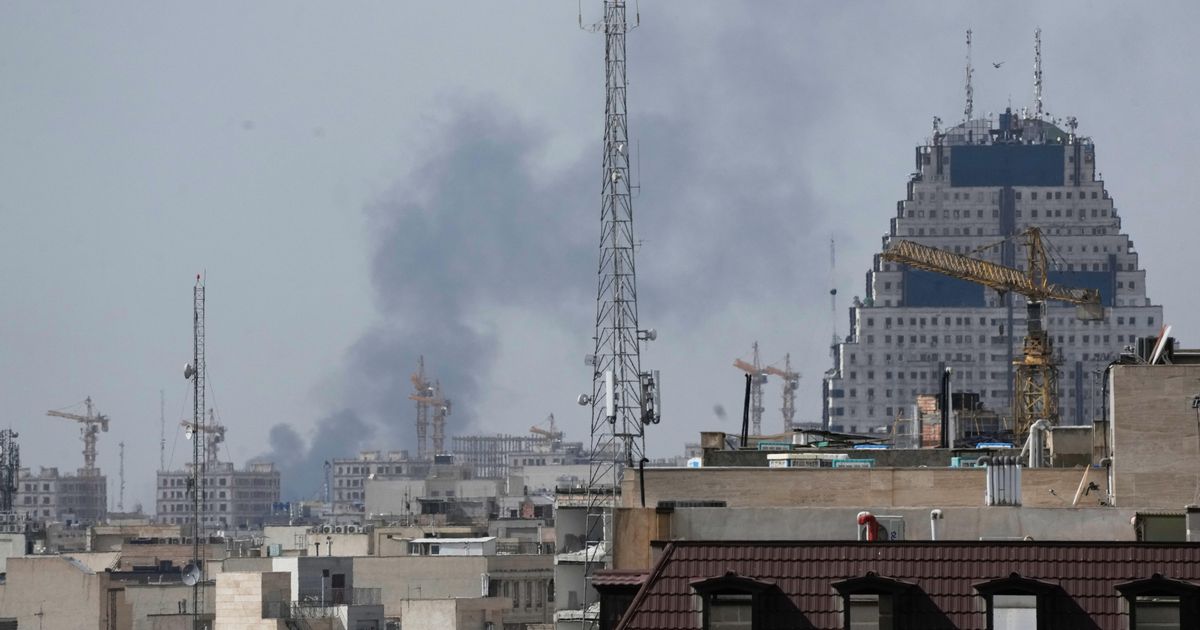
North Carolina is home to a large Iranian community. Many have spoken out against the country’s regime and requested help from the United States to bring freedom to the Iranian people.
WRAL News spoke with Shahram Mazhari, who said Saturday’s strikes put his country one step closer to making freedom a reality.
What was a sign of attack from the U.S. and Israel in Tehran, the capital of Iran, was a glimpse of hope for Mazhari, who lives in Charlotte after moving to North Carolina from Iran as a teenager.
“This is a moment that we’ve been waiting for for 47 years,” he said.
Mazhari said his aspirations to return to his country were destroyed after an Islamic regime took over in 1979, calling it “one of the most vicious regimes that the history of mankind has ever seen.”
In January, WRAL News was there as local Iranians gathered in downtown Raleigh to speak out against the thousands killed amid ongoing protests in Iran and to request a lifeline from the U.S. and President Donald Trump.
Fara Pourshariati moved from Iran to the U.S. more than 30 years ago.
Her friends and family remain in her home country. She said this is a moment they have been waiting for.
“We have been waiting. President Trump keeps saying help is on the way. Every night. Every day. We had lost our hopes, and then it happened,” she said.
Others share a different opinion, believing the U.S. involvement is not the answer.
Beth Deghan, an Iranian rights advocate, believes there are other ways of achieving change.
“We believe regime change in Iran cannot be done by the outsider. The Iranian people are doing it. If someone from outside wants to bring regime change, they need boots on the ground,” she said.
Demonstrators gathered again on Saturday to march in opposition to the US-Israel strikes on Iran in downtown Raleigh.
Police were blocking off
streets as roughly 50 demonstrators walked along East Hargett Street.
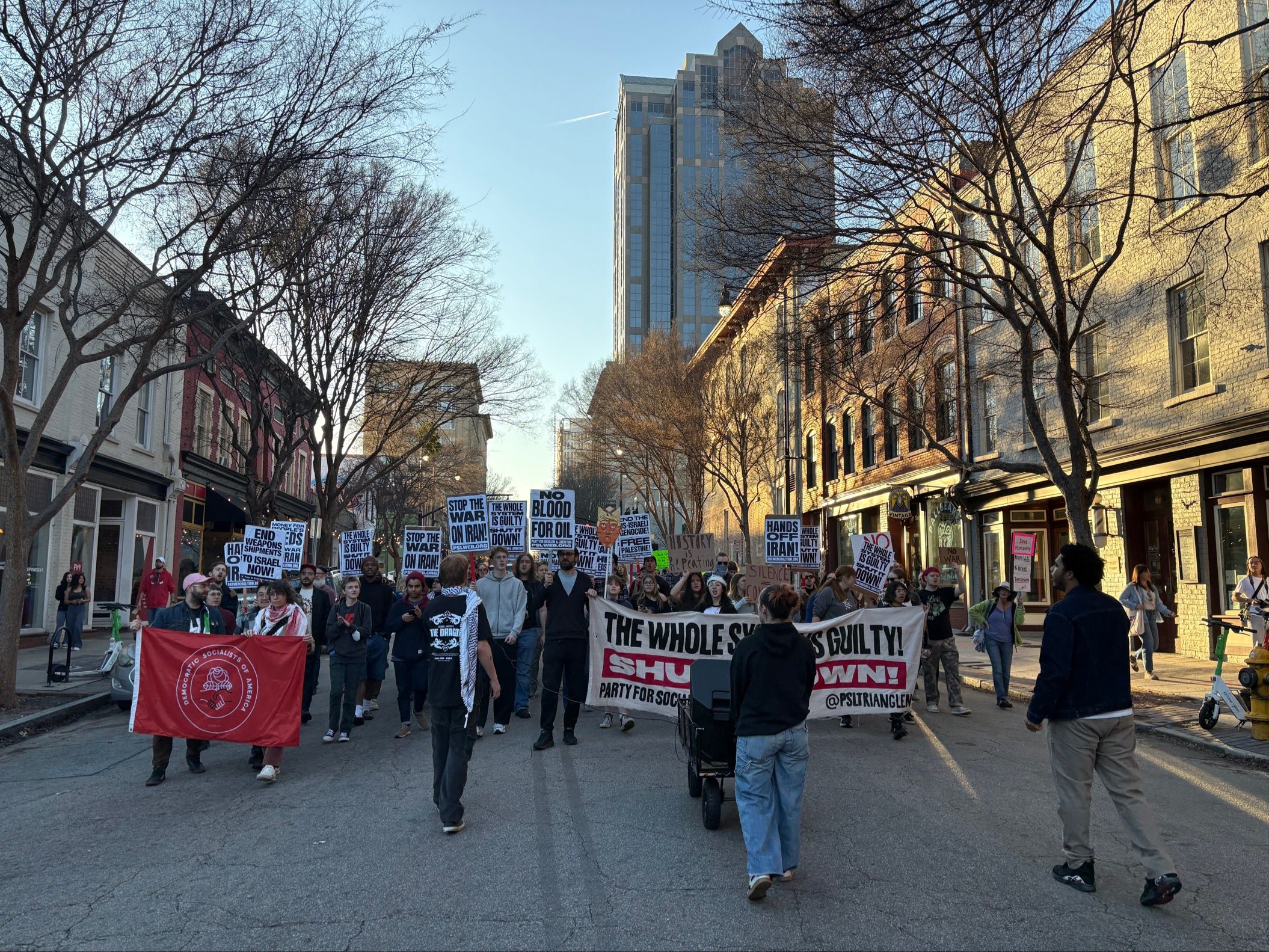
Tap to watch: Demonstrators gathered in Raleigh protesting US-Israel strikes
In the midst of the strikes, the president encouraged Iranians in this video posted to Truth Social, saying in part, “When we are finished, take over your government. It will be yours to take.”
Read the president’s full statement here.
In a brief phone interview with The Washington Post, Trump said, “All I want is freedom for the people.”
On Saturday, Mazhari told WRAL News what he thought of the president’s words, saying, “We’re going to look at it as a positive sign, and once enough damage has been done at the highest level of the regime’s officials, the Iranian people can do the rest.”
Iran’s foreign minister has called a regime change “mission impossible.”
To that, Mazhari said, “I have absolutely no trust, no confidence, and I have no regard for the foreign minister of the Islamic regime.”
Mazhari explained there is a lot of uncertainty and concern for Iranians, but the desire for new leadership and freedom keeps him optimistic.
“We’re hoping that a better future is awaiting the Iranian people at this moment,” he said.
Local lawmakers react following the strike in Iran
Some local lawmakers have also shared mixed reactions following the strikes in Iran.
Some say the strikes were unwarranted and unconstitutional, while others commend the president and say the strike was long overdue.
On X, Republican Senator Thom
Tillis said the Iranian regime has “spent decades as the world’s leading
sponsor of terrorism, systematically destabilizing the Middle East while
calling for the death of America.”
“President Trump has rightfully
determined that this theocratic dictatorship cannot be allowed to acquire
nuclear weapons and continue to slaughter its own citizens who simply want
freedom,” the post read in part.
Republican Senator Ted Budd’s also
took to “X” saying the president “knows well that the American people
do not favor prolonged conflict, but there is also little doubt that Iran’s
reckless ambition to obtain nuclear weapons and long range missiles represents
a grave threat to our safety and security.”
Democratic Congresswoman
Valerie Foushee posted this statement saying the president’s strikes are “completely
illegal and are plunging us into a senseless regime-change war over oil.”
“He needs to be held
accountable. Lives are at stake,” her statement read in part.
Her statements were echoed in a
statement from Democratic Congresswoman Deborah Ross.
“Trump’s attack on Iran is
unwarranted and unconstitutional. Iran is controlled by a despotic regime that
must be held accountable, but Trump is dragging our country into a war that the
American people don’t want and that Congress didn’t authorize.”
So what happens next in Iran?
North Carolina native and
retired US Army Lt. General Bob Ashley says American boots on the ground are
unlikely, but air strikes alone are unlikely to bring about a change of
leadership in Iran.
Ashley said with Iran’s Supreme
Leader, Ayatollah Ali Khomeni, dead, it’s not clear who – or what – will take
control of the country of more than 90 million people.
“Regime change doesn’t always
mean tantamount to some form of democracy,” Ashley said. “We could get an
outcome that is potentially worse, or we could get some kind of an interim entity.
But clearly the theocracy and the regime that’s been in place since ’79 is at
its weakest position.”
Ashley told WRAL News in the
wake of the strikes that the US will now be taking a closer look at the aftermath and
deciding what happens next.
“That’ll dictate the nature of
future strikes, or some more diplomatic outreach, depending on what we learn
over the course of probably the next 12 [to] 18 hours,” Ashley said.
President Donald Trump has
vowed that strikes on Iran could last days or weeks. Ashley says that alone is
unlikely to guarantee a new government steps forward.
“How do we continue pressure,
economically, politically, how do we enabling somebody enable some of these
groups that are protesting… and so I think we really have to look at this
beyond just the military domain, to look at multiple different layers in which
how we want to go after this,” Ashley continued.
Ashley says Iran also can retaliate, including with missiles, rockets and
drones