
This is a rush transcript. Copy may not be in its final form.
AMY GOODMAN: This is Democracy Now!, democracynow.org. I’m Amy Goodman, with this special report.
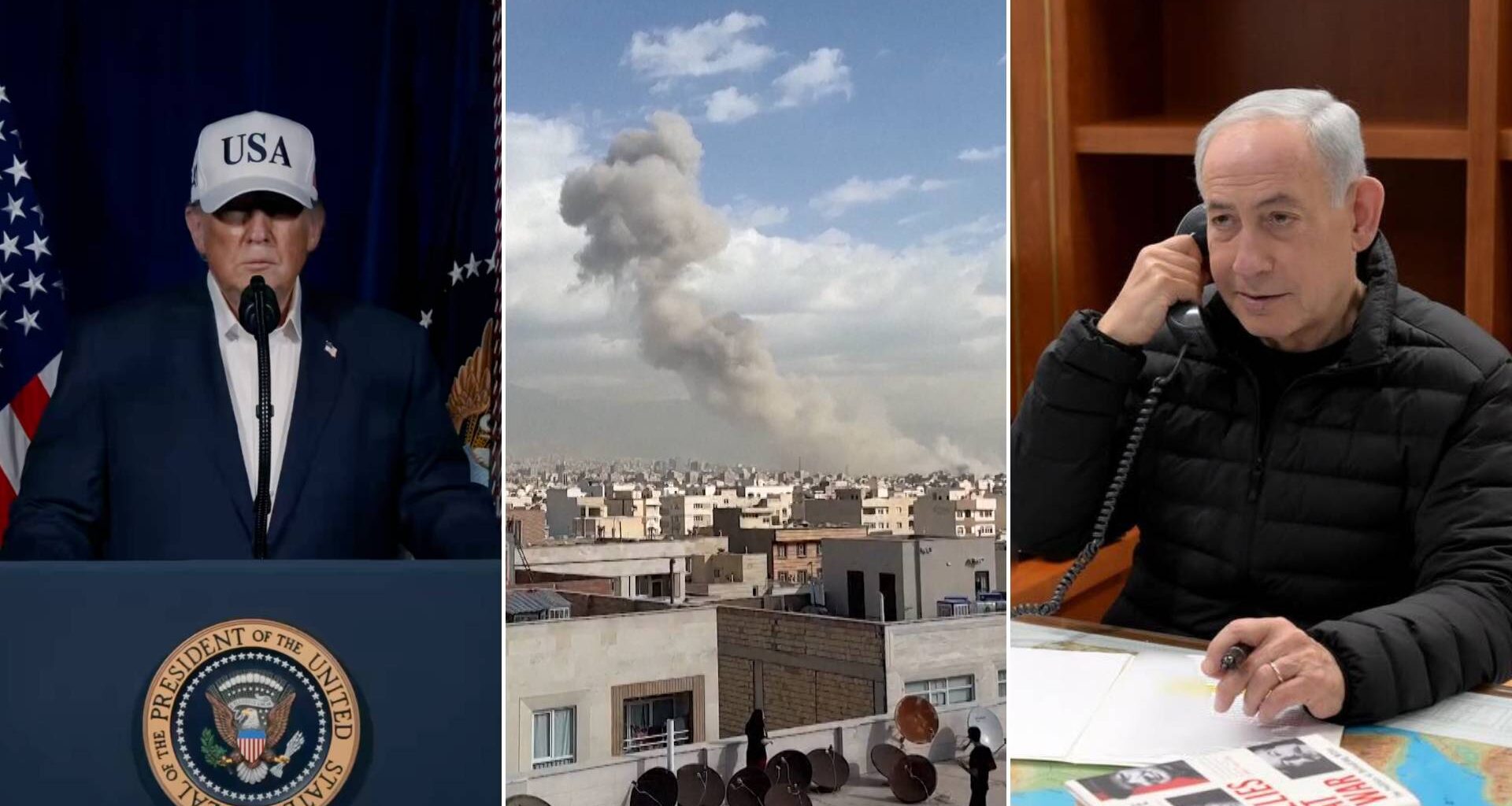
The U.S. and Israel have launched an unprovoked attack on Iran, striking sites across Iran, including the compound of Iran’s Supreme Leader Ayatollah Ali Khamenei. The Israeli military says it’s struck over 500 targets, including three sites where senior Iranian officials were gathering.
Iranian state media reports one Israeli strike hit an elementary girls’ school in the south of Iran in Minab, killing at least 85 people, including at least 60 children. Two more students were killed in a strike on a school east of the capital Tehran. Iran reports the U.S. and Israeli attacks have killed at least 200 people so far.
Iran responded by launching attacks across the Middle East targeting Israel, United Arab Emirates, Qatar, Kuwait, Bahrain and Jordan. Several U.S. bases were reportedly hit.
In a video message, President Trump called for regime change and urged Iranians to take over the government. Trump launched the attacks without congressional approval.
Oman’s Foreign Minister Badr al-Busaidi criticized the U.S. for attacking Iran in the middle of negotiations. He wrote online, quote, “I am dismayed. Active and serious negotiations have yet again been undermined. Neither the interests of the United States nor the cause of global peace are well served by this,” he said.
The U.N. Security Council is scheduled to hold an emergency meeting today.
In this special broadcast, we’ll be joined by a number of guests. We begin with Trita Parsi, executive vice president of the Quincy Institute for Responsible Statecraft, who has written a number of books about Iran and the United States.
Trita, welcome to Democracy Now! Can you respond, what has taken place in these last hours?
TRITA PARSI: This is clearly an illegal war and a war of aggression. It’s illegal in terms of international law. It clearly is illegal in terms of domestic American law. This issue has not been debated. It has not been voted on by Congress. And this is Trump, really, also, in addition to all of these things, betraying his own base, who, to a very large extent, voted for him precisely because he presented himself as the candidate that would end endless wars.
But this is clearly a war of choice. The Omani foreign minister laid out yesterday on CBS News clearly that inside the negotiations the Iranians had moved significantly and offered concessions that made the deal on the table dramatically stronger than what the Obama deal from 2015 was. For instance, not only would the Iranians not be amassing any low enriched uranium or any enriched uranium at all, whereas in the Obama deal they would be able to have up to 300 kilos at any time. Now they will be down to zero. With zero amassed enriched uranium, you cannot build a bomb, obviously. But on top of that, based on the needs basis for continued enrichment, the Iranians actually would likely not enrich anything at all for another three to five years, which means that during the duration of Trump’s presidency, there would be no enrichment in Iran. Despite all of this, despite the ease in which he could declare victory and say that he got a much better deal than Obama, Trump opted to go for war, because what he clearly seems to be looking for is not a deal, but capitulation and surrender.
AMY GOODMAN: And can you talk about his direct call for regime change and for the people to take over?
TRITA PARSI: So, clearly, he is searching for various ways of being able to justify why he has taken this specific position. He has, for instance, done everything from going back to history and claiming that, you know, for 47 years the United States had to deal with Iran in very many problematic ways. He’s referring to IEDs that killed American soldiers in Iraq. He’s referring to the suppression of the Iranian people, which it’s difficult to believe that he actually cares about. He is searching for justifications of this.
And I think that I find that very interesting, because it’s very clear, based on that, in my reading, that he knows that he’s going to have a very hard time actually selling this to his own base. The starting point is already extremely low, with no more than 20% of the American public supporting this, in general, and amongst Republicans, it’s not stronger than 35%, which is a very low level. Remember, when Bush went into Iraq in that illegal war, he had managed to lie enough to get the American people to support that war at 79%.
AMY GOODMAN: The latest you have heard about the casualties in Iran, and then also the hitting of the Gulf states, not to mention sending drones to Israel and hitting U.S. bases, as well, Trita Parsi?
TRITA PARSI: As I had predicted back in August when I wrote this article for Foreign Policy, in the next war, the Iranians would likely strike back hard very early on, instead of allowing what they did in the 12-Day War in which they were pacing their responses. This time around, they’re trying to quickly inflict as much damage as possible on Israel, on the United States, but also on neighboring states that are hosting American bases, even if those bases are currently not being used by the United States. They’re trying to expand the arena of the war, the theater of war, in order to make it as difficult as possible for the United States to continue this war.
When it comes to the casualty rate inside of Iran, we’re hearing varying numbers, but one thing that I think is quite noteworthy is that the fact that there was such a high casualty rate at a school for young girls in Iran. Over the course of 30 days of warfare, it would be almost statistically impossible to see a scenario in which some civilian target would not be hit. But the fact that this was hit on the first day of the war, I think, has already colored the view of a lot of Iranians inside of Iran who do not care for this regime, who do want to see a change, but now it’s become very clear that this would come at their expense, at the cost of ordinary civilian Iranians, innocent Iranians, rather than this fantasy that is being sold to many people from the outside that this would be some sort of a glorious and dignified regime change war.
AMY GOODMAN: I know you have to go. The latest figures we have — and this is going to change through the time we post this online — Iranian Red Crescent Society saying 201 people killed, 747 wounded in Iran, Trita.
TRITA PARSI: That sounds plausible, although, at the same time, I think at the end of the 12-Day War in Iran, there were one thousand, roughly, hundred killed over the course of 12 days. And at least for the first day of this war, the intensity of these attacks have actually been far less than what it was during the June war. I suspect, however, that the United States is going to intensify the bombardment significantly tonight.
AMY GOODMAN: I want to thank you, Trita Parsi, for joining us. Trita Parsi is executive vice president of the Quincy Institute for Responsible Statecraft.
We are joined by a number of guests, including Negar Mortazavi, an Iranian American journalist, host of The Iran Podcast, senior fellow at the Center for International Policy, born in Tehran, speaking to us, though, from the United States. The latest news we have, over 200 people killed in Iran, over 700 injured in this U.S.-Israeli attack on Iran. Iran has retaliated by attacking, according to the latest news, Saudi Arabia, Bahrain, as well the United Arab Emirates. I think there were reports Jordan sending drones and missiles to Israel, and at a girls’ school in southern Iran, over 80 people killed. It’s believed over 60 of them children. It’s a girls’ school, 60 of them girls. We’re joined by Negar Mortazavi, an Iranian American journalist, host of The Iran Podcast, senior fellow at the Center for International Policy, born in Tehran, in the capital of Iran, speaking to us from the United States.
Negar, can you respond to what has taken place in these last hours?
NEGAR MORTAZAVI: Absolutely. So, a horrific war, another regime change war in the Middle East, has begun. That seems to be the goal. I don’t know how far the U.S. and Israel are going to go, but we saw a prelude to this in last June, and sort of the same pattern is repeating. In the middle of negotiations between the U.S. and Iran, Israel attacked, and then the U.S. joined. And this time, they just did a joint operation. It’s an illegal war. There’s no vote from the U.S. Congress, unlike past regime change wars in the U.S. even that turn out to be failures, but this one had no vote from the U.S. Congress, no Security Council, U.N. Security Council, no input from the international community. We’re hearing from international, from U.N. leaders. I saw the U.N. rapporteur on Iran calling this unlawful, the U.N. secretary-general calling it unlawful.
And from the first day, the first moments even of the war, as you said, Amy, we’re seeing civilian casualties, an elementary school targeted in the city — in the town of Minab in Iran, dozens of children killed, many injured. And it’s just, you know, the civilian toll of a war across the region. Also, we’re seeing Iran had threatened and promised to retaliate and turn this into a regional war, make sure it spills outside of the borders, so its neighbors would also feel the pain and it wouldn’t just be bound to Iran. And we’re seeing that. We’re going to see this casualty, civilian and noncivilian, not just in Iran, but also potentially to U.S. service members — in Israel, we’re also seeing images — and in many of the Arab countries who are neighbors of Iran and are hosts of U.S. bases.
AMY GOODMAN: We have this from Volker Türk, the human rights high commissioner of the United Nations, saying, “I deplore the military strikes across Iran this morning by Israel and the United States of America, and the subsequent retaliatory strikes by Iran. As always, in any armed conflict, it is civilians who end up paying the ultimate price. Bombs and missiles,” Volker Türk says, “are not the way to resolve differences but only result in death, destruction and human misery.” That’s the U.N. human rights chief, Volker Türk. Negar, if you can talk about President Trump’s call for the people of Iran to rise up? He is demanding regime change.
NEGAR MORTAZAVI: Absolutely. I mean, I echo what the statement that you just read from the U.N. official and other U.N. officials that we’ve seen are doing — not so much from world leaders, Western leaders. I was looking at some statements from European leaders, the EU, EP, France, and they don’t echo this. You know, it seems like the Europeans have a hard time condemning wars depending on who launches them and who’s being attacked. And this is yet another case. And so, it’s sort of the double standard, and the hypocrisy is there. So I’m not expecting much leadership from Europe to try to stop this. But maybe regional leaders, maybe some of the neighbors, maybe some of the Arab leaders, would be able to sort of step in and push for a ceasefire, for diplomacy.
But again, going back to President Trump, yes, it seems like the rhetoric matches another regime change war. And it’s ironic, because this is the, quote-unquote, “president of peace” who is launching yet another regime change war in the Middle East, potentially something that can be even more catastrophic than Iraq or Afghanistan. This is a president who has criticized, attacked and mocked past presidents for launching similar regime change wars. He’s even attacked or mocked presidents for thinking about potentially launching a regime change war on Iran.
And we still don’t understand the justification. We’ve heard it from some congressional leaders who had said that the president needs to make the case to the American people. He didn’t, and the justification is not clear. What is exactly the threat coming from Iran? By the comments of the president and the administration themselves, they obliterated the nuclear program, if that’s even possible. By the reports of the State Department, nuclear program of Iran was a civilian program. Iran has posed no harm or threats to the U.S. homeland. And so, to essentially attack once again, like June, and call this preemptive or a response to an imminent threat, I think we just haven’t seen that kind of justification, and also to do it in the middle of negotiations. The last round of negotiations just happened in Geneva, the third round, and a subsequent round was scheduled for Vienna, for Vienna in a couple of days, and come these attacks, as it did in June.
So, it’s just — I would say it’s astonishing. It’s very horrific. And this is going to have real impacts. I’ve spoken to people in Iran on the ground in Tehran trying to leave the city. There’s traffic. Roads are being blocked again, as we saw in June. And people are just horrified, not knowing what the extent of this is going to be and how far this is going to go.
AMY GOODMAN: Negar Mortazavi is an Iranian American journalist. She is host of The Iran Podcast, senior fellow at the Center for International Policy here in the U.S., born in Tehran.
We’re going to go to Tel Aviv right now, to Ori Goldberg, who is an independent Israeli political analyst and scholar, written extensively on Iran and Israel. Let’s see the latest we have. Israel says it has struck over 500 targets in Iran using about 200 fighter jets. The Israeli newspaper Haaretz writes this is “the biggest military flyover operation in Israeli Air Force history.”
Can you talk about what’s happening on the ground in Israel? And were you shocked by this attack, the joint U.S.-Israeli attack on Iran in the midst of these negotiations that were taking place, that were being mediated by Oman, Ori?
ORI GOLDBERG: Thank you, Amy. I was indeed surprised by the attack. I thought that it was in the best interests of both the United States and the Islamic Republic to reach an agreement quickly.
What’s going on on the ground in Israel, Israelis are — they’re a schizophrenic combination of resigned and jubilant. We can do both, apparently, ever since Israel began its genocidal efforts in Gaza. So, Israelis have become resigned to the notion of war with Iran. There’s absolutely no political opposition. In fact, the leader of the Israeli opposition has said this in so many words: There are no opposition coalition now; we all stand behind the government and our glorious men in uniform.
And Israeli citizens are kind of panicking, but in a sort of tangential way to the main effort. Supermarket chains opened, and this is not a regular thing, because today is Saturday. It’s Shabbat. Most businesses are closed. But supermarket chains have opened, and Israelis have flocked to them, demonstrating, you know, classic panic buying of staples, even though there’s no shortage expected. So, on the one hand, Israelis are panicking. Israelis do really feel like they have no understanding of how long this war might last, how long this operation might last, and they don’t know how to prepare for it. But on the other hand, Israelis are completely resigned to the notion that war with Iran is necessary, that Israel must fight Iran in order to get directly at the head of the snake, as we like to call the Islamic Republic here.
Now, listening to Ms. Mortazavi’s analysis, I agree with just about everything she said, except for the notion that this is a regime change war. I don’t think this is really a regime change war. I don’t think it’s a regime change war for the United States, and I don’t think it’s a regime change war for Israel. I think American and Israeli interests are converging in a very short-term time period. I think that for Trump, appearing to be a victorious, triumphant elder statesman, or at the very least a maverick who does what he will and restores America to greatness, is of paramount importance, particularly at this moment in time when his ability to lead is being questioned from just about every direction, including the GOP itself. And for Netanyahu, I mean, what I — the quote I just provided from the leader of the opposition says it all. The Israeli political establishment has caved completely before Netanyahu. There is no opposition. Protests against Netanyahu have fallen completely silent. The protesters, many of them, are now occupied either in flying these jets or directing them, these fighter planes, these bombers over Iran. So, the broad consensus in Israel that war is necessary, and war with Iran is most necessary of all, has once again been validated, and that is wholly and completely in Netanyahu’s favor.
To sum it up, I would again stress the point that this convergence of interests is very much in the short term. Neither the U.S. nor Israel has any kind of notion where this might go. And I think the U.S. would be prepared for all sorts of options, including a coup d’état inside the Islamic Republic, and an Islamic leadership claiming it holds the authority to negotiate a ceasefire or an acceptance of American demands. Israelis, of course, are talking about the need to get at Iran before it manages to fulfill its generations-long wish to destroy Israel. That means nothing in practical political terms. It is wholly open to political interpretation and manipulation. And I expect Netanyahu, who excels precisely at such manipulation, to do his thing.
AMY GOODMAN: Ervand Abrahamian is also with us, professor emeritus at the Graduate Center CUNY, the City University of New York. Your response to what Ori Goldberg said, and where you see these attacks going?
ERVAND ABRAHAMIAN: Well, as many American politicians have also articulated, the administration has gone to war without making basically clear what the objectives are. This could be intentional so they can declare victory whatever happens. But I suspect that they themselves are confused about what they really want. I mean, so many contradictory arguments are given. The last one I heard was about the president saying that Iran had long-range missiles that would hit the United States. This is reminiscent of, of course, the Bush with Saddam Hussein, claiming that he could, at a drop of a hat, destroy Manhattan and so on. But in reality, of course, Iran does not have long-range missiles. It does have medium-range missiles, which could feasibly break through the Iron Dome and affect Israel. But so, if this war is about defending Israel, I don’t see why the president just could not openly tell the United States public that this is basically a war for defense of Israel. I mean, Israel is, after all, an U.S. ally. I can’t see why he can’t be honest about that.
But then there’s often this, as Negar said, change of regime. The term of “change of regime” was a substitute for military coup d’état. This was the old days when the U.S. had military organizations or had supplement — or, basically, trained, armed, financed various militaries through the world, and at a green light the military could take over. The situation in Iran is very different. The Revolutionary Guards are the military. And if they are the alternative government, they take over and more sweep aside the politicians and the clerics, that’s not going to solve the problem. I would — if I was Israeli, I would be much more nervous with the Revolutionary Guards in power, because they would be much more, basically, realistic, let’s say. Our only way of defense is not to rely on negotiations with unreliable people in Washington. Our only way of defense is actually to have a deterrent, go all the way for a nuclear bomb. And this is what American conservatives would recommend also, openly, that a nuclear bomb is a deterrent. So, a regime change, I’m not sure if the people in Washington have thought this out, because if you have an alternative, then it’s feasible, but there is no alternative except for the Revolutionary Guards.
So, this is, I think, again, a way to camouflage the real reason. I think the real reason is much more maximalist, much more drastic. I think they’re thinking more in terms of not the destruction of the regime, but the destruction of the whole nation-state of Iran, as it was done in other countries in the Middle East. So, if you decapitate, break down the state, the whole opportunity arises that you can pour in arms, dependent of discontent in the society, basically start a civil war, and then have maybe 10 years of basically chaos, where you don’t have to worry about Iran because Iran doesn’t exist. So, that can — it happened in elsewhere, and that would be declared very much a victory. But, of course, that would be disastrous for Iran. It would be disastrous for the region. It would also be disastrous for Europe, because it would create another mass exodus of people searching for haven, for survival.
So, I don’t know if they’ve thought of this, or they basically think that four days of war, somehow then they can declare victory and somehow say, “Well, we got what we wanted.” But that wouldn’t solve the problem, because, as before happened, Trump said they had obliterated the military nuclear policies, but six months later, then again, the fear again is the nuclear project. So, is the armada going to sit there in the Indian Ocean permanently? And that has implications for U.S. military power elsewhere. I mean, the Chinese then might see a good opportunity basically to move into Taiwan, if the U.S. is basically bogged down in the Indian Ocean. So, these are things that probably the Pentagon thinks about, but people in Washington, in the White House, haven’t thought through.
AMY GOODMAN: In a moment, we’re going to be joined by the former Washington Post global affairs columnist Ishaan Tharoor and the war crimes prosecutor Reed Brody. But I did want to ask Negar Mortazavi about who exactly Reza Pahlavi is and the position of the shah’s son. The U.S. installed the shah, overthrowing the regime and the government of Iran, the first democratically elected leader of Iran, in 1953. Give us — take us forward from there, and what you see happening with him.
NEGAR MORTAZAVI: Sure. Just to respond very quickly to Ori, I mean, the regime change rhetoric is something that’s been coming from the White House, from the president himself. It may or may not be the end goal. He said he’s there to help the Iranian protesters. When they presumably needed help, help never came. So, it’s very unclear what the goal of the president is. This may all just be leverage for negotiations, for geopolitics. If he receives a phone call from the Iranian supreme leader, from the president, even the foreign minister, saying, “We’re ready to accept your deal and capitulate,” he may just stop this. So, I think it’s also the unpredictability of the decision-making of the president that sometimes brings the understanding to almost a situation of a Russian roulette: You can go either way. I’ve been hearing from serious people in Washington going either way.
But as far as the sort of alternative, Reza Pahlavi, the former prince or the son of the Iran’s last shah, has been sort of making the rounds in the past years. We know from reporting, excellent reporting by Haaretz, Israeli media, the Citizen Lab, that there has been serious investment by the Israeli government into sort of creating an image and sort of a popular or hyped popular support for Reza Pahlavi through online operations. Diaspora media has been used a lot to try to project an image of an immense popularity, much more than it actually is. He does enjoy a base in the diaspora. He does have a growing base inside Iran. We see his name being chanted by people, as far as the protests. But there’s also sort of a authoritarian and undemocratic movement of people around him, his advisers and people that are close to him, some of his supporters, that don’t allow any form of criticism or sort of challenge to this image of him being the only alternative, the only leader that everyone should rally around and be behind. I mean, just for saying these words on your show, I may get attacked right after online by some of his supporters and the people around him, as it’s happened to journalists, to analysts, to academics.
But yeah, he’s seen as one alternative by some Iranians inside Iran, in the diaspora, and potentially sort of a path forward, if — you know, and there are a lot of “if”s — if this regime were to fall, if there was some form of a foreign intervention. I would say the closest we can compare to is the U.S. invasion of Iraq and then Ahmed Chalabi, essentially a leader that was brought in from the outside. If all of these things happen and align, which I don’t know if that’s even likely, then he may be an alternative that’s available. Or the U.S. may be thinking about a route similar to Venezuela — who knows? — a form of decapitation of leadership, but trying to make deals and continue with what’s remained of the regime or a form of a coup inside the country, or just a war of attrition that could potentially stop with a ceasefire, similar to what we saw in June. There are so many scenarios, depending on how Iran fights back and how the U.S. and Israel continue, and also how the neighbors react to this.
AMY GOODMAN: Ervand Abrahamian, on our show, we’ve talked to you numerous times about what happened in 1953, the U.S., together with Britain, on behalf of BP, overthrowing Mohammad Mosaddegh, the democratically elected leader, installing the shah. And, of course, this man, his son. Your thoughts on what this means?
ERVAND ABRAHAMIAN: Well, it’s a very different situation. I mean, in ’53, there was an Iranian military that was trained, equipped by the U.S. And both the British and the CIA had a lot of influence in the military, so they could organize the military. The present situation, there’s a shah in exile. There is no organization or party in Iran that’s pro-shah. There’s no institution. The military is very much pro — more extremist Islamic. The old army — this is about 40 years beyond — those majors, captains have gone. It’s been actually defanged. The old army basically has a commissar system that’s very much controlled by the clerics.
So, somehow, out of the blue, is the shah going to parachute in and declare himself king? The only alternative I could see is, I mean, like, basically after the Napoleonic Wars, yes, the Bourbons returned. but to do that, you needed the British Army in France. You needed the tsarist army, the Prussian Army, the Austrian army. If you can get a such a huge coalition of armies to invade a huge country like Iran, 90 million people, yeah, the shah could be restored that way. But short of that, it’s pure [inaudible] —
AMY GOODMAN: You mean the shah’s son.
ERVAND ABRAHAMIAN: Shah’s son, or — I mean, the idea is just pure fantasy. And the people in exile often have been so divorced from reality. And also, there’s such a blind hatred. People who — it’s more like the White Russians after the Russian Revolution, such blind hatred that they think that anything is better, or they’re even willing to have chaos, basically destruction of the country, to get rid of the present despicable regime.
AMY GOODMAN: I wanted to bring Ishaan Tharoor into this conversation, former global affairs columnist for The Washington Post. Ishaan, your response to what has happened? And put this in a global context for us.
ISHAAN THAROOR: Thanks for having me on, Amy, and it’s great to be part of this conversation.
Look, I think the idea that this is a regime change war is an apt one to discuss, and I don’t think we need to shy away from that language. We know clearly that a lot of what President Trump is thinking and doing gets shaped on a weekly basis by whoever’s whispering into his ear in Mar-a-Lago or whatever golf course he’s on. And the prospect that he has been probably told repeatedly by interlocutors in Washington, by Israeli interlocutors, that you, of all American presidents, have this historic chance to defeat this regime, to supplant this project, this almost five-decade-long project in Iran, that’s been a thorn in all of our sides, I think the allure of that is huge for President Trump.
And for whatever, you know, we can scoff at his pretensions about peacemaking, his desires, you know, his previous rhetoric about, you know, calling again — you know, his previous rhetoric, especially in speeches that he delivered in the Middle East, condemning regime change wars in the past. I mean, the hypocrisy at this point is not even on the — it’s irrelevant, because we’re seeing this is an administration that, first and foremost, the through line in everything that it does is a kind of constant reminder to the rest of the world that it is unbound, that it is — its primacy is paramount, and that it can do — it is allowed to set the terms as it sees fit. And they have long agreed with the idea that they can reset the table when it comes to the Middle East. What we’re seeing right now is that the Middle East is the table.
And, I mean, just in this day’s actions, and, of course, worse may be to come soon, tomorrow and into the early hours tonight, but just in this day, I mean, the scenes we’re seeing across the Gulf, debris and rocket strikes and drones hitting Bahrain and Kuwait and Doha and in Dubai, this is pretty alarming. And this is — this is really forcing very hard conversations and recalibrations in the Arab world. And, you know, I think for a long time some of these Gulf states had — you know, they’ve enjoyed positioning themselves as these kind of oases in the world, these hubs for tourism, for business investment, for expats all over the world. And you’re getting that image getting quite dramatically punctured. And that has pretty big implications for Trump, as well, because he has hitched so much of his foreign policy wagon to the powers in the Gulf, to the monarchies in the Gulf, and now you’re going to have some pretty interesting conversations in the coming days, especially if this conflagration worsens.
AMY GOODMAN: Reed Brody, you’re a war crimes prosecutor. I wanted to quote some U.S. politicians, like Congressmember Alexandria Ocasio-Cortez, who blasted Trump for the escalation, saying, “The American people are once again dragged into a war they did not want by a president who does not care about the long-term consequences of his actions. This war is unlawful. It is unnecessary. And it will be catastrophic.” And Senator Bernie Sanders says that this operation is “illegal, premeditated and unconstitutional.” Senator Sanders said, “Trump, along with his right-wing extremist Israeli ally Benjamin Netanyahu, has begun an illegal, premeditated and unconstitutional war. Tragically, Trump is gambling with American lives and treasure to fulfill Netanyahu’s decades-long ambition of dragging the United States into armed conflict with Iran.” Again, that’s Senator Bernie Sanders. Reed Brody, as you speak to us from France, your response?
REED BRODY: Well, look, these attacks are a clear violation of the foundational principle of the postwar legal order, which is the nonuse of force. In the wake of World War II, the United States, particularly, helped design and champion a global system that prohibits states from attacking other states, except in two very limited circumstances set out in the United Nations Charter. A state can only use force against another state if the Security Council votes to authorize a war, or where the state is the subject of an armed attack, which has been interpreted to mean an imminent attack. And obviously neither of those situations hold here.
I mean, President Trump has presumptively committed the international crime of aggression here, just as he did in Venezuela last month, and just as Vladimir Putin did in Ukraine. Interestingly, the Council of Europe has just established a Special Tribunal on the Crime of Aggression Against Ukraine, an ad hoc international criminal tribunal aimed at prosecuting the Russian leaders who carried out that invasion. But, obviously, I don’t think we’re going to see that kind of tribunal here.
It’s also important to remember, under the U.S. Constitution, that only Congress, not the president, has the power to declare war. The president obviously is the commander-in-chief, but he is obliged, at the very least, to consult with Congress before he initiates a war. The 1973 War Powers Act, which was passed in response to President Nixon’s secret bombing campaign in Cambodia, codified this by legally requiring that the president consult with Congress before introducing U.S. armed forces into hostilities, unless there is, again, an imminent threat where the U.S. has been attacked. And we don’t have any information that the president has consulted with Congress. He is required within 48 hours to explain the legal basis, the circumstances, how long the military action is expected to last. And then, if Congress doesn’t approve the war, if it doesn’t authorize the operation within 60 days, he’s required to stop it. So, I think the president has violated international law here, and he’s violated national. He’s violated the U.S. Constitution, as well.
AMY GOODMAN: I want to talk about what’s happening also on the ground in Iran, the reports that Negar is getting on the ground. And also in Israel right now, Ori, I want to ask you: How many times have you gone into shelter today? What is it like? I mean, Israel started this, with the U.S., attacking Iran, but now talk about what’s happening there.
ORI GOLDBERG: Well, in my Tel Aviv suburb, it was anywhere from 13 to 15 or 16 times since 8:15 this morning, when our minister of defense decided to alert us to the fact that Israel was initiating what he called a preventive attack on Iran by sounding the sheltering sirens. But since then, it’s been, again, 13 to 15 times over a 12-hour period, perhaps even more. We lost count. I think Israel — Israeli authorities are doing the best they can to always be prepared as a sort of a gross overcompensation for the events of October 7th, 2023. They want everybody in shelters for as long as possible, even when there’s a remote possibility of a missile or a rocket bypassing Israel’s aerial defense. Again, this —
AMY GOODMAN: You also have Iron Dome. And don’t you have a U.S. aircraft carrier that’s right there also targeting if there are missiles and drones?
ORI GOLDBERG: Oh, we do, but Iranian missiles and drones seem to be getting through all of these defense arrays. We have not been told to what extent, of course — another classic Israeli move, not alerting the public to whatever is actually happening on the ground, but simply making sure everyone is sheltering, so that can be crossed off the list. We’re only getting word from people like IDF Chief of Staff General Eyal Zamir, even Prime Minister Netanyahu himself, that this operation will take as long as it takes, that it requires deep breaths.
And now, as we were speaking, I received a push notice with a quote from Netanyahu saying it’s likely that Khamenei is gone. I don’t know what that means. I don’t know if that is of any significance. What I can say about that is that it is simply a repetition of Israel’s very standard modus operandi. That’s what Israel does. Israel assassinates. It goes after senior leadership. This has never worked. It never worked with Hamas. It never worked with the PLO. There’s not a lot of reason to assume it would work, certainly not instantaneously, with the Islamic Republic.
But the important thing, as far as Israelis are concerned, and again, here, there is suddenly a newfound bonhomie between the IDF, the Israeli military, and the government, after long months of tensions over Gaza. Everybody seems to be reading from the same messaging sheet right now, including senior military leadership. “This is the suitable Zionist reply to the ongoing threat from the Islamic Republic. Our men in uniform are safeguarding the Zionist dream of the generations, but also fulfilling the values handed down to us by our pioneering forefathers.” These are all quotes from General Zamir’s speech to the Israeli public on the radio and on television. The prime minister has not yet spoken.
So, this is where Israel is at the moment. The actual citizens, the average Joe, if you will, doesn’t know what’s happening, is eager to embrace war, because we’ve been taught that for 20 years that war with Iran is essential, and it is, in many ways, our raison d’être. And we’ve made the world come to understand that wherever Iran is bad, Israel is good. Israel is hoping to bank on that. But just like Negar said about the Trump administration, it’s very much unclear that Israel knows what it wants. It simply wants another day or another win, and it can’t see any further than the tip of its proverbial nose.
AMY GOODMAN: At the time of this recording, we do not have any official confirmation of this, but, Negar Mortazavi, and also word is that the internet is almost totally shut off in Iran. But what would this mean, what Netanyahu is saying, that Khamenei is gone?
NEGAR MORTAZAVI: Again, I don’t want to get ahead of my skis here, but, as you said, Amy, also — but, you know, this could mean — this could be very consequential as far as Iran’s response or sort of the posturing that they would take in retaliation. I mean, they don’t want to sort of let this project weakness, or I doubt that we’re going to see a Venezuela style of situation. Their posturing and sort of their threats or promise was that they would retaliate, no matter what the leadership had said time and again, that essentially they see themselves as walking martyrs, that they’re not afraid of getting killed, getting assassinated. We heard this directly in meetings with the Iranian president in New York around the U.N., that they have had, essentially, officials assigned to a few level below anyone who is in a position of leadership to very quickly and immediately take over the responsibilities if any senior official is assassinated. So, I think the system will try to continue for as long as they can and retaliate for as long as they can.
And also, one other thing I would sort of warn us is that sort of the pattern that we saw in the June war was that in the first couple of days it sounded like — and especially the Israelis were pushing, the Israeli government was pushing this narrative — that it’s a done deal, that they have absolute control of the Iranian skies. I see Ori has heard that, too, that Iranian skies, on land, air, that the Iranians are completely done, to the point of sort of even an idea of regime change back then. And then, also, at the same time, this narrative was pushed that Iranians would rise up and sort of take over and would bring down the fall of the regime, less than this time, but this was also a narrative that was going around in June. And then we saw Iran was able to sort of regroup and hit back after a few days and inflict a lot of pain on the other side, not as much as pain as they took, but they did inflict a lot of pain on the Israeli side, more than it was expected, more than it was presented.
And I think the other point that’s important is that Iran’s tolerance, Iran’s risk tolerance, is a lot higher. So Iranian casualty was much higher compared to the Israeli casualty, but Israeli risk tolerance is a lot lower. Ori maybe can speak more to this. And I think having to run to shelters and the civilian casualty on the Israeli side, and then also in the Arab countries, it was talked about how these are oases for people to work, to live, to bring their countries from various places around the world to these sort of cities in the Gulf, Dubai, Abu Dhabi, other cities, with the long-term visions of investment, of stability, of security. The risk tolerance for all of these places is very low, and I think that’s part of the Iranian calculation in their posturing, and also exactly the reason why they have adopted this new doctrine that they’re going to escalate, and they’re going to make sure that everyone is going to feel the pain around the region and it is not going to be bound to just Iranian borders. And I think the hope, indirectly, is that the neighbors would sort of step up and force a ceasefire, because of this pain that’s being inflicted on them.
AMY GOODMAN: I wanted to go back to Ishaan Tharoor. An official from the European Union said vessels have been receiving VHF transmission from Iran’s Revolutionary Guards, saying no ship is allowed to pass the Strait of Hormuz, the strait the world’s most vital oil export route, as Reuters reports, which connects the biggest Gulf oil producers, such as Saudi Arabia, Iran, Iraq and the United Arab Emirates, with the Gulf of Oman and the Arabian Sea. If you can talk about the significance of this, Ishaan?
ISHAAN THAROOR: Of course, that is hugely significant. It is the strategic kind of chokepoint of one of the most important arteries in the world when it comes to global energy and global energy supplies. And whereas the U.S may be a little bit insulated from the blows that this would have on global energy markets, many countries in the region would not be. If you look at, say, the Indian media right now, one of the main points of conversation there is principally on what’s going to happen to oil prices and gas prices, and then, of course, outrage over these perceived violations of international law and Western hypocrisy. So, no, this is a major chokepoint that the Iranians have always potentially been able to close off. Of course, the one — what you read out, the European naval officer’s confirmation, this is the only bit of evidence we have that this has actually happened so far, so I don’t want to say definitively that they’re doing this. But, yes, if they do do this, this will be the next escalation. And it would — it’ll be part of the kind of rolling series of tit-for-tat steps they can take.
I think, you know, just to step back a little bit, when you talk about the Europeans — and Negar brought this up, as well — you know, we’re barely a month removed from Canadian Prime Minister Mark Carney going to Davos and delivering this very kind of definitive speech on the sort of the illusion of the rules-based order and the extent to which — although he didn’t say directly, he basically cast the United States as a hegemon that we should see as — middle powers, like Canada, should see as fundamentally no different than another would-be hegemon in China. And now, you know, weeks later, you have Carney, as well as other European governments, putting out very careful, timid statements about, you know, what the U.S. is doing here, not really leaning into any kind of rhetoric about, you know, sovereignty or international law, and being very, you know, acquiescent to the status quo that is authored by the U.S. whenever it sees fit.
AMY GOODMAN: Reed Brody, you’ve been following — I mean, you’re an American and Hungarian who lives in Europe. You’ve been following Europe’s stance on what’s happening in the United States right through to today. If you can comment further?
REED BRODY: Well, I think that’s a very important point that was just made. I mean, you know, over the last six weeks or so, there’s really been — I mean, since Greenland and Davos, there’s been a sea change in the relationship between Europe and the U.S., but we’re not seeing that here. I mean, Spain, Pedro Sánchez, yes, they rejected very clearly the unilateral military action. And you have others. Norway, Switzerland have called out the violations of international law, and plus, you know, the U.N. High Commissioner for Human Rights Volker Türk and people like that. But the rest of Europe, including the official European Commission and Council, have given very bland statements about deescalation and respect for human — respect for international law on all sides. So, I think, you know, this is not a — and Mark Carney, who has — you know, Canada has really spoken out in favor of this.
So, it’s really unfortunate. I mean, we saw Europe standing up for international law in Greenland. They didn’t stand up for it in Gaza. They didn’t stand up for it in Venezuela. And it looks like, by and large, they’re not standing up for it here. And really, for Europe, it’s a shame. I mean, I can — you know, one can understand from a Washington point of view that when you’re the most powerful country in the world, you’re not — you don’t feel like you’re best protected by rules. You’re best protected by your might. And I think Vladimir Putin probably feels the same way, and China probably feels the same way. But Europe is actually best protected by a rules-based order. And that is really what Europe should generally be standing for, and, unfortunately, it’s not here.
AMY GOODMAN: Put together the attack on Iran right now and the recent attack on Venezuela, with the Venezuelan president and his wife abducted, not — being now in prison not far from where we’re broadcasting from, in New York City, Reed.
REED BRODY: Yeah, I mean, you know, this is — I mean, you know, we are going back to the law of the jungle here, I mean, from the United — I mean, this — I mean, Donald Trump, as he said, he doesn’t — as he told The New York Times, he doesn’t feel constrained by international law. He only feels constrained by his own morality. But, you know, this is really — I mean, this is the law of the jungle. This means that, you know, the United States can invade anybody. It certainly means that Russia — I mean, what is it saying that Russia can’t do it? What does it say that China can’t do it? I mean, these are — I’m sorry, these are crimes. This is the crime of aggression. You go back to Nuremberg, which held that the — what they called crimes against peace was the supreme international crime. And again, the World War, the post — foundational principle of the postwar legal order is that you just cannot attack other countries. I mean, for many centuries, it was allowed. That’s when people attacked other countries, attacked other countries for many reasons. But since — particularly since World War II, that is — this is the supreme international crime. You just cannot go around invading countries that you feel should be invaded just because you don’t — I mean, obviously, you know, I mean, the people of Iran have been suffering for five decades under this theocratic dictatorship and — but it just cannot — doesn’t give the United States the right to go in and invade.
AMY GOODMAN: Final comment from Ervand Abrahamian? Again, I think what Ori Goldberg was just mentioning in Tel Aviv is that the Israeli prime minister, Netanyahu, says there are signs Iran’s Khamenei is dead. And the significance of this, as we wrap up this special broadcast?
ERVAND ABRAHAMIAN: Well, he can — Netanyahu can declare victory and go home, if that’s true. But in reality, even if he’s dead, I don’t see what difference it’s going to make, long term. Basically, there is an Islamic Republic. It has its military, the Revolutionary Guards. And remember — and I think Khamenei is, you know, 86. He’s got cancer. Rationally, he would be better off being a martyr under Israeli bombing or American bombing than die in the next few months or years in bed. So, from his prospect, that would be fine. He will go down in history as a martyr fighting Western imperialism and for Islam. But his death would not make any difference.
Remember, when Khomeini died, the expectation was this regime was so much around Khomeini that the system would collapse. The fact is, the clerics were actually very careful, from 1979, to build a very organized, centralized constitution and bureaucracy. It’s as if they had read Max Weber about institutionalizing charisma and revolutionary power. So, what they’ve done is created all sorts of organizations that even if the top is decapitated, there are other people already there ready to replace them. In fact, many of the Revolutionary Guards that were assassinated in the June war were promptly replaced by others. And I’m sure they’ve done the same with the supreme leader. They already have candidates, people already lined up to replace them. So it’s not going to make any difference politically.
So, it might be useful for a declaration of victory and to basically say everything has ended, but the regime is going to be there. And this, again, the idea of replacing the regime with something else, you have to have something else to replace it with. And I don’t see anyone happy at creating an organization to replace it. So, in the diaspora, there might be a lot of the talk about the shah, but he really does not have an organization or a base or an institution in Iran that could say, “Yes, the shah should come back and lead the country.” So, we’re back, basically, in a no-man’s situation, a war situation.
AMY GOODMAN: Well, Ervand Abrahamian, I want to thank you so much for being with us, professor emeritus at the Graduate Center CUNY, City University of New York. His books include Oil Crisis in Iran: From Nationalism to Coup d’État and Iran Between Two Revolutions. Professor Bahamian was born in Tehran, Iran. I also want to thank Reed Brody, war crimes prosecutor, member of the International Commission of Jurists and author of To Catch a Dictator: The Pursuit and Trial of Hissène Habré. Ishaan Tharoor, former global affairs columnist at The Washington Post, among the third of the entire staff who were laid off. I’m really appreciative, Ishaan, you could join us. Amazing that almost the entire Middle East staff of The Washington Post was let go. Negar Mortazavi, an Iranian American journalist, host of The Iran Podcast, senior fellow at the Center for International Policy. Ori Goldberg in Tel Aviv, independent Israeli political analyst, written extensively on Iran and Israel. And I want to thank Trita Parsi, executive vice president of the Quincy Institute for Responsible Statecraft, who started off this discussion, as we end this special broadcast. I’m Amy Goodman. This is Democracy Now!