
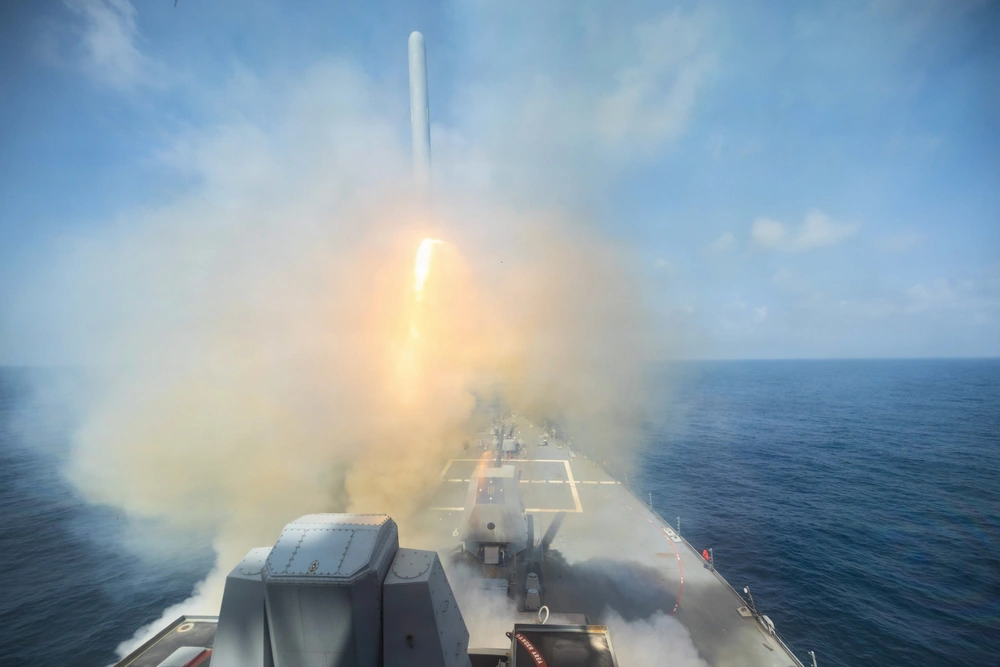
On Feb. 28, the United States and Israel launched coordinated but separately named military campaigns against Iran — the United States under Operation Epic Fury and Israel under Operation Roaring Lion — striking Iran’s nuclear facilities, ballistic missile infrastructure, and military leadership and command structures. In a video message broadcast, President Donald Trump again urged Iranians to “take over your government. It will be yours to take.” Whatever else the campaign accomplishes, it cannot be mistaken for coercive diplomacy. It is a regime change operation, and the American president has defined that end state objective explicitly.
This is the second major military campaign against Iran in under a year. Last June, Israel’s Operation Rising Lion and America’s Operation Midnight Hammer significantly degraded Iran’s enrichment infrastructure but left its highly enriched uranium stockpile largely unaccounted for, believed to be stored in or beneath bombed facilities. The Trump administration declared the program “obliterated,” then launched another campaign eight months later, ending nuclear negotiations with Iran in Geneva.
The United States has pursued regime change against governments before, in Iraq in 2003 and in Libya in 2011. The pattern is consistent: coercive approaches to weapons of mass destruction in the Middle East have not produced more manageable nonproliferation outcomes. The question for Washington now is what happens next and whether military force in Iran can succeed where diplomacy did not.
The Limits of Military Force
The U.S. and Israeli strikes can set back Iran’s nuclear program by degrading enrichment infrastructure, eliminating key personnel, and signaling resolve. Rising Lion and Midnight Hammer did all of these. But three dynamics the previous strikes have left unresolved or actively worsened now demand Washington’s attention.
First, military strikes can destroy facilities but cannot account for the material already produced. A confidential International Atomic Energy Agency report circulated on Feb. 27 confirmed that Iran’s last verified stockpile stood at 440 kilograms of uranium enriched to 60 percent purity — sufficient for as many as ten nuclear weapons, if further enriched — stored in a tunnel complex at Isfahan that the June 2025 strikes left structurally unaffected. The agency cannot account for its current location or condition. Two military campaigns have made that stockpile harder, not easier, to find.
Second, the strikes can target commanders but cannot eliminate the oversight structures required to control what they leave behind. Israeli strikes last June killed the Iranian Revolutionary Guard Corps’ commander in chief, the armed forces chief of staff, the Aerospace Force commander, and at least 14 nuclear scientists. The latest American and Israeli attacks are designed to go further. Yet Iran appears to have anticipated this. Within hours, Iranian forces launched simultaneous retaliatory attacks across multiple fronts without waiting for centralized authorization, suggesting pre-delegated response authority — a sign that decapitation strategies face diminishing returns against a regime that has spent months dispersing its command structures. Regardless of whether the regime survives, its enriched uranium stocks will remain in damaged, partially unaccountable facilities with no international monitoring.
Third, strikes can foreclose diplomacy but not substitute for it. The Geneva talks ended with Omani mediators describing “significant progress” but no deal. That opening is now closed — and Iran’s initial retaliation makes clear this is a different conflict than June 2025. Then, Iran gave advance warning before launching missiles at Al Udeid Air Base in Qatar, a signal calibrated to facilitate de-escalation. No such signal has accompanied its response this time. Iranian strikes have targeted U.S. bases across the Gulf, including in Bahrain, Kuwait, Qatar, and the United Arab Emirates. The conflict is already a multi-front regional war.
The Proliferation Risks That Remain
The central question is what becomes of Iran’s nuclear program under three plausible scenarios — none of which clearly delivers the resolution the U.S. and Israeli strikes are intended to achieve.
If the regime were to fall and be replaced, Washington appears to assume that a pro-Western successor would dismantle what remains of the program. That assumption deserves scrutiny. The United States made a similar bet in Iraq in 2003, expecting a stable, friendly government to immediately follow Saddam Hussein. Instead, it inherited a decade of instability and no durable framework for managing what it left behind — and Iraq had no active nuclear program. Iran does.
If the Iranian regime were to collapse without a coherent successor, the analogy is less Iraq than Libya: fragmented authority, rival factions, and competing regional actors, with no single interlocutor able to make or enforce binding commitments. In such a setting, the International Atomic Energy Agency would face the daunting task of reconstructing a monitoring baseline over a program far more advanced and technically sophisticated than the one it confronted after Gaddafi’s fall.
The third possibility is regime survival — the outcome most consistent with the Islamic Republic’s record. The system has endured the Iran-Iraq war, nationwide protest waves in 2017, 2019, 2022, and a bloody crackdown on mass uprisings last month, emerging each time more consolidated. A government with that history is unlikely to collapse quickly because of military strikes. It is more likely to adapt. And if it adapts, the nuclear program may adapt with it — moving further into concealment, dispersal, and gradual reconstitution.
In each scenario, the form of the challenge shifts, but the underlying proliferation risks remain. Without boots on the ground, the United States will be unable to conduct reliable bomb damage assessments to gauge the impact of the strikes or state of Iran’s remaining fissile material. Iran’s stockpile is currently sufficient, if processed at an undeclared facility, to produce weapons-grade material for multiple devices. The International Atomic Energy Agency has “lost continuity of knowledge” over that material. Damaged declared facilities provide cover for covert reconstitution, and the absence of inspectors since the summer of 2025 means there is no baseline against which to detect it. The administration’s own claim that Iran could produce weapons-grade material within a week implies that a covert sneak-out is a near-term possibility.
Across the region, there is also the risk of a proliferation cascade. Saudi Crown Prince Mohammed bin Salman has been unambiguous: “If [Iran] gets one, we have to get one.” The United Arab Emirates, Turkey, and Egypt are watching. Two military campaigns that degraded monitoring without eliminating Iran’s nuclear program send an unmistakable signal to every government in the region that the nonproliferation regime cannot constrain a sufficiently determined state.

Managing the Residual Risk
The diplomatic opening for nuclear talks that existed as recently as last week is gone. Washington has yet to articulate what it would accept as resolution — and without that, there is no framework for what comes next. What remains is a nuclear security crisis and the possibility of a protracted war that will not wait for politics to catch up. Contingency planning, separate from any future diplomatic efforts, needs to begin now in the event of regime change, collapse, or survival. The Nunn-Lugar Cooperative Threat Reduction program is a good model but the wrong operational template. It assumed a government with sovereign interest in orderly material accounting and a bilateral relationship through which cooperation could be coordinated. The Iranian scenario, by contrast, assumes an adversarial or fractured government and a political environment in which visible cooperation with Washington carries severe domestic costs. Effective planning requires different intermediaries and honest thinking about what can be achieved without Tehran’s cooperation versus what cannot.
Finally, it is worth confronting directly the argument that regime change will resolve concerns about Iran’s nuclear ambitions. The program predates the Islamic Republic, launched by the Shah with American assistance in the 1970s, suspended after the 1979 revolution, and revived under the pressures of the Iran-Iraq War. A change in leadership today would not erase stockpiles, centrifuge capability, or technical expertise, nor would it eliminate the strategic conditions that make nuclear development attractive. Any Iranian government, this one or a successor, revolutionary or pro-Western, faces a nuclear-armed adversary in Israel and the United States that has now twice struck Iranian territory in a single year.
This is a situation with no good options. The president who promised no more regime change in the Middle East has launched exactly that — against a country of ninety million people, with no framework for what follows, and no telling how it ends. What the coming weeks and months require is not a victory lap but a serious reckoning with what has been left behind: enriched material of unknown location, command structures of uncertain integrity, and a regional environment in which the case for nuclear deterrence has never been stronger.
Nima Gerami is an associate at Arcipel, a London-based consultancy that provides defense, security, and geopolitical advice to governments and corporations worldwide. He previously served at the National Defense University and the U.S. Department of State. His work focuses on nuclear policy, deterrence, and regional security in the Middle East.
Image: NAVCENT Public Affairs via DVIDS