
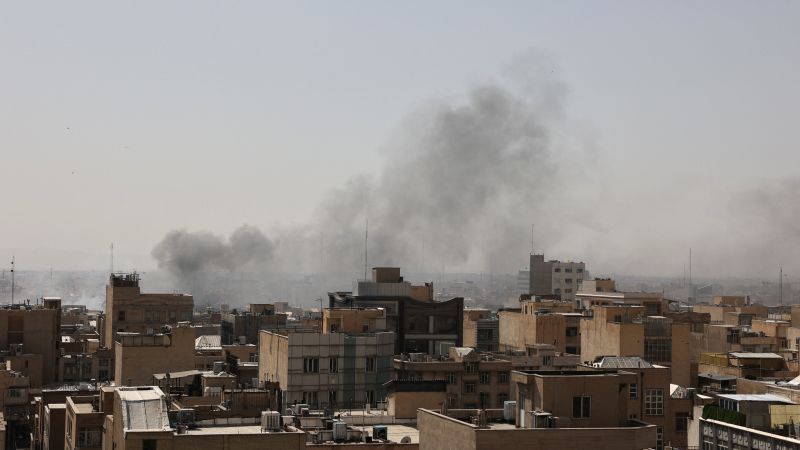

In the final hours of his life, the regime that Iran’s supreme leader spent decades constructing stood largely alone.
At its zenith a decade ago, the Islamic Republic of Iran boasted a network of allied Islamist militias in Iraq, Lebanon, Yemen and Gaza, as well as close partnership with the ruthless dictatorship government in Syria.
But the joint US and Israeli surprise attack on Saturday revealed how few friends were willing to stand beside Ayatollah Ali Khamenei.
The Lebanese Shiite militia Hezbollah has yet to join in this weekend’s conflict. Israel killed Hezbollah’s leader Hassan Nasrallah in September 2024 and decimated much of its leadership. Israel’s military continues to bomb suspected Hezbollah targets across Lebanon on an almost daily basis.
Several months later, rebels toppled the Syrian dictator Bashar Al Assad. For more than a decade, the Iranian military fought in Syria to prop up Assad’s regime throughout a devastating civil war.
Iranian-backed Houthis in Yemen have threatened to attack critical Red Sea shipping routes but have yet to do so.
Months into Russia’s full-scale invasion of Ukraine, Kyiv started to report the appearance of killer Shahed drones, manufactured in Iran, striking Ukrainian cities and towns. Despite substantial evidence of Russian-Iranian military cooperation, the Kremlin was nowhere to be seen throughout the first 24 hours of US-Israeli bombardment of Iran.
Throughout its 47-year history, the Islamic Republic of Iran has demonstrated an ability to endure huge pain. Hundreds of thousands of Iranians died in the eight year Iran-Iraq war throughout the 1980s. In the decades since, Iran’s economy suffered – but endured – beneath multiple layers of US-led economic sanctions.
Year after year, the Iranian security forces also demonstrated a ruthless willingness to crush popular uprisings on the streets of Iranian cities.
Often using deadly force, with widespread allegations of torture and other mistreatment, Basij militia-men and police deployed to beat protesters into submission in 1999, 2003, 2009, 2022, and whe recent economic protests that began in December 2025.
Similar deadly tactics were used against periodic uprisings in ethnic Kurdish regions of the country.
While the regime always emerged intact from these periods of unrest, the repeated killing and brutalization of fellow citizens eroded the legitimacy of the Khamenei’s theocracy.
Against this backdrop, the Iranian regime made occasional high-profile mistakes that were deeply embarrassing, while also revealing incompetence at the highest levels of government.
In 2020, Iranian air defense shot down Ukrainian Airlines Flight 752 shortly after take off from Imam Khomeini Airport in Tehran. All 176 people on board were killed. A court in Tehran later acknowledged it had been a mistake at a time of increased tension with the US.
In May 2024, then-president Ebrahim Raisi was killed in a helicopter crash over northwestern Iran. Tehran had to rely on a reconnaissance drone from neighboring Turkey to find Raisi.
This mix of brutality and ineptitude led long-time Iran watched Karim Sadjadpour to declare the Islamic Republic a “zombie regime.”
Iranian officials are vowing revenge. Tehran has also declared 40 days of mourning after the assassination of its supreme leader.
But there have also been scenes of spontaneous celebration in Syria and Iran as well as among the vast Iranian diaspora around the world.
Khamenei had few friends and many enemies after 36 years in power.