
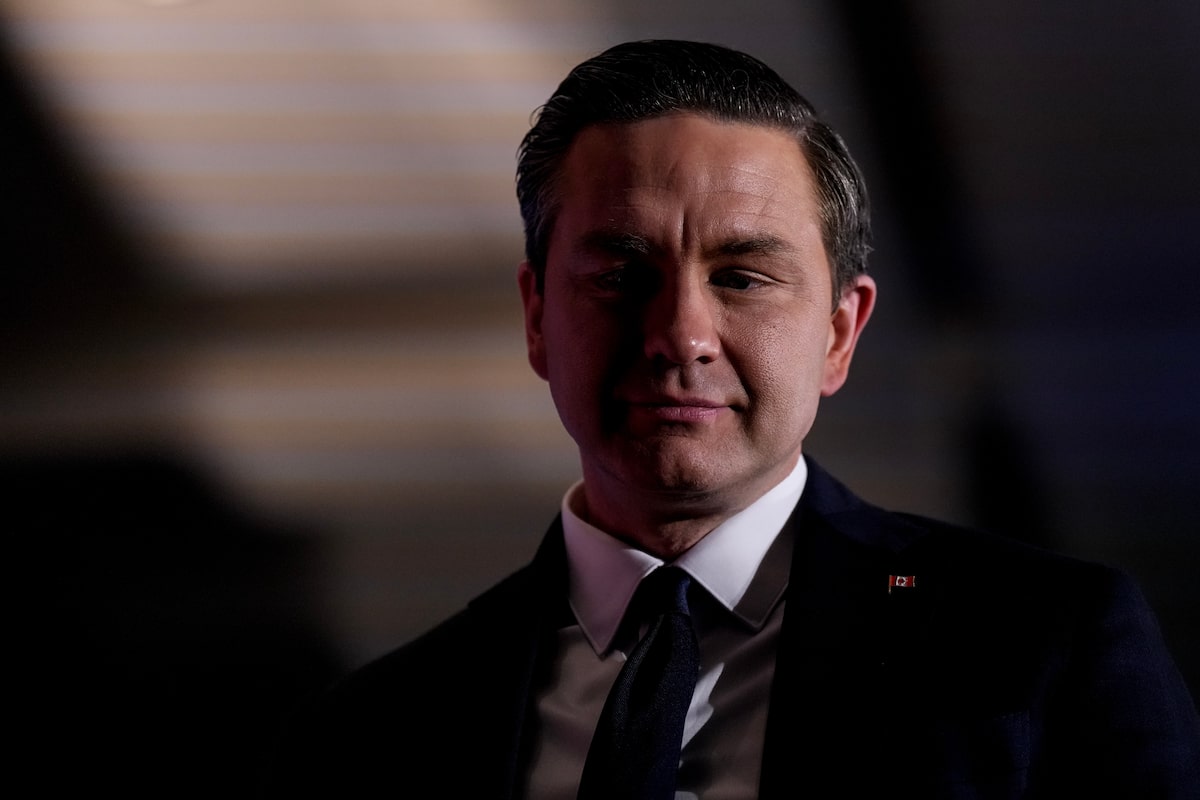
Conservative Leader Pierre Poilievre after his speech to the Economic Club of Canada in Toronto on Feb. 26.Chris Young/The Canadian Press
Conservative Leader Pierre Poilievre said he’s open to meeting with U.S. leaders if it will help Canada’s efforts to end the continuing trade dispute.
Mr. Poilievre also said he “can’t stand” U.S. President Donald Trump’s talk about Canada becoming the 51st state, doesn’t like Mr. Trump’s tariffs and doesn’t like the way he’s treating Canada.
“At various times, I’ve been upset by the words he utters and the things he does, just like everyone else,” Mr. Poilievre told the podcast The Bridge with Peter Mansbridge.
“But as I age, I become more stoic in focusing on what I can control.”
Mr. Mansbridge spoke with Mr. Poilievre just after the Conservative Leader delivered a speech Thursday laying out his vision for Canada-U.S. relations.
The full interview is set to publish on Monday, though sections of Mr. Poilievre’s remarks were posted online Friday.
Opinion: Poilievre makes the pivot on Trump, but repudiates Carney’s foreign policy
The leader’s speech to a downtown Toronto business crowd reflected pressure on him to more directly lay out a plan for how he’d manage the trade dispute with the Americans if he were to become prime minister.
A perception that he failed to articulate that vision was cited as a factor in his inability to win government last spring.
Mr. Poilievre pushed back against that idea with Mr. Mansbridge. He noted, for example, a speech he gave in February, 2025, where he directly addressed Mr. Trump’s threats against Canada.
Since the election, three Conservative MPs have decamped to the Liberals, all explicitly citing Mr. Carney’s approach to addressing the current geopolitical instability.
One of them, Chris d’Entremont, also cited Mr. Poilievre’s tone and leadership style.
The Conservative Leader said the MPs knew exactly who he was when they ran for him, but also said he is engaged in self-reflection.
And, he said, he likes to think he is improving.
“I’d like to think that I’m improving all the time, but, you know, a person is like a river. You can’t dip your toe in it twice. It’s always changing,” he said.
Mr. Poilievre is set to travel to London and Germany next week for meetings with British and German politicians and businesses. He’ll also deliver speeches in both countries.
The trips are his first business travel abroad as Opposition Leader, though they are being paid for by the Conservative Party.
Mr. Mansbridge asked him why he’s not going to Washington instead.
“I told Prime Minister Carney that if there’s anyone he wants me to meet with, I’d be happy to do it, and at the at the appropriate time, I will do that,” Mr. Poilievre said.
“And he did express some openness to it, but we’ve got to make sure that we put the country first.”
He said he’s not gone to to the U.S. yet as he did not want to risk a foreign country thinking there were two different leaders to negotiate with, and playing one off the other.
But Mr. Poilievre said that doesn’t mean he agrees wholeheartedly with Mr. Carney’s approach. He accused him, for example, of already making concessions to the U.S. without receiving anything in return.
“My main criticism of Mr. Carney is that in 10 months he hasn’t really done very much,” he said.
“There’s been lots of announcements and papers signed and ceremonies held, but not actual results.”
In his speech Thursday, Mr. Poilievre had set out his own approach, adding to his long-standing promise to speed up natural resource development as a means to diversify Canada’s economy.
He said his goal is building up leverage for Canada through a new strategic energy and minerals reserve, shoring up Canadian control over critical technologies and building up domestic defence production capabilities.
He told Mr. Mansbridge he does not think an election is necessary ahead of the review of the U.S.-Mexico-Canada free trade deal, saying Mr. Carney was already elected on a mandate to handle the U.S.
He said that’s why in his speech, he’d offered to strike an all-party working group on trade.
“I think that being united will be a real force going forward.”
Mr. Poilievre said he and Mr. Carney have a mutually respectful relationship, and he complimented the prime minister on his response to the shooting in Tumbler Ridge, B.C. Mr. Carney invited Mr. Poilievre and the other party leaders to travel there together for a vigil.
He also relayed an anecdote about one of Mr. Carney’s children and his own daughter nearly colliding on their bicycles on an Ottawa pathway – a story he and Mr. Carney have discussed.
“We disagree on our politics, but we’re both fathers, we’re both proud Canadians, and in that sense, I think there’s a mutual respect,” he said.