
The United States and Israel’s strikes on Iran are expected to spark a surge in oil prices when futures trading opens Sunday at 6 p.m. ET, experts warn.
The Organization of the Petroleum Exporting Countries (OPEC) and its allies said early Sunday it would raise its daily output by 206,000 barrels a day after pausing incremental production increases earlier in the year. In the fourth quarter, OPEC boosted production by 137,000 barrels per day.
The production increase may somewhat blunt the expected surge in oil prices when the futures market opens Sunday evening, but energy analysts didn’t expect the production increases to do much to keep prices in check.
Oil prices have been rising in anticipation of an attack on Iran, and on Friday, Brent crude, the global benchmark, rose 2.9% to $72.87 a barrel.
But how much oil gains will depend on how long the military campaign might last and the conflict’s potential impact on the Iran-controlled Strait of Hormuz.
On Saturday, Trump posted on Truth Social that “heavy and pinpoint bombing … will continue, uninterrupted throughout the week or, as long as necessary to achieve our objective of PEACE THROUGHOUT THE MIDDLE EAST AND, INDEED, THE WORLD,” reaffirming earlier comments that the military campaign would be “massive and ongoing.”
Here’s what you need know about the oil market as the military conflict ensues.
Iran plays a pivotal role in the global oil market. It is a major producer of oil, controls a vital shipping lane for crude and exports to oil-hungry nations such as China. The country also boasts the world’s third-largest proven oil reserves, according to OPEC.
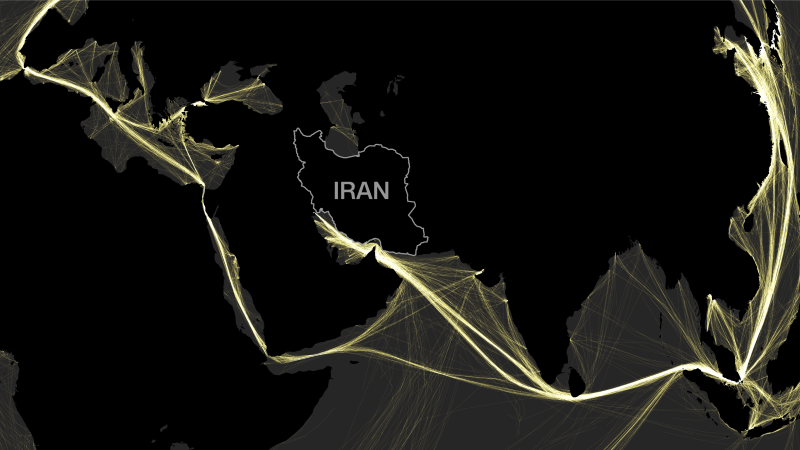
The Strait of Hormuz, a narrow waterway off Iran’s southern coast, is the main shipping route for crude from oil-rich countries such as Saudi Arabia and Kuwait to the rest of the world. Iran controls the strait’s northern side. About 20 million barrels of oil, or about one-fifth of daily global production, flow through the strait every day, according to the US Energy Information Administration, which calls the channel a “critical oil chokepoint.”
Iran has threatened to close the vital waterway in previous conflicts with the United States and other Western nations. During Iran’s 12-day conflict with Israel last year, Goldman Sachs estimated that oil prices could blow past $100 a barrel if there was an “extended disruption” to the strait.
Closing the Strait of Hormuz would cause an energy crisis, Bob McNally, president of Rapidan Energy Group, told CNN.
But an even bigger concern would be if Saudi Arabia’s oil production facilities are attacked and knocked offline for a long period of time. McNally notes that the oil plant in Abqaiq, Saudi Arabia, that was attacked in 2019 had specialized equipment that “you can’t just order from General Electric.”
Asian economies, including China and India, would be left particularly exposed if the Strait of Hormuz were closed.
Their scramble to secure oil from other countries could send global prices higher. Even a more benign scenario in which only Iranian oil shipments are affected would have knock-on effects globally.
“Since oil is a global, fungible commodity, a disruption anywhere affects prices everywhere,” Clayton Seigle, a senior fellow at the Center for Strategic and International Relations, a Washington, DC-based think tank, wrote in a recent research note.
“A loss of Iranian barrels would cause China to bid for substitute supplies,” Seigle said, estimating that the price of crude would rise by at least $10-12 as a result.
Iran is the world’s sixth-largest oil producer, and any military conflict with the country would mean surging oil prices, boosting gasoline prices and overall inflation, according to experts.
“I think Brent crude and (West Texas Intermediate) will roof on the open. Also, we should see refined product margins rise sharply, as well as (Dutch TTF) and other gas benchmarks,” said McNally of Rapidan Energy Group, adding that it will be an “all skate.”
Oil prices could rise as much as $5 per barrel, if not more, said Andy Lipow, president of consulting firm Lipow Oil Associates.
Gas prices across the nation average $2.98, having ticked up slightly from the lowest levels since 2021, after dropping below $3 in December — the first time in four years, according to the American Automobile Association. The Trump administration has repeatedly celebrated falling gas prices, which the conflict in Iran threatens to unravel.
When Israel attacked Iran last June, Brent crude posted its biggest single-day gain since March 2022. The price rose further after the United States became involved in the brief conflict and fell sharply when a ceasefire was announced.