
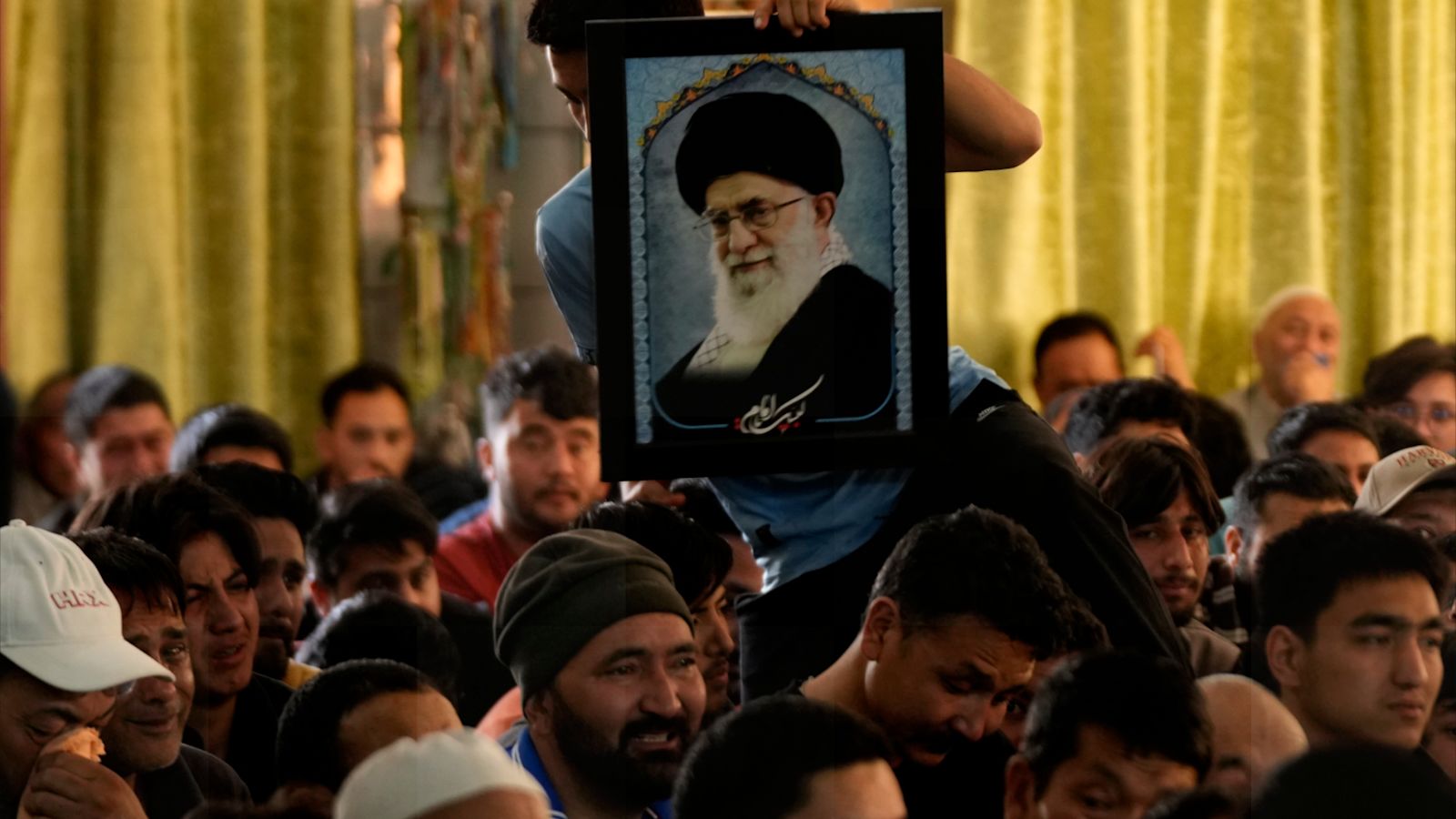
US-Israeli strikes have continued into a second day as Iran vowed revenge over the killing of its country’s Supreme Leader, Ayatollah Ali Khamenei.
There were explosions in Tehran on Sunday night as Israel said it was taking its attacks to the “heart” of Iran’s capital.
The US has said that three service members have been killed and five others seriously injured since the operations began.
More than 200 people have been killed since the start of the US and Israeli strikes, according to Iranian authorities.
Iran fired missiles in retaliatory strikes on US military bases in the Gulf Arab states as well as Israel following Khamenei’s death.
Smoke rises up after a strike in Tehran, Iran on March 1, 2026. Credit: AP
A senior White House official has told the Associated Press that “new potential leadership” in Iran has suggested they are open for talks with the United States.
The official, who spoke to the Associated Press on the condition of anonymity to discuss internal administration deliberations, said President Donald Trump says he is “eventually” willing to talk, but for now, the military operation “continues unabated.”
The official did not say who the potential new Iranian leaders are or how they made their alleged willingness to talk known.
Trump told The Atlantic in an interview on Sunday that he planned to speak with Iran’s new leadership. “They want to talk, and I have agreed to talk, so I will be talking to them,” he said, declining to comment on the timing.
Earlier on Sunday, US President Donald Trump had warned Iran that any retaliation would only lead to further escalation.
Posting on social media, Trump said: ” THEY BETTER NOT DO THAT, HOWEVER, BECAUSE IF THEY DO, WE WILL HIT THEM WITH A FORCE THAT HAS NEVER BEEN SEEN BEFORE!”
Rescue workers at the site where several people were killed by an Iranian missile strike in Beit Shemesh, Israel on March 1, 2026. Credit: AP
Meanwhile, Israeli police have said they’re searching for 11 people after an Iranian missile strike in central Israel.
The missile hit a synagogue in the town of Beit Shemesh.
At least nine people have been confirmed dead, with many others injured.
After Saturday’s initial strikes, Iran immediately launched missiles and drones towards Israel and US military bases in Bahrain, Kuwait, and Qatar.
The Israeli military said Iran fired dozens of missiles at Israel, with many intercepted.
Satellite images released by Planet Labs show before and after images of Dubai following strikes.
Officials at the UK Foreign Office are understood to be working on plans for potential evacuation routes should airspace in the Gulf remain closed.
British nationals are currently being advised to stay where they are and follow the instructions of local authorities and monitor the Foreign Office’s travel advice, which officials expect to change rapidly.
Those in Bahrain, Israel, Palestine, Qatar and the UAE have been urged to register their presence with the Foreign Office online.
More than 94,000 people have already registered their presence, a scheme the Government has used before to provide urgent updates to people affected by international crises.
Iranian state TV says Supreme Leader Ayatollah Ali Khamenei has died. Credit: AP
Khamenei’s death on Saturday in a strike on his Tehran office has thrown the future of the Islamic Republic into question and raised the risk of regional instability.
Iranian state television confirmed Khamenei’s death after initially dismissing Trump’s statement that the Supreme Leader had been killed as “false rumours”.
Trump urged the Iranian people to seize “the single greatest chance … to take back their country”.
The US and Israel described Saturday’s attacks as a “pre-emptive” strike against a Tehran government intent on developing nuclear weapons.
Talks between the US and Iran aimed at resolving the issue of Tehran’s nuclear ambitions ended on Thursday without agreement, but were expected to resume at a later date.
The UK has agreed to a US request to use British bases to attack Iranian missile sites, according to the Prime Minister.
Britain has so far not been involved in the US-Israeli strikes on Iran, and is reported to have previously refused American requests to use UK bases for operations against the country.But in a statement on Sunday night, Sir Keir Starmer said he had granted the request “to prevent Iran firing missiles across the region, killing innocent civilians, putting British lives at risk, and hitting countries that have not been involved”.The US will use the bases for the “specific and limited defensive purpose” of hitting missile launch sites or storage depots in Iran, he added.
Starmer said Britain’s allies in the Gulf had “asked us to do more to defend them”, and accused Iran of putting British lives at risk across the region.
On Sunday, Downing Street said that Starmer had spoken with the kings of Jordan and Bahrain as well as the crown prince of Kuwait.
Starmer expressed “solidarity” with the leaders of several Middle Eastern countries “in the face of dangerous Iranian escalation” following joint US-Israeli air strikes.
Subscribe free to our weekly newsletter for exclusive and original coverage from ITV News. Direct to your inbox every Friday morning.
Have you heard our podcast Talking Politics? Tom and Robert dig into the biggest issues dominating the political agenda in every episode…