
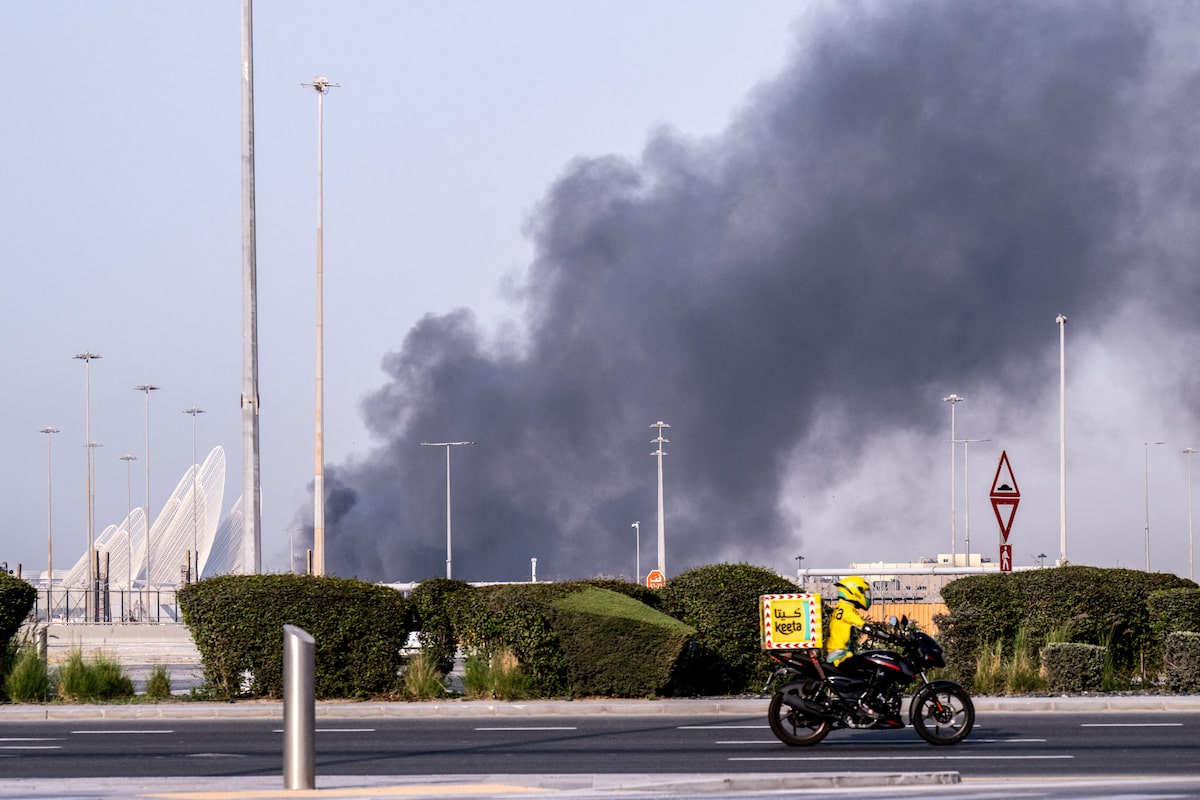
A plume of smoke rising from the Zayed Port following a reported Iranian strike in Abu Dhabi on Sunday.RYAN LIM/AFP/Getty Images
Missile attacks across the Middle East are throwing the safe haven status of Persian Gulf countries into question, upending the investment thesis that lured wealthy foreigners and a growing number of Canadian companies to the region.
Cities such as Dubai and Abu Dhabi in the United Arab Emirates and Doha in Qatar have blossomed into global commerce hubs over the past two decades, backed by oil-rich governments that have funded modern infrastructure and gleaming skyscrapers.
As they blossomed, they also offered something many countries in the Middle East could not: political calm. The likes of Qatar, Oman and the UAE have developed reputations for being politically-neutral, much like Switzerland, and that has made them less likely to be roped into regional wars.
Combined with ultra-low tax rates, this neutrality has lured wealthy foreigners, and it has also turned the Gulf into a hotbed for investment dollars. Canada’s Brookfield Asset Management BAM-T has long raised money in the region; Canadian lenders such as Royal Bank of Canada RY-T and National Bank of Canada NA-T are looking to expand in the Gulf; and Canadian insurers Manulife Financial Corp. MFC-T and Sun Life Financial Inc. SLF-T both recently opened offices in Dubai to court high net worth investors for their international arms.
A list of Iranian attacks on countries in the region
Yet the safety that gave them comfort was thrown into question this past weekend after Iran retaliated for missile attacks that killed Ayatollah Ali Khamenei, the Supreme Leader. Over two days, debris from 390 missiles and 830 drones hit airports in Abu Dhabi and Dubai, the luxury Burj Al Arab hotel in Dubai, a high-rise building in Bahrain and Fairmont’s The Palm, in Dubai, where four individuals in the parking area were injured. All of these events seemed extremely unlikely only a few days ago.
“The image of Gulf cities as stable havens and safe places to live, work, and do business is now under attack,” Kristian Coates Ulrichsen, a fellow for the Middle East at the Baker Institute for Public Policy, wrote in an email to The Globe. The attacks, he added are a “rude awakening for many of the expatriate residents, tourists, and other visitors, and may inflict psychological damage that is hard to measure, but may be difficult to unsee, especially if the disruption lasts longer than just a few days.”
Prolonged instability in the Gulf could also have an impact on global capital flows, according to Karen Young, a senior research scholar at Columbia University’s Center on Global Energy Policy and an expert in Gulf countries’ economic statecraft, said in an email.
“More and more, Gulf investment vehicles, either fully-or-partially-state owned, are now preferred partners in infrastructure investment and private equity funds globally and now serve as a dominant source of capital in the energy sector and in technology and AI,” she said.
Even with the UAE under attack, most expats feel safe, say they’re not leaving
The region is now home to multiple sovereign wealth funds, each managing hundreds of billions of dollars, and this money has been readily flowing into the West as Gulf governments try to diversify away from oil. In late 2024, for instance, Abu Dhabi-based Mubadala Capital bought Canadian asset manager CI Financial for $4.7-billion.
The importance of this capital is not lost on Mark Carney, who travelled to Doha in January for the first-ever visit by a sitting prime minister. While there, the Amir of Qatar, His Highness Sheikh Tamim bin Hamad Al Thani, committed to making “significant strategic investments in Canadian nation-building projects.”
The third leg of the Gulf’s financial appeal has been its status as a hotbed for infrastructure projects, many of which have attracted Canadian capital and expertise.
In 2022, the Caisse de dépôt et placement du Québec, the province’s pension fund, announced one of the largest Canadian investments in the region, partnering with DP World to co-invest US$5 billion in three UAE assets. They included the Jebel Ali Port in Dubai, one of the world’s largest, and building the National Industries Park in Dubai, a 21 square km area designated for manufacturing and processing companies.
Oil prices surge in response to Middle East conflict
Over the weekend, DP World suspended port operations at Jebel Ali, and Dubai’s media office said a fire was caused by debris from the aerial interception of an Iranian missile or drone. In an emailed statement, the Caisse said it does not have an office or employees in the Gulf region and that it is monitoring the situation closely.
Canadian engineering firms WSP Global Inc. WSP-T and Atkinsrealis Group Inc. ATRL-T have also profited off the infrastructure boom. Based in Montreal, WSP just helped build the Zayed National Museum, the National Museum of the UAE in Abu Dhabi, and it was also contracted to upgrade major highways in Kuwait, as well as help build the Kuwait Children’s Hospital.
It is possible the Gulf’s bout of instability will subside quickly. On Sunday, U.S. President Donald Trump said he was willing to talk to Iran’s new leadership, and any talks could result in a lasting ceasefire. If that plays out, the infrastructure money is likely to keep flowing and foreigners are likely to keep flocking to the region. In 2025, Dubai attracted the most millionaires globally, according to Henley & Partners, a consultancy that specializes in residence and citizenship planning.
But it is also possible that Iran will become destabilized amid a leadership vacuum, and the resulting chaos could spread throughout the region.
It may seem far-fetched at this moment in time, but the weekend’s chaos showed that what was considered unthinkable only a few weeks ago was in fact possible, and the region’s promise of stability is fragile.
With files from Andrew Willis and James Bradshaw