
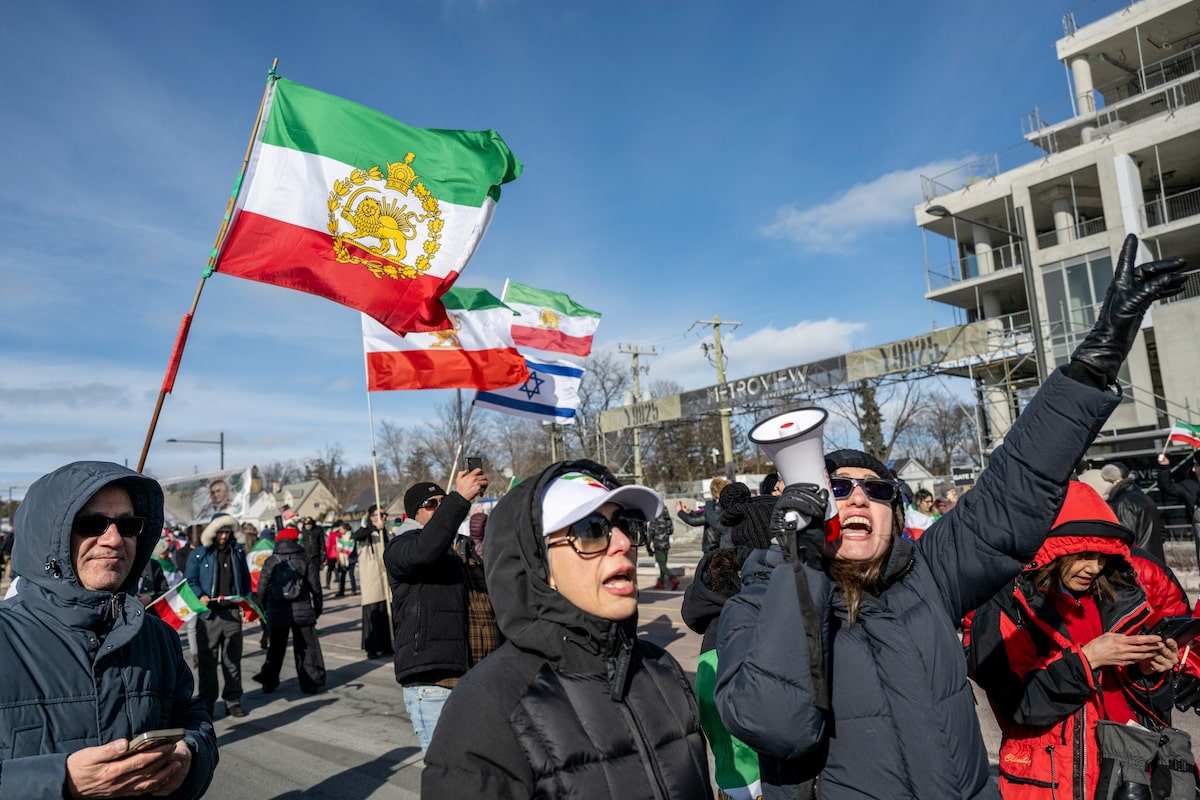
People take part in a demonstration supporting the American-Israeli attacks against Iran in Richmond Hill, Ont., on Saturday.EDUARDO LIMA/The Globe and Mail
On early Sunday morning, Solar Gholami was called back to his gym north of Toronto by friends, who told him the police were waiting to see him.
He arrived to find 17 bullet holes in the street windows of the building in Richmond Hill, Ont., and several panes of shattered glass.
Mr. Gholami, the owner of Saliwan Boxing Club, was the main organizer of a Saturday rally in the area around his gym, originally planned as a demonstration for the people in Iran, fighting for democracy. By the afternoon, it had become a loud, festive dance party, the streets filled with thousands of Iranian-Canadians celebrating the death of Supreme Leader Ayatollah Ali Khamenei, a brutal dictator who ruled the country for 36 years.
Since January, when the Iranian government killed peaceful protesters, many of them students, Mr. Gholami has been among the members of Canada’s Iranian diaspora calling for American military action to help topple the regime. “The world is a better place today for everyone,” he said of Ayatollah Khamenei’s death.
Mr. Gholami said he is now working with York Regional Police to determine who was responsible for the vandalism, and how he can reopen his gym safely, especially for the teenagers and young people who are members.
“I’m a fighter. I am not afraid,” he said, vowing to keep organizing rallies until the Iranian people are also safe, and free.
At a protest in Richmond Hill, Ont., thousands marched and some danced as a planned demonstration took on new meaning amid escalating tensions involving Iran, the U.S. and Israel.
The Canadian Press
While they wait to know for certain that families are safe, and follow the latest news out of Iran, members of Canada’s Iranian diaspora also expressed different views about the American military action, and what should happen now that Ayatollah Khamenei is dead.
As the news broke, thousands of people from the country’s Iranian communities took to the streets in cities such as Vancouver, Calgary, Toronto and Montreal, in some case turning planned anti-government protests into celebrations.
Many, such as Mr. Gholami praised U.S. President Donald Trump’s decision to bomb Iran, seeing it as a necessary action to remove an oppressive and violent dictator. “Unfortunately, some bombs will get people too, but we don’t have any other choice.”
Others continue to condemn the bombings by the U.S. and Israel as foreign intervention that risks innocent civilians and will likely further destabilize the region. “They are killing women and children, and it is breaking my heart,” said Mona Ghassemi, president of the Iranian Canadian Congress. Forcing change in Iran, she said, especially by a self-interested Western power will likely lead to more upheaval and civilian deaths. “It is short-sighted to be celebrating.”
Opinion: Two wrongs don’t make a right in the Iran war
Some fervently support Reza Pahlavi, the Western-educated eldest son of the deposed Shah, who has been living in exile since 1980. Others are just as fierce in their opposition to any semblance of a monarchy.
And some, like Safaneh Mohaghegh Neyshabouri worry that whatever comes next will lead to more devastation for her country.
For years, Prof. Neyshabouri had a green shirt hanging in her closet, never worn, purchased shortly after she arrived in Alberta from Iran in 2010.
“It was my aspirational shirt,” she said, only to be worn in celebration on the day that Ayatollah Khamenei died.
Time passed: She got her PhD, married, became an associate professor in Gender and Sexuality Studies at the University of Calgary. She watched Iran suffer under Ayatollah Khamenei’s rule, even as she had children, and the shirt became too small. What never went away was the memory of being among the crowd, demonstrating peacefully in Tehran, in 2009, when the militia fired upon protesters, and the desire for the people of Iran to achieve democracy.
Eyewitness video released on Feb, 28 and geolocated by Reuters showed black smoke billowing from a destroyed school building in the Iranian town of Minab, where at least 40 people were killed in an Israeli airstrike, state media said. Reuters could not independently confirm the reports.
Reuters
And yet, since learning that her country’s dictator had been killed by foreign bombs, she has not felt like celebrating. She is still grieving for young women killed in a school caught in the bombing, still worried about loved ones in Iran taking cover. And she is afraid about what happens now, with bombs still falling, with her friend reporting the tense presence of Iranian militia, and the future uncertain.
“I find myself so fearful for the future of Iran that my other emotions cannot upload,” she said. As a mother safely in Canada, she is weighed down by survivor’s guilt. She knows friends in Iran who have not been sending their children to school for fear they’d be apart if the bombing started.
“I know many Iranians were waiting for this,” she said, believing that the bombing would begin and end quickly, the Supreme Leader would be taken or killed, and the Iranian people would be left to decide their future. But that’s not what history teaches, she said. “It’s not going to be that easy. I think a lot about the human cost and the lives that are going to be lost.”
In the meantime, she said, she hopes that, within Canada, the people who care deeply about what happens next in Iran, can work together, despite differences of opinion.
“I really hope that at least for those of us in the diaspora, we think, ‘What can we build? What could we do to make it better?’”