
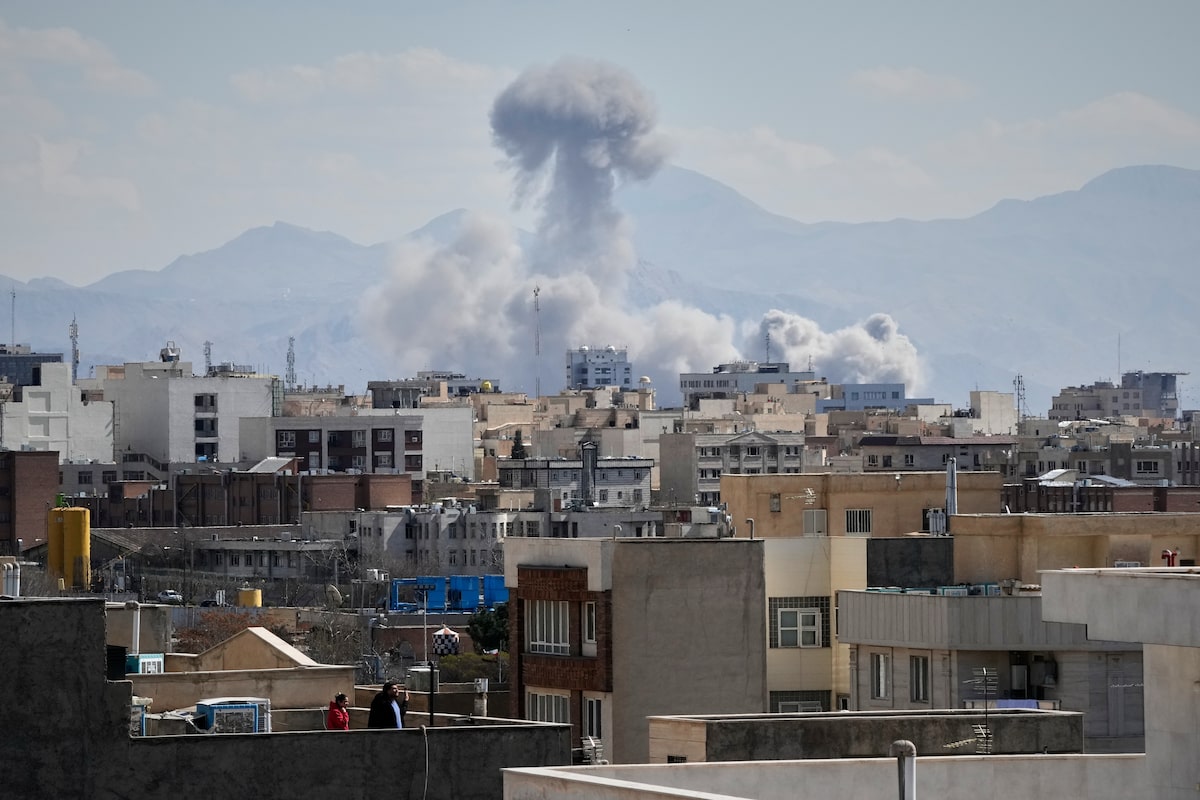
Smoke rises after a strike in Tehran, Iran, on Sunday.Vahid Salemi/The Associated Press
No vote of Congress. No United Nations approval. No legal authority. No problem.
Without the customary constitutional restraints on presidential power or bows to the authority of international law, Donald Trump mobilized a formidable military armada, unleashed a barrage of firepower on Iran, singled out the country’s leadership for decapitation, began what could be a lengthy armed struggle and set in motion unpredictable change in the world’s most combustible region.
None of this conforms to American law or to the once-revered and sometimes-honoured standards of the rules-based international order. Then again, none of that matters.
American presidents from Harry Truman to Barack Obama have ordered U.S. troops into combat without formal declarations of war or the express consent of Congress and have toppled governments in, among many other places, Iran, Panama and Libya – all before Mr. Trump’s interventions this year in Venezuela and Iran.
Israeli strikes rock Tehran after Iran retaliates for killing of Khamenei
“All of international law is a political question,” former secretary of defence William Cohen, a one-time Republican senator, said in an interview.
“We did not give evidence in this matter. We did not make the case internationally.” In a practical sense, these omissions “will not prohibit the United States from taking military action, but it does convey the notion that the U.S. will act in its own interest whenever its national security is endangered.”
That is at the centre of the shifting rationale – Mr. Trump’s critics argue that it is the “cover” – that the Trump administration asserted as U.S. forces gathered in the region and then, with Israel, began hostilities.
The final justification was a combination of the argument that Iran’s future nuclear and missile capabilities endangered American lives – in the region and, ultimately, on American soil – and that human-rights violations in Iran required the removal of the theocracy of Supreme Leader Ayatollah Ali Khamenei, who was killed in an air strike Saturday.
Writing in the journal of the Carnegie Endowment for International Peace last August, Oona A. Hathaway, a professor at the Yale Law School, and Stewart Patrick, the director of the endowment’s Global Order and Institutions Program, argued that “even when states have violated the prohibition on the use of force, they have typically felt compelled to justify their actions within its framework – most commonly in terms of self-defense.”
Since returning to the White House 13 months ago, Mr. Trump has felt few constraints on his actions and has practised a unilateral conception of the presidency that even leaders in more dangerous times with more fully developed legal justifications, such as Abraham Lincoln during the Civil War and Franklin Delano Roosevelt during the Second World War, did not contemplate.
“He’s not constrained by anything but his own impulses,” said Kal Raustiala, a professor of international law at UCLA, “and it doesn’t appear that Trump cares about international law.”
U.S. President Donald Trump announces that the U.S. had begun ‘major combat operations’ in Iran in a video released on Saturday.Donald Trump via Truth Social/Reuters
Much of international law, which sets out formal justifications for military intervention, was created at the behest of, or with the explicit approval of, the United States. The United Nations Charter, for example, requires countries to “refrain in their international relations from the threat or use of force against the territorial integrity or political independence of any state.” It establishes two justifications: self-defence in the face of an imminent threat and approval by the UN.
American presidents, and indeed the American people, have viewed those as impediments to the country’s interests and often have professed a willingness to act outside those restraints.
A 2011 Pew Research Center poll, for example, found that Americans were evenly split over whether the country should feel required to win UN support to use military force or whether that constraint would “make it too difficult” to do so. Some two-thirds of Germans, British and French respondents agreed with the restraints.
“Since the end of the Cold War, the United States has behaved as though it can alter the prohibition whenever its national interests or foreign policy demands,” wrote Mary Ellen O’Connell of the Notre Dame Law School in the Georgetown Law Journal last year.
The U.S. House of Representatives was set to vote this week on a measure that would have restrained Mr. Trump from undertaking a military mission like the one he began over the weekend. It would have faced uncertain prospects in the House, difficult obstacles in the Senate and a certain veto by the President.
Analysis: Which regime? What change? Iran’s complexity means there are no magic bullets
Lawmakers on Capitol Hill often are reluctant to constrain presidents while U.S. forces are facing hostilities in the early days of military operations. It wasn’t until 1973, more than a decade after U.S. troops first saw action in Vietnam – a war that had at least surface congressional approval, in the form of the 1964 Gulf of Tonkin Resolution – that Congress voted to restrain U.S. military activities in Southeast Asia. Facing a certain congressional override if he vetoed it, President Richard Nixon signed the measure.
Now Democrats are demanding that lawmakers return to Washington from their recess to vote to restrain Mr. Trump under the War Powers Act, which Congress passed over Mr. Nixon’s veto.
Despite bipartisan support for the law, no president has been constrained by the 1973 act, nor by other measures, due in part to the ambiguities in constitutional provisions that make the president the commander-in-chief but delegate to Congress the power to declare war.
This awkward arrangement has been the subject of legislative, judicial and scholarly debate since shortly after the Constitution went into effect in 1789. It flared as soon as a dozen years later, when Thomas Jefferson, reacting to piracy against American ships, sent U.S. troops into action in the Barbary Wars, the engagement that permitted the famous reference to “the shores of Tripoli” in the second line of the Marines’ Hymn.
“This current war is unconstitutional, and it doesn’t matter,” said Andrew Bacevich, an emeritus Boston University historian of military affairs. “But the fact that it’s unconstitutional will have no effect whatsoever on U.S. policy. The President will do whatever he wants, whenever he wants to, and for whatever purpose he chooses.”