
Words by Lucy Middleton
Iran has launched a wave of retaliatory attacks across the Middle East after US-Israeli strikes killed Supreme Leader Ayatollah Ali Khamenei just one day after conflict began.
Iran and allied armed groups fired missiles at Israel, Arab states and US military targets around the region on Monday, with previously safe havens like Dubai coming under fire, and hundreds of thousands of airline passengers stranded around the globe.
At least 555 people have been killed in strikes by Israel and US, while the US death toll stands at four.
The Islamic Revolutionary Guard Corps (IRGC) vowed to deliver a “severe, decisive and regret-inducing punishment” after Khamenei’s death.
ITV News takes a look at what Iran’s weapons arsenal looks like.
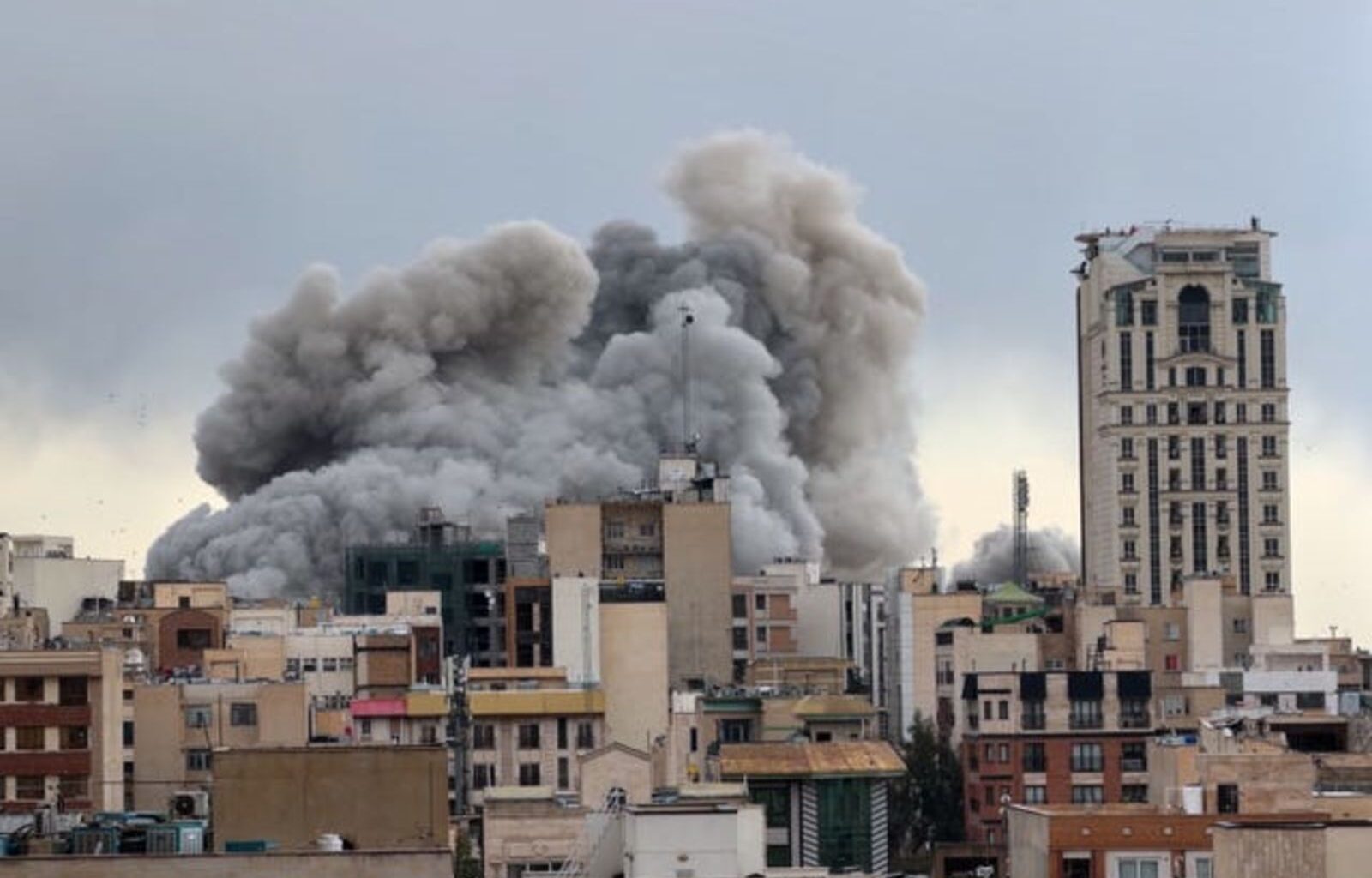
Smoke rises from a warehouse in the United Arab Emirates, following reports of Iranian strikes in Dubai Credit: AP
What weapons does Iran have?
Iran is home to one of the largest and most diverse missile arsenals in the Middle East, defence analysts say.
This includes mortars, rockets, drones and cruise missiles, which are designed to fly at low altitudes and strike targets on the ground, Iran analyst Behnam Ben Taleblu told ITV News.
The “higher tier” of weaponry are the ballistic missiles, which have a guided rocked-powered ascent but then follow a freefall trajectory towards their target, he said.
“Ballistic missiles have only grown in importance for the Islamic Republic,” Taleblu said. “This is Iran’s most important long-range strike tool.”
Ballistic missiles can be short-range, medium-range and long-range. The furthest of these could reach up to 3,000km, but Iran has a self-imposed cap of 2,000km.
Iranian officials have stated 2,000km is enough to protect the country as it allows them to reach Israel, but Western analysts warn the limit could be removed at any time.
In 2023, Iranian state media unveiled pictures of hypersonic ballistic missiles named Fattah-1 and Fattah-2, which the Islamic Revolutionary Guard Corps claimed can reach up to 1,400km and travel 15 times the speed of sound.
The regime has been striving to increase its combat-readiness over the last two decades, and has improved the range, precision, mobility, survivability and lethality of ballistic missiles, research has shown.
One-way attack drones – also known as suicide drones, due to their self-destruction – have also extended Iran’s long-range strike power at a lower cost than missiles.
How big is Iran’s weapons arsenal?
The exact number of Iran’s missiles is unclear.
In 2022, US Central Command’s General Kenneth McKenzie said Iran had more than 3,000 ballistic missiles, but many weapons were either used or destroyed during the 12-day war last year.
Israeli officials claimed Iran’s supply of ballistic missile launchers was cut in half during the war, but satellite images have shown the regime had largely rebuilt its programme since June.
Weapons have also been moved underground, in a bid to protect them from strikes.
“There is no way of truly knowing what the Iran regime has left,” said Rosa Freedman, a Professor of Law Conflict and Global Development at Reading University.
“But, as you can see from the last two days, they were ready to go.”
How far can Iran’s missiles reach?
With Iran’s self-imposed cap, the regime’s ballistic missiles can reach countries in a radius of 2,000km around the country.
This contains the entire Middle East region, as well parts of Western Africa, Eastern and South Asia.
US President Donald Trump has repeatedly claimed Iran has developed missiles that “could soon reach the American homeland”, but there is no evidence to suggest this is the case.
An unclassified assessment by the Defense Intelligence Agenct (DIA) in 2025 said Iran had the potential to develop a missile with a range greater than 5,500km – “should Tehran decide to pursue the capability” – by 2035.
Subscribe free to our weekly newsletter for exclusive and original coverage from ITV News. Direct to your inbox every Friday morning.
How does this compare to the US and Israel?
Despite the improvements in ballistic missiles, Iran’s weaponry “pales in comparison” to Israel or the US, Taleblu told ITV News.
On Sunday, the Israel Defense Forces (IDF) said that it had dropped more than 1,200 munitions across Iran during the attacks that killed Khamenei.
The strikes also killed Khamenei’s family, and the army’s chief of staff General Abdol Rahim Mousavi and defence minister General Aziz Nasirzadeh.
The US military said B-2 stealth bombers had struck Iran’s ballistic missile facilities with 2,000-pound bombs, and Trump claimed nine Iranian warships had been destroyed.
Before launching its first strike, the US had been building up what Trump called an “armada” of American firepower in the region, with analysts at the International Institute for Strategic Studies estimating it includes 10% of available US airpower.
More than 100 US fighter jets, capable of intercepting drones and missiles, have also been sent to the region.
You can hear Talking Politics wherever you get your podcasts, including Apple Podcasts and Spotify, and watch every episode on YouTube and ITVX