
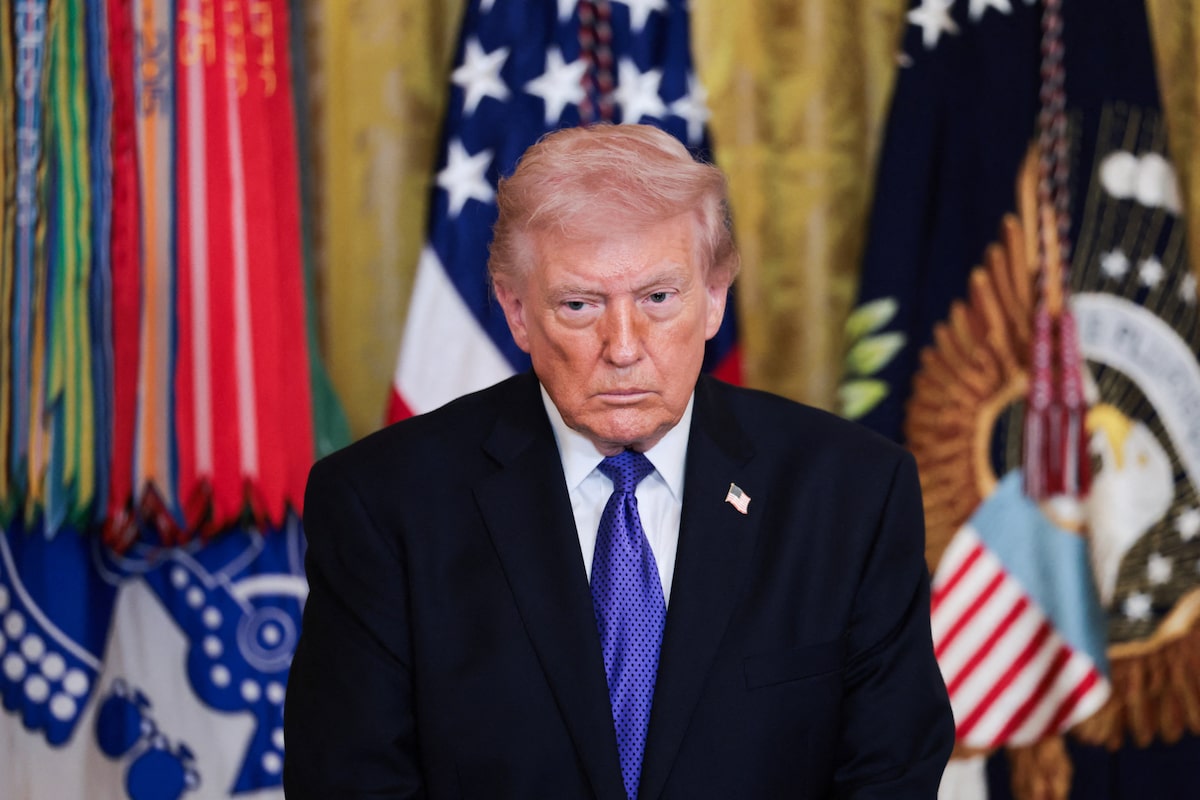
U.S. President Donald Trump attends a Medal of Honor ceremony at the White House in Washington on Monday.Jonathan Ernst/Reuters
President Donald Trump said Monday that the U.S. war with Iran is planned to last “four to five weeks” but could go “far longer,” while Defence Secretary Pete Hegseth did not rule out deploying ground troops.
In their first public appearances since the start of the U.S.-Israeli attack on Saturday, Mr. Trump and Mr. Hegseth presented its objectives and backed even further away from the President’s campaign vow to keep his country out of long-term conflicts, even as polling suggested a majority of Americans disapprove of the attack on Iran.
Speaking in the East Room of the White House before handing out three Medals of Honor to military personnel, Mr. Trump said the U.S. “continues to carry out large-scale combat operations in Iran.”
Members of Iranian security forces stand guard on a street next to a billboard of Iran’s supreme leader Ayatollah Ali Khamenei in Tehran on March 2.-/AFP/Getty Images
“Right from the beginning, we projected four to five weeks, but we have capability to go far longer than that. We’ll do it,” the President said.
He outlined four goals for the war: destroying Iran’s missile capabilities; sinking its navy; ensuring it never obtains a nuclear weapon; and stopping it from arming and funding proxy militias in the region.
Mr. Trump did not repeat his calls for regime change from this weekend when, in two videos, he urged Iranians to overthrow the theocratic dictatorship that has ruled the country since 1979.
The intensity of the attacks, the killing of Iranian Supreme Leader Ayatollah Ali Khamenei, and the lack of any apparent exit plan indicated the conflict would not end anytime soon. It was already having far-reaching consequences: Safe havens in the Mideast like Dubai have seen incoming fire; hundreds of thousands of airline passengers are stranded around the globe; oil prices shot up; and U.S. allies pledged to help stop Iranian missiles and drones.
The Associated Press
The war continued to spread throughout the Middle East on Monday, as Iran hit 10 countries with missiles or drones in retaliatory strikes aimed at U.S. bases, and the U.S. government told American citizens to immediately get out of the region.
Six U.S. service members have been killed so far, the military said Monday. The Red Crescent has put deaths in Iran at 555.
The Iranian Revolutionary Guard warned that ships trying to pass through the Strait of Hormuz would be set on fire, a move that threatens to further choke off international oil and gas shipments from the Persian Gulf.
Saudi Arabia shut down its largest oil refinery following a drone attack while Qatar stopped natural gas production. Israel said it had launched another series of attacks, including on Iran’s state broadcaster. Iranian-backed militia Hezbollah fired missiles at Israel from Lebanon and Israel hit back with air strikes on Beirut.
Supreme Leader Ayatollah Ali Khamenei and many of Iran’s top military commanders were killed in the initial air strikes on the weekend.
In a Pentagon briefing, Mr. Hegseth said there were no U.S. troops currently on the ground in Iran but left the door open to the possibility. “We’re not going to go into the exercise of what we will or will not do,” he said.
War in the Middle East expanded Monday as Israel and the United States continued to hit Iran, who launched retaliatory strikes in the region.
The Associated Press
He insisted, however, that the war would not become a “quagmire” like the 2003 U.S. invasion of Iraq, which went on for eight years and spiralled into a wide-ranging and bloody sectarian conflict.
“This is not Iraq. This is not endless,” he said.
While he said he hoped the Iranian people would rise up against their government, he specified that the U.S.’s goals were more narrowly focused on destroying the country’s military capabilities.
“No stupid rules of engagement, no nation-building quagmire, no democracy-building exercise, no politically correct wars,” he said. “This is not a so-called regime-change war.”
When a reporter asked if there was a concern that the attacks could turn into a longer war, Mr. Hegseth snapped back: “Did you not hear my remarks?”
Still, the Trump administration’s indication that the fighting could grow marks a further step in the President’s departure from his once non-interventionist foreign policy. In his victory speech after the 2024 election, Mr. Trump vowed, “I’m not going to start a war. I’m going to stop wars.”
It is also a political gamble. In a CNN poll published Monday, 59 per cent of respondents said they disapproved of the U.S. attack on Iran and 56 per cent said they believed a long-term war was likely.
Hezbollah and Israel open new front in regional war
Elisa Ewers, a former national security official in the administrations of George W. Bush and Barack Obama, said it’s not clear what Mr. Trump’s endgame is for the war – whether it’s toppling the regime in Tehran, taking away its ability to project power across the region or destroying its navy.
“All of these things are possible, but they’re not all possible in the time that you have when real economic costs are being extracted from the Gulf,” she said in a briefing Monday by the Council on Foreign Relations think tank in Washington.
Also unknown is Mr. Trump’s willingness to negotiate a settlement with Tehran. “There’s still very much a big question mark as to what the President’s intentions are as far as an off-ramp to diplomacy,” she said.
Both chambers of the U.S. Congress, meanwhile, are expected to vote this week on war powers resolutions aimed at reining in Mr. Trump’s ability to carry on the attack.
The measures – one in the Senate, set to be voted on Tuesday, and one in the House of Representatives, which could come up Wednesday – are mostly symbolic: Even if they pass, the President will almost certainly veto them. It would take a two-thirds majority in both chambers to override the veto.
But Democratic Senator Tim Kaine, who is pushing the move in the Senate, said it was still important for lawmakers to speak up.
“The President seems to have no plan for the aftermath, and it looks like Iran is now poised to choose a new leader from the current regime,” he told reporters.
Mr. Trump, meanwhile, said no one should doubt that he has the attention span to pursue a longer war.
“I don’t get bored. There’s nothing boring about this,” Mr. Trump said. “Somebody actually said, from the media, ‘I think he’ll get bored after about a week or two.’ No, we don’t get bored. I never get bored. If I got bored, I wouldn’t be standing here right now, I guarantee you that.”
With a report from Reuters
Have your travel plans been impacted by the Middle East war?
Are you a tourist or business traveller whose plans have been affected by the conflict in the Middle East? Have you been dealing with travel delays and suspended flights? Share your story below.