
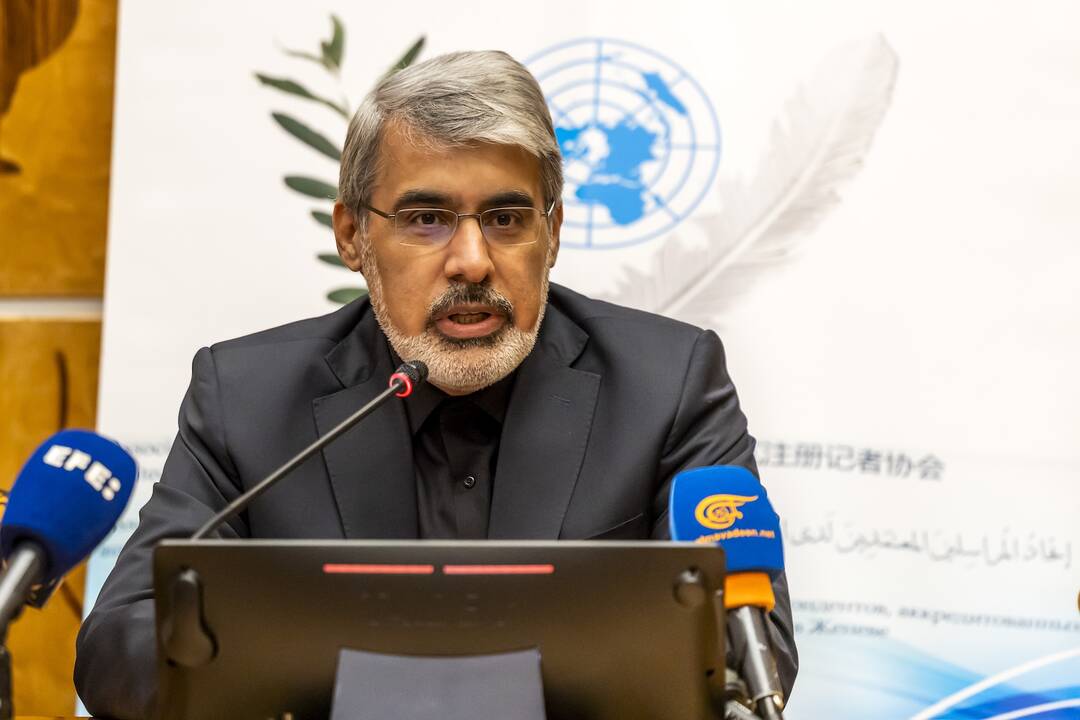
As hostilities escalate between Iran, and the United States and Israel, Tehran’s top diplomat in Geneva says the UN must address attacks against Iran, and insists that its strikes on neighbouring Arab countries are focused on US targets.
Just days after a joint US-Israeli military operation struck Iran, killing Supreme Leader Ali Khamenei and dozens of senior religious and political figures, and prompting retaliatory strikes across the region, Iran’s representative in Geneva framed the unfolding crisis as a matter of international law.
In a two-hour briefing with journalists on Tuesday, Iran’s ambassador to the UN in Geneva, Ali Bahreini, argued that the attacks constituted grave violations of the UN Charter and said the organisation, including the Human Rights Council, had a legal responsibility to respond.
Engaging with UN rights body
The Iranian ambassador said he planned to meet with the United Nations high commissioner for human rights, Volker Türk, on Wednesday to discuss developments and urge him and his office to exercise “their responsibility in this historic moment”. He said the office as well as the UN as a whole have “a great responsibility to strongly address the unlawful attacks against Iran”.
He added that Iran was working on activating a special meeting at the Human Rights Council to “bring to the attention of the international community the crimes committed by the United States and Israel”. A special session at the UN rights body requires the support of one third of its 45 member states, which Tehran may struggle to secure.
In two weeks, the Human Rights Council is scheduled to hold separate discussions on rights violations, including recent crackdowns on anti-government protesters that left scores dead. Bahreini told journalists that Iran would be open to “any kind of investigation with regard to the crimes committed by Israel and the United States”, citing Saturday’s strike on a school in southern Iran, in which 156 people, including children, were killed.
‘They’re our friends’
Responding to questions about Tehran’s strikes on neighbouring Arab countries, he said, “we don’t have any problem with our neighbours. They are our friends.” He insisted that Iran was not at war with them and that attacks on their soil were focused on US military bases. “We have asked our neighbours to understand the situation…that, unfortunately, and despite their desire, their land is being used against our country.”
Earlier on Tuesday, Saudi officials reported that the US embassy in the capital Riyadh had been hit by two drones, while Oman’s commercial port was also struck in a drone attack. On Monday, Saudi Arabia, speaking on behalf of the Arab group, and Kuwait, condemned the Iranian attacks in the Human Rights Council.
Bahreini told Geneva Solutions that “serious orders had been given to the military not to create harm to civilians” in attacks, and accused Israel and the US of being responsible for “operations in those countries and then attributing them to Iran”.
Washington’s real intentions
The US-Israeli military operation was all the more surprising that it followed a round of negotiations between Washington and Tehran held less than 48 hours before in Geneva, and with another one forthcoming. Bahreini said that in hindsight, the US attacks on Iran signal that Washington had “no real intention to do negotiations with Iran and to make efforts for a peaceful solution of the issue.”
Bahreini defended that Tehran, on the contrary, had been “very serious” in preparing for nuclear talks last week in Geneva, working closely with Rafael Grossi, director general of the International Atomic Energy Agency.
“We reached the point where everybody was optimistic about the results of the negotiations,” he said.