
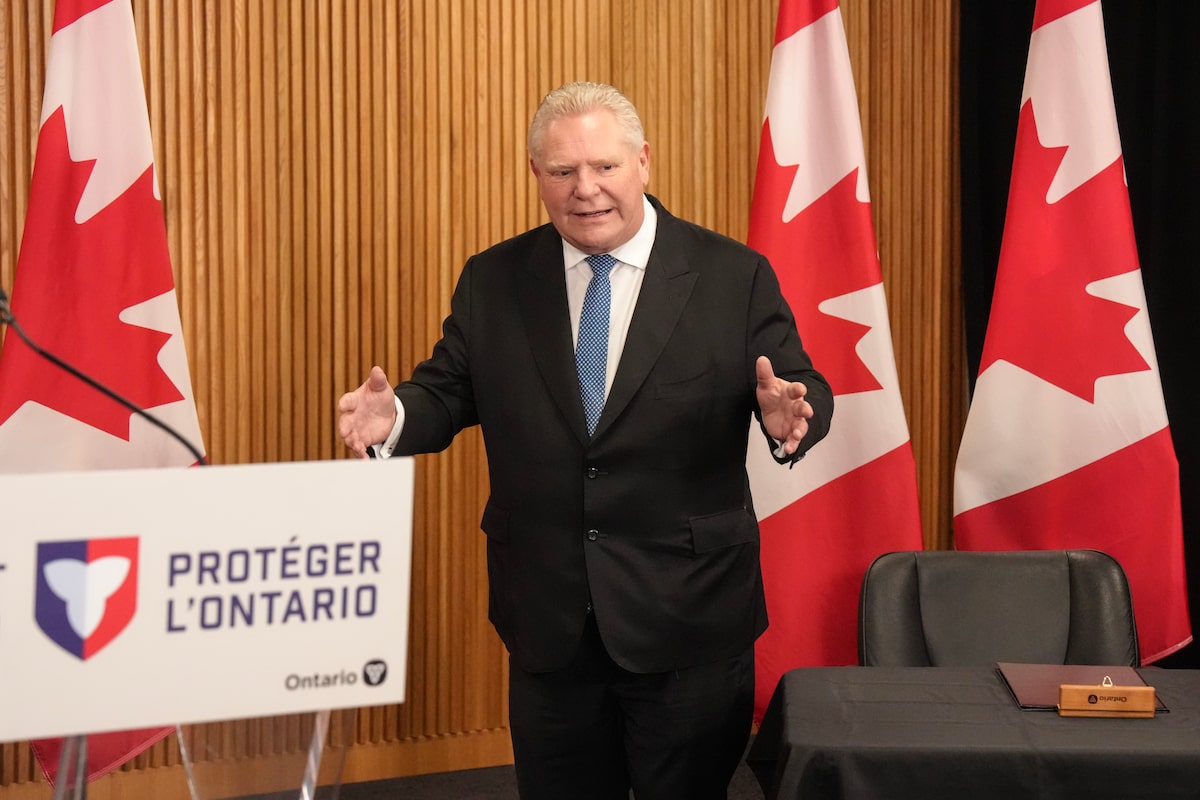
Ontario Premier Doug Ford previously alleged that some students were buying luxury items with OSAP money.Chris Young/The Canadian Press
Ontario undertook more than 900 fraud investigations into its student assistance program last year – although provincial officials declined to say what came of the probes.
Premier Doug Ford has cited the alleged misuse of public funds as part of his reasoning for making changes earlier in February to the Ontario Student Assistance program.
While OSAP was comprised mostly of grants for students, it will now shift predominantly to loans, which must be repaid.
The government says the previous program was financially unsustainable and that the students most in need will still be able to access financial aid, including from individual institutions.
Student groups and opposition parties, however, say it will unfairly affect lower-income students and saddle them with years of debt, and have called on Mr. Ford to reverse his decision.
According to the office of Nolan Quinn, Minister of Colleges, Universities, Research Excellence and Security, the ministry over the past two years has been investigating numerous counts of fraud and misuse of OSAP funds.
In 2025, there were 902 investigations undertaken for “potential student financial assistance misrepresentation/fraud,” up from 862 investigations in 2024.
The ministry says it has a “zero-tolerance policy for fraudulent use of OSAP” and is implementing new technology and exploring other avenues to strengthen the program’s integrity and crack down on fraud.
But Mr. Quinn’s spokeswoman, Bianca Giacoboni, said the office couldn’t provide any information on the outcome of the investigations, including how many were completed and whether any money was recouped.
Last month, Mr. Ford – who said he has received thousands of calls from students about the changes – alleged that some were buying luxury items with OSAP money.
“I’ve heard some nightmare stories on the other side as well, about kids going out there buying fancy watches and cologne and not needing it,” he said on Feb. 17.
How will Ontario’s tuition changes affect you? It depends on your income
He also said students were picking “basket-weaving courses” and should choose in-demand fields such as science and technology, trades and health care to gain employment after graduation. Those comments have triggered backlash from Indigenous artists and craftspeople, who say basket-weaving involves a host of useful skills.
Asked about Mr. Ford’s allegations about some students misusing OSAP funds, Mr. Quinn’s office provided links to TikTok videos as well as posts on X from students claiming to use their OSAP money for goods such as Ray-Ban sunglasses, Christmas gifts or betting on Toronto Blue Jays baseball games.
According to the province’s figures, 473,000 students from across Ontario received OSAP in 2024-25, up from 346,000 students in 2020.
The province spent $1.7-billion on OSAP grants in 2024-25 – compared with $699-million in 2020 – and $301-million on loans, compared with $119-million in 2020.
And in fiscal year 2025-26, OSAP costs ballooned to $2.7-billion, the government said.
Opinion: With Ontario’s student-loan reforms, universities must now fight for their very lives
The changes to OSAP will now be more heavily weighted to loans. A maximum of 25 per cent of a student’s funding will come in the form of grants, according to the government’s new plan, much lower than was previously the case.
Students at private career colleges will also no longer be eligible for OSAP grants.
The government is also lifting its freeze on domestic tuition fees at publicly funded universities and colleges and boosting postsecondary funding by more than $6-billion over four years.
Ontario NDP Leader Marit Stiles called the OSAP changes meanspirited and deeply unpopular. She said if there are individual allegations of misuse, those should be pursued on a case-by-case basis.
“It is not fair to attack all students like this when students and young people are just trying to get by,” she said in an interview.
Kayla Weiler, government relations and policy co-ordinator at the Canadian Federation of Students-Ontario, called Mr. Ford’s allegations a distraction and said many students are considering dropping out of school as a result of the changes.
“Students are really agitated about this, they’re really frustrated and upset,” she said, adding that the group plans on holding a rally at Queen’s Park on March 4.
“For a lot of young people, their parents can’t help them. They’re also struggling to make ends meet and put food on the table.”
Federal Liberal MP Iqra Khalid, who represents Mississauga-Erin Mills, gave a statement in the House of Commons last week lambasting the Ford government for its changes to OSAP.
In an interview, she said the move will predominantly impact low-income communities who are struggling with high food costs and lack of affordable housing.
“Low-income students are being scapegoated, and that’s not fair,” she said.
“Fix the problem, fix the leaks. Don’t completely revamp a whole system that over half-a-million students in Ontario rely on.”
Editor’s note: A previous version of this article incorrectly stated that students at private career colleges will no longer be eligible for OSAP. They will no longer be eligible for OSAP grants.