
“School districts can go ahead and enact policies saying that students must be outed to people in their life, regardless of safety, moving forward,” they told KQED. “Trans youth deserve autonomy, trans youth deserve safety. And if the people who are physically in control of them do not have their best interests or safety in mind, it is up to other adults in that youth’s life to help that youth access better safety. That’s what the California law is doing.”
In a statement, State Sen. Scott Wiener called the decision “dangerous.”
“The issue of forced outing has life or death consequences for far too many LGBTQ kids,” he said via email. “Some will die. Some will get kicked out and become homeless. Some will be sent to conversion therapy.”
Some parents challenging the law have suggested the opposite.
Two parents who signed onto the suit allege that they were not informed that their middle-school-aged child had started to use male pronouns and changed his name at school until he attempted suicide and was hospitalized. Another set of parents said that they confronted school leaders about using their child’s preferred pronouns and name, and were told that state law prevented the school from informing parents without their child’s permission.
“California’s policy of hiding a child’s gender transition from mom and dad was not only unconstitutional, but it was also dangerous. No school should ever place ideology above a child’s well-being or a parent’s God-given authority,” Greg Burt, the vice president of the California Family Council, said in a statement.
In their decision, the Supreme Court majority said parents are likely to succeed in the case, based on arguments that California’s law violates free exercise and due process rights.
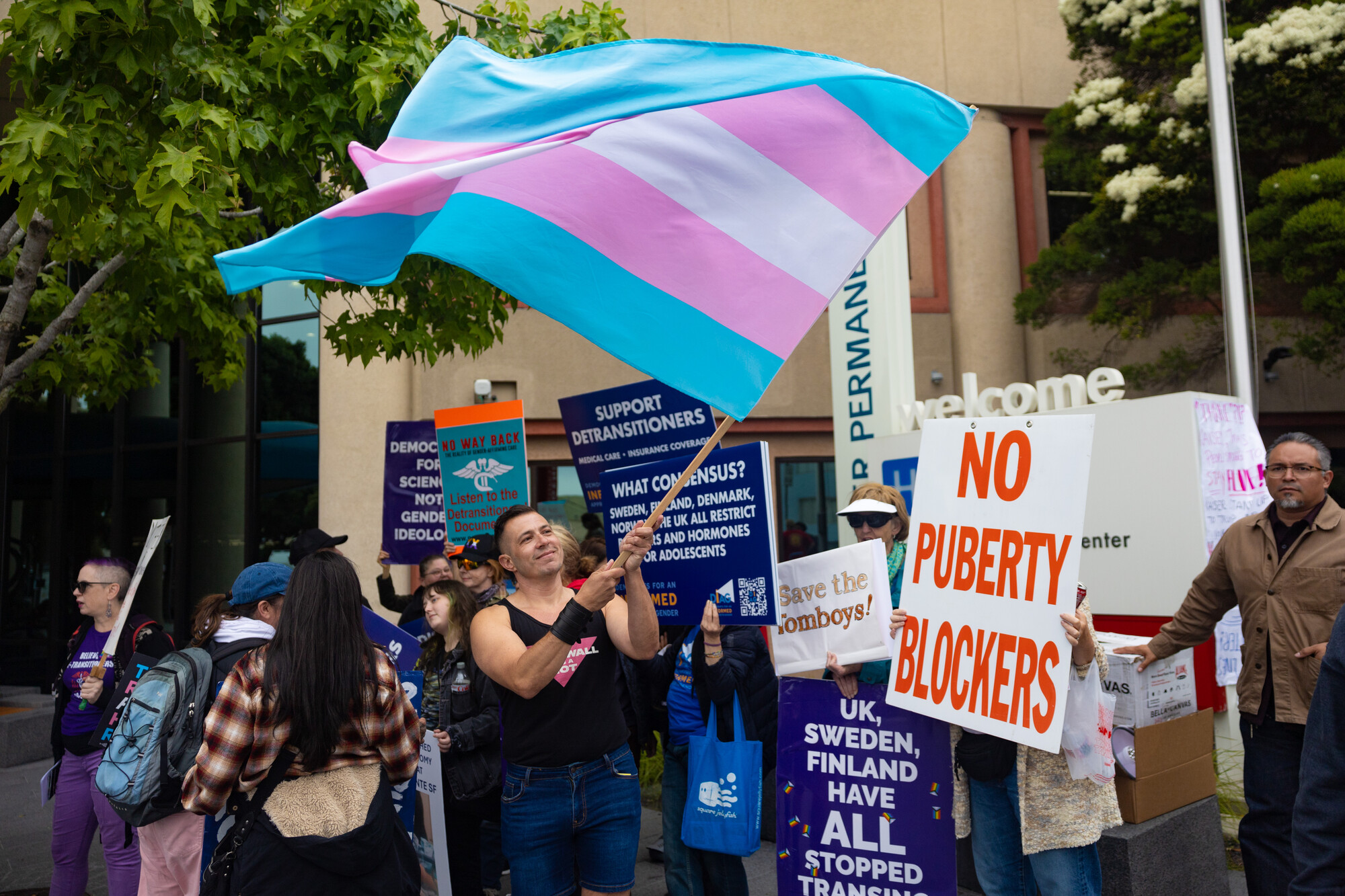 Calder Storm waves a transgender flag at a rally and vigil, honoring transgender patients affected by Kaiser’s decision to halt gender-affirming care to minors, outside of Kaiser Permanente on July 25, 2025. (Gina Castro/KQED)
Parents with religious objections have argued that they have “sincere religious beliefs about sex and gender” and “feel a religious obligation to raise their children in accordance with those beliefs,” according to the court. Other parents say it violates their 14th Amendment right to “have primary authority with respect to ‘the upbringing and education of children.’”
“California’s nondisclosure policy thus quite obviously excludes parents from highly important decisions about their child’s mental health … and is unlikely to satisfy heightened scrutiny. Our resolution of the parents’ likelihood of success on this claim is dictated by existing law,” the decision reads.
Justice Elena Kagan dissented, along with Justice Ketanji Brown Jackson. Kagan cautioned that the court’s decision, before hearing any oral arguments in the case or a full decision by the appellate court, is hasty.
“The Court is impatient: It already knows what it thinks, and insists on getting everything over quickly,” she wrote.
She also criticized the court’s decision to use “shortcut procedures” to vacate the appeals court decision more quickly — pointing to a similar case out of Massachusetts that the Supreme Court is considering hearing.