
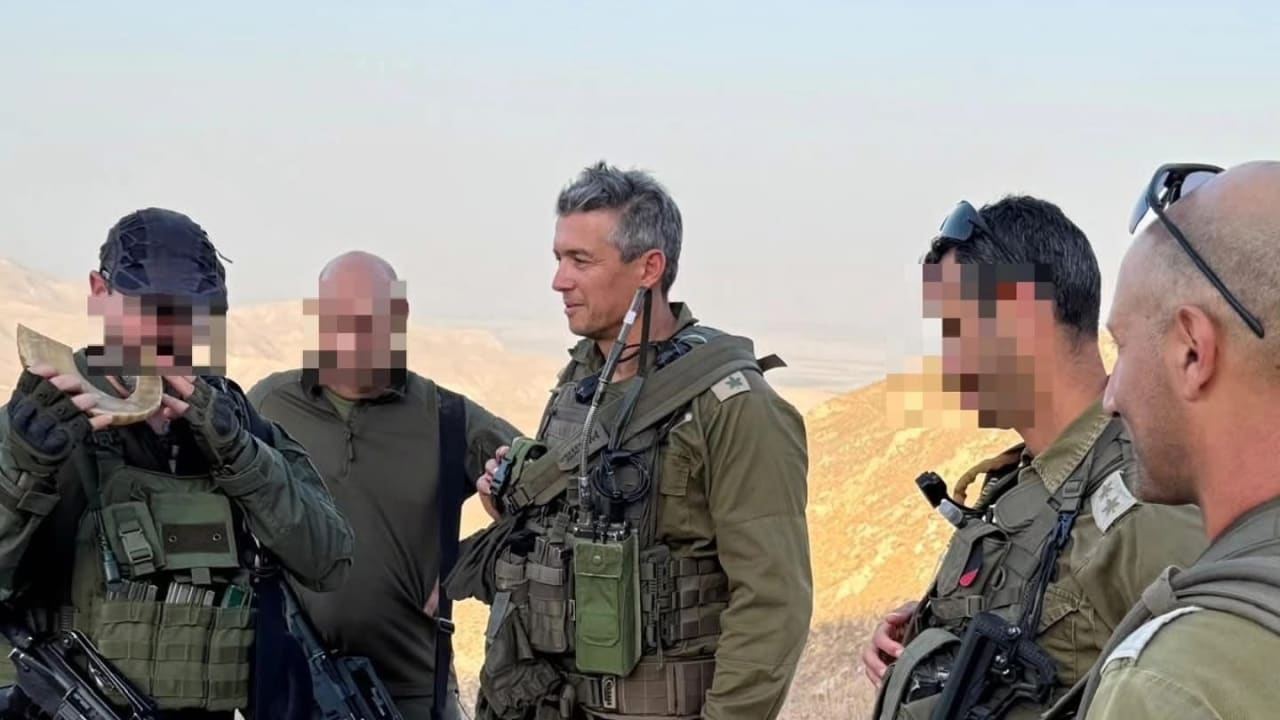
Israel can no longer rely on passive defense along its northern border and must seize the opportunity during Operation Roaring Lion to fully demilitarize Hezbollah and assert military control inside Lebanon, Reservist Party leader and former communications minister Yoaz Hendel told The Jerusalem Post on Tuesday.
Hezbollah joined Iran in the ongoing conflict on Monday, firing toward Israel and leading to Israeli retaliation. This reignited tensions between Lebanon and Israel after the 2024 ceasefire deal between the two countries, which had been kept relatively intact.
“Israel can’t sit passively, we need a proactive strategy,” Hendel told the Post, warning that failing to come up with one could cause the repetition of the mistakes that led to the October 7 Hamas attacks in 2023.
“The great failure happened because we didn’t move the decisive fight into the enemy’s territory.”
Hendel is a battalion commander in the IDF reserves. While serving, he participated in numerous military operations, such as Israel’s war against Hamas and in the Second Lebanon War.

“I think the great hope is that if the broader operation succeeds and the regime in Iran is replaced, there’s a good chance Lebanon will lose its incentive to be a proxy or spear pointed at Israel,” Hendel said about Operation Roaring Lion and military action against Hezbollah.
“Then perhaps Lebanon could become a free state managing reasonable relations with Israel, not necessarily peace, but reasonable relations.”
“Now is an opportunity to stabilize the situation with a control line that includes two empty kilometers of population-free area along our border, complete demilitarization up to the Litani River, and Israeli forces present, possibly through rotating entries and exits, and certainly in high controlling positions,” Hendel said.
Biggest failure from Oct. 7: Not transferring decisive battle to enemy territory
The Reservist Party leader spoke on taking lessons from failures during the October 7 Hamas massacre in 2023 and implementing them amid the escalation with Lebanon to prevent such attacks from recurring in the future.
“The central lesson from October 7, the biggest failure that happened to us, was not transferring the decisive battle to enemy territory. For many years, we relied on passive defense, with an approach – not just rhetoric but actual policy – of containing the enemy.”
Regarding Israel’s last ceasefire agreement with Lebanon in 2024, Hendel said that while the round of fighting ended with an agreement talking about demilitarization in southern Lebanon and without Hezbollah’s presence, “in practice, we gave up almost all our assets.”
“We have only a few forward positions, and they’re very close to Israeli territory,” he said.
He noted that from personal experience in his time serving in Lebanon, when he stood on the hilltops, it was possible to see Hezbollah’s control.
“Add to that the enormous quantity of weapons they stored, in Shi’ite villages right along our border and in underground warehouses, and you understand they had a plan to conquer the Galilee.”
“They could have made us pay a very heavy price,” Hendel remarked.
Israeli residents living on Lebanon’s border will not be evacuated from their homes during Operation Roaring Lion, amid escalating tensions on the Lebanese border.
Hendel told the Post it was good that the government was not evacuating residents from their homes again.
Communities along Israel’s northern border were severely affected in the aftermath of October 7 and throughout the ensuing war. Hundreds of thousands of residents were forced to evacuate their homes during Israel’s last conflict with Hezbollah as the area came under continuous rocket fire. The area has still not recovered from the damage it sustained.
Hendel noted that Israel had already seen the consequences of a massive evacuation in the northern city of Kiryat Shmona.
“I’m glad they [the residents] are staying. That obligates the IDF to go deeper into enemy territory and fight,” Hendel explained.
Hendel’s Reservists Party comprises reserve soldiers, their families, wounded IDF veterans, bereaved families, and civilian volunteers. It positions itself as a response to the leadership vacuum that followed the October 7 attacks and calls for universal conscription. The party registered itself officially in September.
Since the start of the Operation Rising Lion against Iran, party members have stepped aside from the political sphere and returned to reserves.
Hendel told the Post he would also be joining the reserve duty as well this week.
When asked what it is like to run the party while members are in reserves, Hendel explained that “it’s part of the challenge.”
“We were managing a political struggle, and now we’re putting everything aside and mobilizing. We’re determined to win this war, giving full backing to the army and government; afterward, we’ll continue the political debate as citizens.”
While Hendel said balancing serving in reserves and working in the political sphere was hard, he also asserted that, currently, the “most important mission right now is the State of Israel.”
Regarding the war with Iran, Hendel expressed his belief that the world was in the midst of a “tectonic shift in the Middle East.”
“If it [the operation] succeeds, it could bring much greater stability and reduce bloodshed for decades. There’s a historic role here for Israel and the United States in shaping the future,” he said.
“But alongside the opportunity, there’s risk. We can’t assume it will look like previous operations. We must be ready for bigger challenges,” he added.