
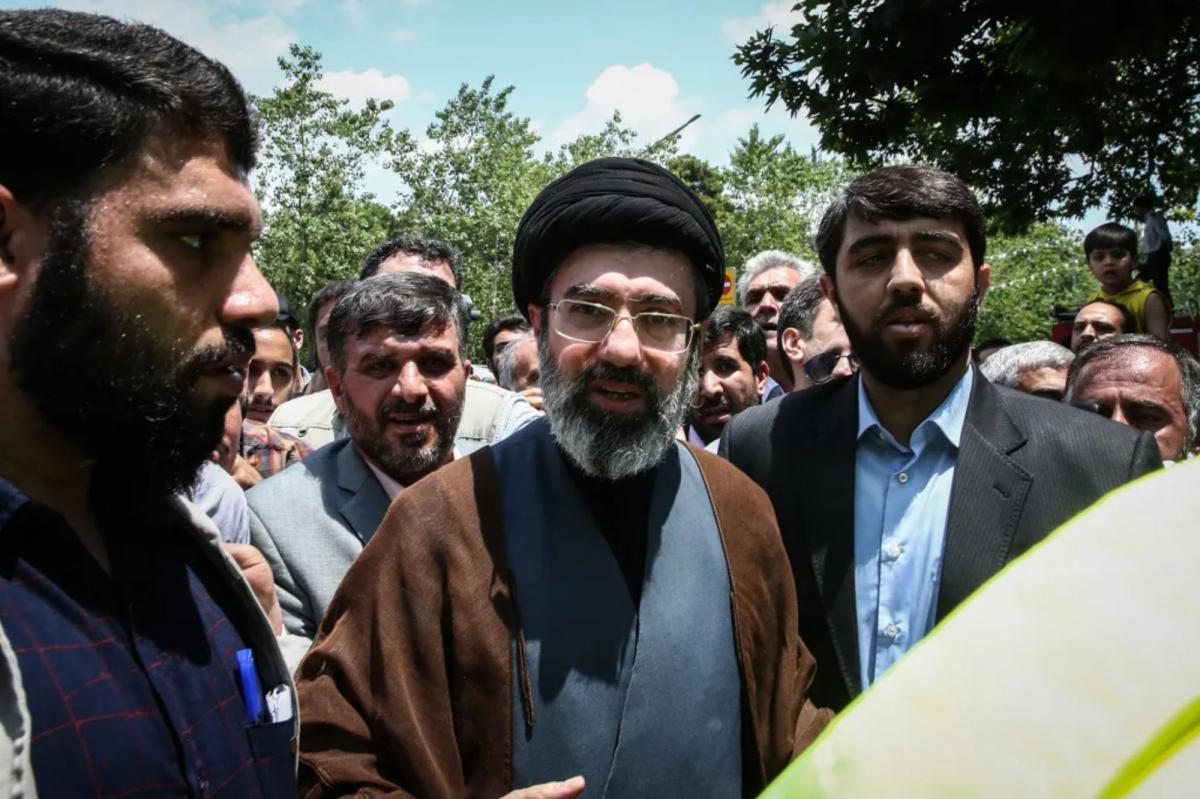
That’s one rocket he won’t be launching.
The son of Iran’s slain Supreme Leader Ali Khamenei, who is reportedly the favorite to succeed his despotic father in power — was treated for “impotency” so severe that he had to be hospitalized numerous times, diplomatic leaks show.
Follow live updates on the US and Israel’s war with Iran
Mojtaba Khamenei, 56, underwent several stints of treatment at the Wellington and Cromwell Hospitals in London after having a hard time conceiving with his wife, US diplomatic cables published by WikiLeaks in the late 2000s showed.
The regime hardliner was reportedly so soft that he checked into the clinics at least four times — including a stay that lasted two months before he was finally able to knock up his wife.
Mojtaba Khamenei (center), son of Iranian Ayatollah Ali Khamenei, was reportedly selected to replace him as supreme leader. picture alliance via Getty Images
“Mojtaba was expected by his family to produce children quickly, but needed a fourth visit to the UK for medical treatment; after a stay of two months, his wife became pregnant,” the diplomatic cable read.
That ordeal also came after Mojtaba went through two “temporary marriages” — allowed under Islamic law so men and women can have non-committal sex in good religious standing — so he could get some practice in the sack.
“His marriage, to the daughter of former Majles Speaker Hadad Adel, followed two ‘temporary marriages’ and occurred relatively late in life, reportedly due to an impotency problem treated and eventually resolved during three extended visits to the UK,” the cable continued, though it remains unclear how many children he ended up siring.
Both his wife and son were reportedly among the 49 people killed alongside his 86-year-old father in a Israeli strike in Tehran on Saturday.
Mojtaba is now poised to take over rule of the country, with numerous reports indicating Iran’s Assembly of Experts — the 88-member council which decides leadership succession — was being pressured by regime hardliners to appoint him to the country’s highest office.
He would bring all his parentage baggage and newfound heartbreak at American hands with him, along with a life of staunch conservatism and accusations of back-room meddling to further his father’s regime.
Iran’s Supreme Leader Ayatollah Ali Khamenei gives his Friday prayer sermon at Tehran University in this video grab from June 19, 2009. REUTERS
If Mojtaba does get picked, he could soon meet the same fate as his father. Israel said Wednesday that the next leader of Iran’s terror apparatus would become an “unequivocal target for elimination.”
A life of privilege and power
Mojtaba was born in 1969 and was 10 years old when the 1979 Islamic Revolution deposed the nation’s monarchy, then joined the notorious Islamic Revolutionary Guards Corps in 1987 after finishing high school, according to New York Times.
He spent about a year serving in the military during Iran’s war with Iraq, then went on to study and teach at an Islamic school for Iran’s clerical elite — experiences that helped ingrain Mojtaba in the nation’s religious and security establishments.
Follow The Post’s coverage of the United States’ airstrikes on Iran:
And it was during that time that his father became supreme leader, and Mojtaba began managing his family’s growing wealth and business interests.
Mojtaba also married Zahra Haddad Adel, whose father was a prominent Iranian conservative politician. That union helped cement Mojtaba’s influence among the nation’s ruling class, which he would wield freely as he began working in the backrooms of government to further his father’s interests.
A master’s son
Mojtaba was being referred to as the “the power behind the robes” in US diplomatic cables by the 2000s, with reports considering him a “plausible candidate for shared leadership of Iran upon his father’s demise” while noting that “regime insiders” felt the same way.
A satellite image shows black smoke rising and heavy damage at Iranian Supreme Leader Ayatollah Ali Khamenei’s compound, following strikes by the United States and Israel against Iran, in Tehran, Iran February 28, 2026. via REUTERS
He’d ingrained himself in his father’s office as prominent wheeler and dealer who was adept at operating out of the public eye, and by 2005 was accused of meddling with the presidential elections to ensure a conservative ally of his father won the office.
The same accusations arose after the 2009 presidential election, with reformist candidate Madhi Karroubi calling Mojtaba a “master’s son” for his alleged conspiracy, according to the Hill.
Everyday Iranians took to the streets to protest the 2009 results, with angry crowds chanting denouncements of his name as they marched. Mojtaba was further accused by reformists of masterminding the violent suppression of those demonstrations, according to the Guardian.
Start your day with all you need to know
Morning Report delivers the latest news, videos, photos and more.
Thanks for signing up!
And by 2019 his position as a powerful and manipulative regime lieutenant was cemented on the international stage when he was sanctioned by the US, which accused him of working to “advance his father’s destabilizing regional ambitions and oppressive domestic objectives.”
A new dynasty
Mojtaba’s appointment as supreme leader would defy fundamental values of the modern Iranian republic — which was founded in 1979 to shake the yoke of a monarchy that had become widely unpopular.
“It undermines the idea ideological nature underpinning the regime. If he’s selected, it’s because of the conditions right now,” Sanam Vakil, a Middle East expert at the Chatham House think tank, told the Financial Times. “People are vying for positions, it’s more open than it looks.”
Iran’s Supreme Leader Ayatollah Ali Khamenei attends an official meeting with Iraq’s Prime Minister Nuri al-Maliki in Tehran September 13, 2006. REUTERS
But others say Mojtaba’s appointment is almost inevitable at this point, with one family member telling the outlet, “it is not yet definite, but his chances are high.”
Mojtaba’s ascension is reportedly being pushed by surviving regime loyalists, and the final decision is expected to be announced next week.
More of the same?
Mojtaba’s appointment could serve as a clear message to the US that Iran had no intention of giving in to its demands, even as bombs continue falling across the country and its military faces increasing obliteration by the day.
Mojtaba’s appointment could serve as a clear message to the US that Iran had no intention of giving in to its demands. NurPhoto via Getty Images
President Trump, however, has expressed optimism that whoever takes control of Iran would deviate from the oppressive policies that led the country to its current predicament — noting that everybody long presumed to be possible successors to Khamenei were “knocked out” in Saturday’s strike.
“It’s not going to be anybody that we were thinking of because they are all dead,” the president told ABC News. “Second or third place is dead.”
But whoever takes over has already been put on notice — with Israeli Defense Minister Israel Katz vowing they would be in the crosshairs if they refused to cease their policy of hostility towards Israel and the west.
“Every leader appointed by the Iranian terror regime to continue and lead the plan to destroy Israel, to threaten the United States and the free world and the countries of the region, and to suppress the Iranian people — will be an unequivocal target for elimination,” Katz wrote on X.
“It does not matter what his name is or the place where he hides.”
With Post wires