
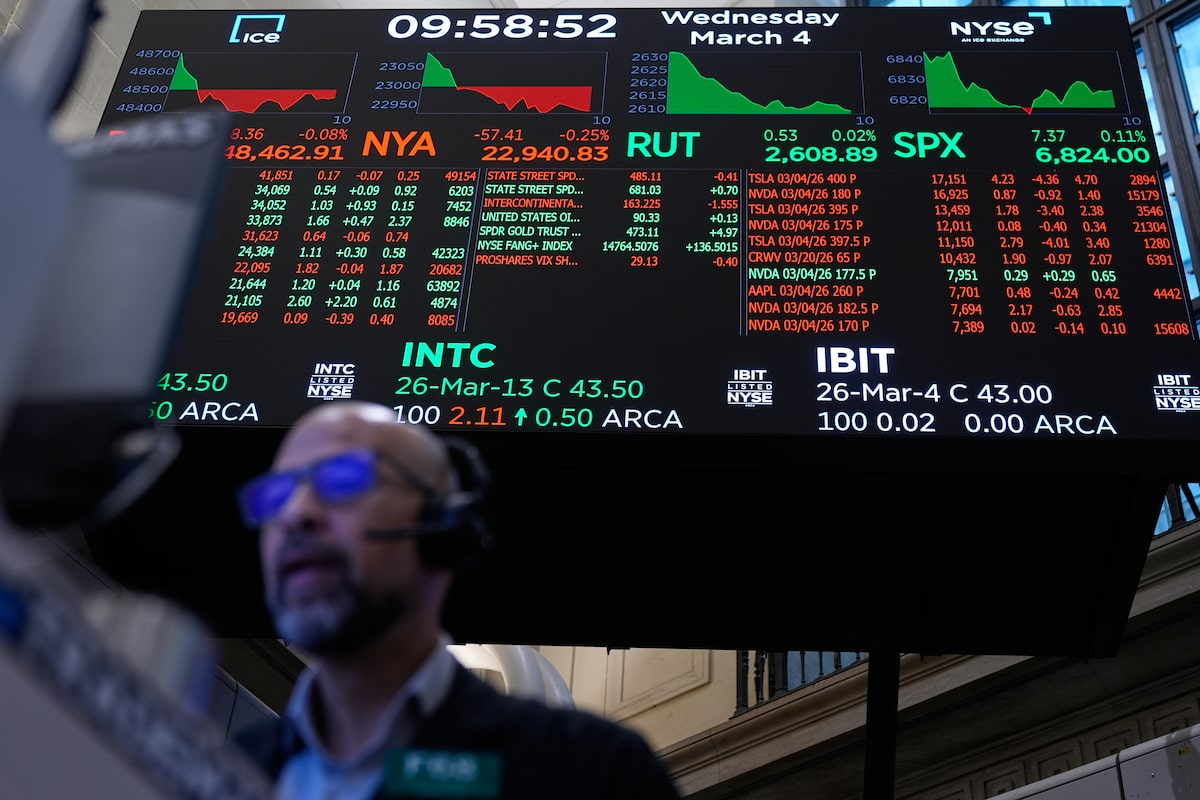
Markets todayU.S. stock index futures edged down as the Middle East conflict entered its sixth day, stoking fears of inflationary pressures that could complicate the Federal Reserve’s monetary policy decisions. Dow E-minis were down 173 points, or 0.35 per cent, S&P 500 E-minis were down 11.25 points, or 0.16 per cent, and Nasdaq 100 E-minis were down 38.5 points, or 0.15 per cent.Oil prices rose, extending a rally as the escalating U.S.-Israeli war with Iran disrupted supplies and shipping, prompting some major producers to cut output and others to take measures to ensure supply security. Brent crude was up US$1.72, or 2.1 per cent, at US$83.12 per barrel, a fifth session of gains. Gold prices gained lifted by safe-haven demand, though a stronger dollar and concerns around the U.S. Federal Reserve’s monetary policy capped gains. Spot gold was up 0.4 per cent at US$5,156.11 per ounce.03/05/26 09:02Canadian dollar weakens, benchmark yield climbs
The Canadian dollar weakened against the greenback on Thursday, and the yield on benchmark government debt climbed.
The loonie was trading 0.1% lower at $1.3648 to the greenback, or 73.27 U.S. cents, after trading in a range of $1.3616 to $1.367.
Canadian government 10-year bond yields rose 4 basis points to 3.326 per cent. The yield on similar U.S. government benchmark debt rose to 4.1402 per cent.
– Reuters
03/05/26 08:41Berkshire Hathaway resumes stock buybacks, CEO Abel says they help create valueOpen this photo in gallery:
Greg Abel, Berkshire Hathaway Vice Chairman and Warren Buffett, Chairman and CEO of Berkshire Hathaway at the CHI Health Center on Friday, May 2, 2025 in Omaha, Neb.Matthew Putney/The Associated Press
Berkshire Hathaway (BRK.B-N, BRK.A-N) said on Thursday it has begun repurchasing its own shares after a nearly two-year hiatus, as Greg Abel begins putting his stamp on the conglomerate after succeeding Warren Buffett as chief executive in January.
The repurchases began on Wednesday and are Berkshire’s first since May 2024. They may also help Berkshire reduce its US$373.3-billion year-end cash stake, which has grown because Berkshire has struggled to find companies and stocks to buy.
Abel also disclosed he bought 21 Class A shares of Berkshire on Wednesday for about US$15-million, representing the after-tax value of his salary, and planned similar purchases in the future. He now owns 249 Class A shares, worth about US$182-million as of Wednesday.
Speaking on CNBC, Abel said the stock repurchases help Berkshire create value for shareholders over the long term.
Berkshire normally discloses repurchases on a quarterly basis, and Abel said the disclosure that they had resumed is a one-time event.
– Reuters
03/05/26 08:36Small caps to watch: Earnings from Maple Leaf Foods, A&W, Spin Master, Savaria and more
– Brenda Bouw
Canada’s S&P/TSX Small Cap Index (TXTW-I) is up by about 80 per cent over the past 52 weeks. It hit a record 1,472.51 on Monday. The Russell 2000 in the U.S. is up about 25 per cent over the past 52 weeks. It hit a record of 2,735.10 on Jan. 22.
Here’s a look at some small-cap stocks making news – or about to:
Maple Leaf Foods Inc. (MFI-T) shares could be active today after the company announced fourth-quarter results that beat expectations. Before markets opened on Thursday, Maple Leaf reported sales of $991-million, up from $917-million for the same period a year earlier. The result was ahead of expectations of $986.8-million, according to S&P Capital IQ.
*
A&W Food Services of Canada Inc. (AW-T) reported fourth-quarter earnings that beat expectations. Before markets opened on Thursday, the burger company reported revenue of $93-million, similar to $93.2-million a year earlier and ahead of expectations of $87.5-million.
*
Spin Master Corp. (TOY-T) reported fourth-quarter results that beat expectations. Before markets opened on Thursday, the company reported revenue of $618.2-million, down 4.8 per cent compared to the same quarter a year earlier. The result was ahead of expectations of $604.3-million.
*
Kits Eyecare Ltd. (KITS-T) reported mixed results for its latest quarter.
After markets closed on Wednesday, the company said revenue increased by 20 per cent to a record $53.9-million in the fourth quarter compared to $44.8-million a year earlier. The result was in line with expectations.
*
03/05/26 07:55U.S. stock futures edge lower as investors weigh Middle East war risks
U.S. stock index futures edged down on Thursday as the Middle East conflict entered its sixth day, raising concerns of fresh inflation pressures that could complicate the Federal Reserve’s monetary policy decisions.
At 7:17 a.m. ET, Dow E-minis were down 173 points, or 0.35 per cent, S&P 500 E-minis were down 11.25 points, or 0.16 per cent, and Nasdaq 100 E-minis were down 38.5 points, or 0.15 per cent.
The CBOE volatility index was marginally higher, reflecting broader investor caution, while futures tied to the rate-sensitive Russell 2000 index were down 0.5 per cent.
Helping limit the losses was a strong forecast from Broadcom that projected its artificial intelligence chip revenue would exceed US$100-billion next year, sending shares of the chip designer up 6.4 per cent in premarket trading.
Despite the U.S.-Israeli air war against Iran showing no signs of cooling off, Wall Street’s main indexes have fared better than their European and Asian counterparts this week, aided primarily by a rebound in technology stocks that bore the brunt of February’s selloff.
The tech-led recovery in the prior session helped the Nasdaq recover all weekly losses, putting it on track to close the week in positive territory if those gains hold through Friday.
– Reuters
03/05/26 07:50CIBC REIT analyst talks subsector valuations and reiterates top picks
– Scott Barlow
CIBC analyst Dean Wilkinson’s monthly REIT report outlines subsector valuation disparities and restates top picks,
“The REIT sector has recovered from a 20-per-cent NAV discount this time last year to well inside a 10-per-cent discount, a figure that on the surface is approaching long-term averages. However, we still make the observation that averages tend to ignore the [distribution curve] tails; the retail REITs are trading near parity, Seniors housing are at a well-warranted premium, while Industrial REITs at just over a 10-per-cent discount represent good value and the apartments are at a historically wide 20-per-cent-plus average discount, Office REITs remain in what can best be described as a state of flux as the push and pull between valuations and deteriorating fundamentals plays out. In short, and with a great degree of oversimplification, that which is working will likely continue to do so for the time being … Re-iterating Our Top Picks: By asset class, we continue favour Seniors Housing (Chartwell and Sienna), followed by Retail (First Capital and Primaris), Multifamily (Killam [Canada) and GO/MHC [U.S.)] and Industrial (Granite).
03/05/26 07:48National Bank examines easing housing affordability crisis
– Scott Barlow
National Bank economist and strategist Daren King updated clients on the easing housing affordability crisis,
“The housing shortage in Canada is mainly the result of an unprecedented demographic shock between 2022 and 2024, a period during which the creation of households far exceeded new construction, significantly worsening housing affordability. Although dramatic, household formation could have been even stronger in recent years, given the increase in population. There is no denying that affordability issues and the difficult labour market, particularly for young people, have slowed household formation in recent years. However, our estimates suggest a pent-up demand of only 77,000 households, which is much less than the 208,000 estimated before Statistics Canada’s recent revision of the number of households actually formed between 2022 and 2025. Despite the potential for this pent-up demand to be released, household formation over the next two years is likely to be the lowest on record due to the slowdown in immigration. The housing deficit that has accumulated since 2022 is significant, but it could gradually be absorbed by the end of the decade, given our population and household projections. However, this assumes that housing starts remaining close to their current level. This is where the main risk lies. The housing market is currently facing a paradoxical situation: moderation in demand is helping to improve affordability in the short term, but it is undermining the profitability of real estate projects and increasing the risk of a decline in supply, which could jeopardize a sustainable rebalancing without targeted public support”
03/05/26 07:35Citi strategist using 2011 Libya intervention as precedent for Iran conflict, warns of unintended consequences
– Scott Barlow
Citi chief U.S. equity strategist Scott Chronert is using the bombing of Libya in 2011 as prologue for the current conflict as he urges clients to prepare for unintended consequences,
“Key observations [from 2011] are: The episode took place early in March of that year but other factors eventually determined the course of equities as time passed. Each of oil prices rising and SPX selling off ahead of the strikes are notable. Interestingly, much as we saw with the strikes on Iran’s nuclear sites last summer, equities rallied into the event while, notably, oil prices continued to rise beyond the intervention itself. Later in the year, equities sold off as the debt ceiling crisis unfolded, along with the U.S. credit downgrade, the European debt crisis, and softer economic indicators driving recession fears. Interestingly, the S&P 500 traded essentially flat for the year, supported by 12-per-cent EPS growth … While we don’t anticipate a 2011 like debt crisis, we do expect that this week’s reprieve from AI disruption may be short lived … Still the important takeaway of this quick note is that we need to be prepared for unintended consequences of the Iran conflict with potential implications to our broader fundamental and equity market views. In this regard, higher-than-expected oil, inflation ramification, and economic headwind on our current soft landing expectation, with negative read through to cyclicals and SMID are one example. Should this put further pressure on the labor condition influenced by AI impacts on white collar jobs then fundamentals do face a headwind”
03/05/26 07:19Scotiabank strategist predicts changes in low volatility and high dividend indexes
– Scott Barlow
Scotiabank strategist Jean-Michel Gauthier attempted to predict changes in S&P’s TSX Low Volatility and High Dividend Indexes,
“OUR TAKE: Neutral. We highlight our final expected changes for the TSX Low Volatility and High Dividend Index for the March rebalance. Both indexes use February 27 as the reference date and March 11 as the pricing date. S&P will announce all official changes on March 13 after the close. Flows shown below are an aggregate of known and predicted flows for S&P and FTSE. TSX Low Volatility: Adds: GEI, CTC/A, BCE, GRT-U, IIP-U, RCI/B, DIR-U, NWC, SAP. Deletes: TIH, EMP/A, LB, CCL/B, IGM, EFN, MTL, KEY, FFH. CCL/B is now a deletion instead of CNR. All other predictions have remained stable. TSX High Dividend: Adds: OTEX, ARX. Deletes: ARE, EIF”
03/05/26 07:13Broadcom rallies as it touts more than $100 billion in AI chip sales in 2027
Broadcom shares (AVGO-Q) jumped about 7 per cent before the bell on Thursday after the company said it expects artificial intelligence chip sales to top US$100-billion in 2027, as it pushes into a market long ruled by Nvidia (NVDA-Q).
Big Tech firms such as Alphabet (GOOGL-Q), Microsoft (MSFT-Q), Amazon (AMZN-Q) and Meta (META-Q) are expected to spend more than US$600-billion to build AI infrastructure this year, boosting demand for chips, servers, storage and networking equipment.
Broadcom expects to deliver 3 gigawatts worth of tensor processing units for AI work to Anthropic in 2027, and plans to ship OpenAI’s first AI chip, delivering over 1 GW, in the same year.
The volumes put Broadcom closer to the scale of recent AI chip deals by Nvidia and AMD.
Investors are, however, questioning whether heavy spending on AI will generate sufficient returns to justify the lofty valuations, leading to sharp declines in the world’s most valuable technology stocks
– Reuters
03/05/26 06:57 Thursday’s analyst upgrades and downgrades
– David Leeder
TD Cowen analyst Brian Morrison is projecting Groupe Dynamite Inc. (GRGD-T) to more than the double its earnings per share year-over-year when it reports its fourth-quarter 2025 results later this month, believing “brand strength/pricing, new store openings/repositioning, and e-commerce growth are driving outsized top line growth, and in turn operating leverage.”
“We forecast this algorithm to continue, that we believe could lead to upside to the consensus Q4/F25 and F2026 outlook,” he added. “This along with strong FCF generation continues to justify its premium valuation.”
Read more: Here
Other companies mentioned include: Arizona Sonoran Copper; Automotive Properties REIT; Athabasca Oil; Baytex Energy; Canadian Packers; Capital Power; Dexterra Group; DRI Healthcare; Evertz Technologies; Gran Tierra Energy; Hudbay Minerals; Kits Eyecare; MDA Space; NexGen Energy; Parex Resources; SSR Mining; Vermilion Energy; VerticalScope
03/05/26 06:44South Korean stocks close up 9.63 per cent, rebounding from worst-ever crashOpen this photo in gallery:
A currency dealer looks at the work report in front of an electronic screen showing South Korea’s benchmark stock index (KOSPI) in a foreign exchange dealing room at the Hana Bank headquarters on March 5.Han Myung-Gu/Getty Images
South Korea’s benchmark KOSPI index closed up 9.63 per cent after surging as much as 12.2 per cent on Thursday, swiftly erasing most of its worst-ever daily drop from a day earlier, buoyed by hopes for progress in U.S.-Iran diplomacy.
The benchmark KOSPI closed up 490.36 points, or 9.63 per cent, at 5,583.90, regaining most of Wednesday’s 12.06-per-cent loss.
Among index heavyweights, chipmaker Samsung Electronics rose 11.27 per cent, while peer SK Hynix gained 10.84 per cent. Battery maker LG Energy Solution climbed 6.91 per cent.
The rebound followed a New York Times report on Wednesday suggesting Iran’s Ministry of Intelligence had signaled a willingness to engage in talks with the U.S. Central Intelligence Agency to seek an end to the war, citing officials briefed on the matter.
The share index climbed to 5,685.47 at the open,
“Oil has somewhat stabilized overnight and there’s definitely more confidence among foreign investors about a potential resolution. The rebound is strong especially for chips,” said Seo Sang-young, an analyst at Mirae Asset Securities Co.
– Reuters
03/05/26 06:08TSX futures muted as Middle East conflict weighs
Futures tracking Canada’s main stock index were muted on Thursday, even as gold and oil prices gained, with investors being cautious amid the rising Middle East conflict.
March futures on the S&P/TSX composite index were down 0.02 per cent, as of 5:34 a.m. ET.
The conflict in the Middle East, which has pressured global markets, entered its sixth day with Israel launching a large wave of strikes on Tehran after Iranian missiles sent millions of Israelis rushing into bomb shelters.
On Wall Street, U.S. S&P 500 e-mini futures and Nasdaq 100 E-minis were flat.
– Reuters
03/05/26 05:30Before the bell: What every Canadian investor needs to know today
– S.R. Slobodian
Wall Street futures were in the red after major North American markets closed higher yesterday.
TSX futures edged lower even as commodity prices climbed.
In Canada, investors are getting results from Canadian Natural Resources Ltd., Maple Leaf Foods Inc., Methanex Corp. and Spin Master Corp.
On Wall Street, markets are watching earnings from Costco Wholesale Corp., Marvell Technology Inc. and Aecon Group Inc.
“Headlines do not point to a near resolution of the Middle East conflict, meaning the risk of further stress remains very much in play,” Ipek Ozkardeskaya, senior analyst at Swissquote, wrote in a note.
03/05/26 05:15Gold prices rise as safe-haven demand grows
Gold prices rose on Thursday, lifted by safe-haven demand amid an escalating war in the Middle East, while a stronger dollar and concerns around the U.S. Federal Reserve’s monetary policy capped gains.
Spot gold was up 0.6 per cent at US$5,168.43 per ounce, as of 3:55 a.m. ET. U.S. gold futures for April delivery were up 0.9 per cent at US$5,179.20.
Israel launched a large wave of strikes on Tehran on Thursday, targeting what it said was infrastructure belonging to the Iranian authorities, after Iranian missiles sent millions of Israelis rushing into bomb shelters.
“On the one hand, there may be greater safe-haven demand for gold given the ongoing conflict in the Middle East. On the other hand, the risk of a prolonged period of higher energy prices that takes rate cuts off the table, and adds to the chance of rate hikes, could be capping further gains,” said Hamad Hussain, a climate and commodities economist at Capital Economics.
The U.S. dollar rose about 0.3 per cent after briefly retreating from three-month highs, as the fallout from the war roiled global markets and kept sentiment fragile. Concerns about energy supply continued to drive up oil prices and stoke inflation fears.
– Reuters
03/05/26 05:10U.S. stock futures slip as oil prices climb higher and Iran launches new attacks
European shares slipped Thursday despite rebounds in Asia and on Wall Street, as Iran launched new attacks and threatened the U.S.
U.S. futures also fell back, with the contract for the Dow Jones Industrial Average losing 0.5 per cent, while that for the S&P 500 shed 0.3 per cent.
Uncertainty about the war in the Middle East has been rattling financial markets, with most taking their cues from what the price of oil is doing.
“Yesterday’s bounce in risk assets already looks less like a turning point and more like a classic relief rally in a market that briefly inhaled before realizing the room was still on fire,” Stephen Innes of SPI Asset Management said in a commentary.
The war brought a fresh wave of attacks by Iran on Israeli and American bases. Iran warned the United States would “bitterly regret” torpedoing an Iranian warship in the Indian Ocean and a religious leader called for “Trump’s blood,” while Israel said it had begun a “large-scale” attack on Tehran.
– The Associated Press
03/05/26 05:07Oil rises on supply concerns as Iran conflict widens
Oil prices rose on Thursday, extending a rally as the escalating U.S.-Israeli war with Iran continued to disrupt supplies, prompting some major producers to cut production and others to take measures to ensure supply security.
Brent crude was up US$2.35, or 2.9 per cent, at US$83.75 per barrel by 3:50 a.m. ET, a fifth session of gains. U.S. West Texas Intermediate crude rose US$2.42, or 3.2 per cent, to US$77.08.
Oil markets are tightening, with the Chinese government telling the largest oil refiners to suspend exports of diesel and gasoline, said PVM analyst John Evans.
Crude oil markets remained on edge as they face ongoing risks to supply following the attacks in the Middle East, with concerns centred on trade flows through the Strait of Hormuz, ANZ analysts said in a note on Thursday.
Around 300 oil tankers remained inside the Strait as vessel traffic in and out of the chokepoint nearly halted following the outbreak of war, according to ship tracking data from Vortexa and Kpler that excludes some of the smallest tankers.
– Reuters
03/05/26 04:30Wednesday markets recap: North American stocks rise after reports Iran is open to talksOpen this photo in gallery:
An aerial view of the strait of Hormuz in 2023. U.S. President Donald Trump said the U.S. would insure oil tankers through the passageway and escort them if necessary.Nicolas Economou/Reuters
North American stocks closed up on Wednesday, after a news report that Iran had signalled openness to talks and a pledge by President Donald Trump to steady oil markets calmed investor anxiety about the Mideast clash.
The S&P/TSX composite index ended up 157.92 points, or 0.5 per cent, at 33,942.86, but held well below the record closing high that was set on Monday.
The Toronto market’s technology sector rose 2.2 per cent, led by a 6 per cent gain for the shares of e-commerce company Shopify Inc.
Both heavily weighted financials and the materials group, which includes metal mining shares, added 0.5 per cent. The price of gold rose 1 per cent as the recent rally in the U.S. dollar paused.
U.S. stocks also closed up after a news report that Iran had signalled openness to talks on ending the war.
The S&P 500 gained 52.83 points, or 0.78 per cent, to end at 6,869.46 points, while the Nasdaq Composite gained 290.79 points, or 1.29 per cent, to 22,807.48. The Dow Jones Industrial Average rose 228.86 points, or 0.49 per cent, to 48,738.98.
U.S. investors flocked again to tech shares, lifting the Nasdaq and keeping the tech-heavy index in positive territory. The S&P 500 remained close to its all-time closing high, reached in January.
Major North American stock indexes fell Tuesday along with bond prices and the price of gold as investors worried that a spiralling war in Iran may be growing into a drawn-out regional conflict with global economic implications.
While markets pared earlier losses after comments from U.S. President Donald Trump that the U.S. would insure oil tankers through the Strait of Hormuz and escort them if necessary, analysts said that investors remained concerned about further escalation of the three-day-old conflict.
“The market is still nervous … risk sentiment will remain very tempered until we get some more concrete signs of de-escalation or negotiation,” George Davis, chief technical strategist, global markets at RBC Capital Markets, said in an e-mailed response to questions.
Canada’s broad TSX/SPX Composite Index fell more than 4 per cent before paring losses to end 2.2 per cent lower at 33,784.94 . It was weighed down by materials companies, with a subindex tracking the sector slumping more than 7 per cent on the day.
The S&P 500 index closed down 0.9 per cent and the tech-heavy Nasdaq index lost 1 per cent.
– Globe staff with wire services