
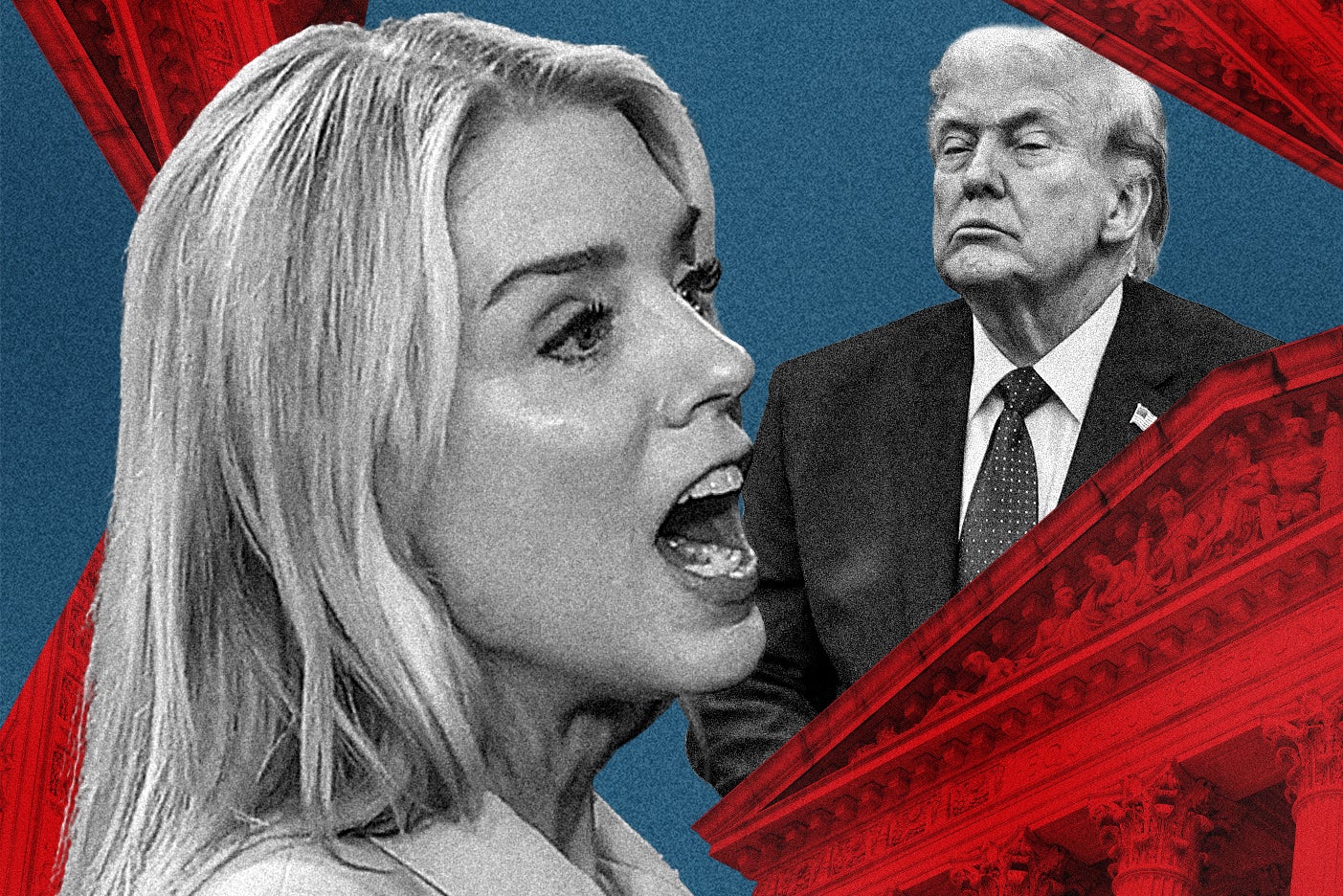
This is Executive Dysfunction, a newsletter that highlights one under-the-radar story about how Trump is changing the law—or how the law is pushing back—and keeps you posted on the latest from Slate’s Jurisprudence team. Click here to receive it in your inbox each week.
From the moment Donald Trump was sworn into office for his second term, he made clear that a major priority of his administration would be pursuing vindictive actions against his perceived enemies. One of the earliest targets of this agenda of retribution: law firms. In his first months in office, Trump signed executive orders that targeted firms that supported DEI, represented the Democratic Party, advocated for liberal causes, or employed prosecutors who had worked on former special counsel Robert Mueller’s investigation into Trump’s 2016 campaign. At least nine other targeted law firms preemptively capitulated, agreeing to provide some $1 billion in pro bono work for causes agreeable to the president. Four decided to push back and sue. Over the course of a year, four separate judges ruled the president’s executive orders were unconstitutional. And this week, for a brief moment, it seemed like the Department of Justice was finally waking up to reality when it moved to dismiss its appeals in these cases.
That lasted less than 24 hours. By Tuesday morning, the Department of Justice submitted a new filing with the U.S. Court of Appeals for the D.C. Circuit asking to withdraw its motion to dismiss, which had been filed one day earlier. “Clown show authoritarianism,” Jameel Jaffer, law professor at Columbia University and inaugural director of the school’s Knight First Amendment Institute, commented.
The battle between Big Law and the Trump administration doesn’t immediately come off as being as existential as, say, the legal challenge over the president’s birthright citizenship executive order. But the attacks on large law firms are pernicious, because alongside satisfying Trump’s vindictiveness, they are also actively preventing people from being able to fight for their constitutional rights. As Trump directs federal agencies to cut off federal funding in crucial areas, target immigrants, and fire public servants, law firms play a vital role litigating against the government to remedy these harms. In Trump’s first term, firms spent countless hours representing people pro bono who were threatened by the administration’s policies; this time around, many have shied away from these fights, in no small part because the president strong-armed them into submission. And this week, as the DOJ walked back its motion to dismiss its appeals against four major law firms, the Trump administration reminded us it will stop at nothing to silence those who dare dissent.
To better understand Trump’s strategy in pursuing Big Law and the fallout it has caused, I spoke with Deborah Pearlstein, director of Princeton University’s Law and Public Policy program. Pearlstein has been sharply critical of law firms’ surrender to Trump, arguing that their capitulation “hastens America’s slide from a system of constitutional democracy” to “a regime of fiat akin to those authoritarian governments our country has long stood against.”
Here’s our conversation, lightly edited and condensed for clarity.
Shirin Ali: The attack on Big Law seems like one element of the Trump administration’s strategy of taking down people and causes it does not like. It leverages executive authority to change laws and regulations as it pleases, while simultaneously attacking the legal pathways for people to challenge said changes.
Deborah Pearlstein: I think that’s exactly right. I think it’s an enormously important point and it’s way too often overlooked. The concern about the attacks on these Big Law firms is not about protecting Big Law as such. Every single one of these firms, the firms that made deals with the administration and the firms that fought back against the administration, made an enormous amount of money last year. They’re doing OK. What’s suffering as a result of these attacks: the ability of ordinary people who were on the receiving end of crackdowns to get good representation to fight back.
I think it’s important to view all of the attacks, including on universities, law firms, NGOs, media companies, as one piece challenging potential threats to the administration’s authority. Similarly, the lesson here is that the institutions that have been willing to fight back have the law on their side and have prevailed, at least in court. The problem has been a shockingly small number of law firms, universities, and media companies have been willing to fight back.
What do you make of the Justice Department walking back its motion to dismiss its appeal of four law firms challenging the president’s executive orders?
It was clear since [earlier this week] that there was some kind of a serious debate inside the Department of Justice, maybe inside the White House, about whether or not to proceed. It is extremely unusual for there to be a leaked report in advance of a Justice Department filing about what the filing is going to be. And you saw that happen hours and hours before there was any kind of filing. The Wall Street Journal reported that they were going to drop the appeal, and yet, it was hours and hours later that anything was actually filed that confirmed that. And only 12 hours or so after that, they changed their mind again.
Whatever their considerations were, there is clearly more than one faction inside the White House and the Department of Justice with a view. My guess would be that the president himself is insistent on pursuing the appeal, and the lawyers in DOJ rightly are advising that it is a losing case. The legality of the original executive orders was challenged by four different law firms in front of four different federal judges, and they all won, handily. That is, it was clear to all of these courts that an executive order targeting a firm because the firm represented clients that the president didn’t like was a violation of, among other things, the First Amendment of the Constitution. I think it is extremely likely that they will lose again on appeal, but in a higher court, so that the ruling doesn’t apply just to the four firms that were targeted, but now is a circuit-wide decision. I think it’s also entirely possible and maybe even likely that they’ll lose at the Supreme Court as well. I suspect there’s a very serious litigation strategy conversation going on there, but, for reasons we’ve seen in lots of cases in this administration, that kind of ordinary strategic thinking doesn’t always prevail.
Would the agreements that DOJ previously negotiated with nine law firms, in exchange for dropping any federal investigations and allowing the firms to retain access to the White House and federal contracts, have been jeopardized if the agency accepted defeat in the ongoing litigation against the four law firms pushing back?
I think there are really two separate legal questions here. The cases challenging the executive orders argued that the orders were unconstitutional and they were held unconstitutional. The question of whether or not these separate deals that these other law firms struck, which nobody has ever seen in writing publicly, are legally enforceable or not is really a separate legal question.
I think the administration was always going to face an enormously uphill struggle in persuading a court that those agreements were enforceable, or indeed that they were agreements at all. And does this help? No, it certainly doesn’t help, but neither did the four decisions in which they lost on the constitutionality of the executive orders.
If the DOJ, and perhaps even the president himself, recognizes that challenging these four law firms’ lawsuits is an uphill battle, why continue the fight?
The president has had a lifelong pattern of pursuing legal cases with or without merit in an effort to either exact revenge or punishment on players he doesn’t like. This seems to me consistent with that approach. You could call that a strategy. I wouldn’t call it a legal strategy. If I were speaking on behalf of my political science colleagues, I would say it is textbook authoritarian playbook for would-be authoritarians to try to attack any independent institutional source of power that might challenge the authoritarian’s ability to carry out his will. The same reason why the White House and the administration wanted to target major universities, media companies, and the same way they have worked to make deals with major industry that they care about. Law firms, for exactly the same reasons, are a potentially independent source of power that can be used to effectively challenge the legality and success of the administration’s actions. I think if viewed as part of that broader strategy, continuing to pursue these cases and attacks against the law firms, especially as the elections approach, this makes perfect sense.
Watching the Trump administration pursue vindication actions is obviously alarming, but what has the fallout been, specifically after Big Law firms were targeted?
There have been enormous repercussions. Let me flag sort of two sets of impacts. One is in just the availability of representation, and particularly well-resourced legal representation to challenge administration initiatives. That availability goes for both pro bono clients and for paid clients. I’ll give you a couple of statistics, as there have been some wonderful investigative reports by Reuters and others that have begun to document these impacts. Dozens of major firms—clearly worried about political retaliation—have scaled back their pro bono work. So, representation from everything like diversity initiatives and immigration cases to all kinds of stuff, there’s been a radical change. Whereas in the last election cycle, we saw large law firms working really actively against various voter suppression efforts and election subversion efforts, now, they are simply not engaged in those cases at all. Last I checked, 29 different cases or efforts by the Trump administration to require states to hand over all of their voting rolls and voter data have all been challenged, but no large law firms are involved in those challenges. The result is that people and organizations, and not just liberal causes, but people whose Social Security benefits have been cut off and scientists whose research funds have been summarily dropped and so forth are trying to turn to small and medium firms looking for somebody to take on their representation, and those firms are overrun. That’s the real-world impact of the chilling effect. Law firms have really dramatically changed their willingness to take on any cause adverse to the administration.

Dahlia Lithwick and Mark Joseph Stern
A New Ruling Forces the Supreme Court to Confront the Trump Administration’s Lies Under Oath
Read More
On the other hand, there’s a much more promising effect that is developing in the profession. Coalitions of groups, including corporate general counsels, law firm partners, an initiative by a bipartisan group of retired federal judges, are coalescing to say, This is not what the legal profession is about and this is not what our ethical obligations require. They are making real efforts to use the power of those coalitions to get firms to change their behavior, working through not only corporate clients that those firms count on for revenue, but also top law students that the firms count on to serve on their staff.
Do you think that, despite facing many losses in court, the Trump administration has still succeeded in chilling dissent and getting people to succumb to the executive branch’s demands?
As He Tries to Rationalize His War in Iran, Trump Cannot Stop Telling On Himself
The Tariffs Ruling Reveals a Growing Rift Between Two Liberal Justices
One of Trump’s Earliest Authoritarian Moves Is Starting to Explode in His Face
Democrats Are Flubbing Their Response to Trump’s Iran War. The Reason Why Is Clear.
It’s important to keep focused on the two separate goals that the administration had. The first goal was trying to punish these firms, exact revenge against them and destroy their businesses, which is what the executive orders were aimed at doing. The lawsuits were essential in disabling that attack, and winning the lawsuits made it clear that those kinds of efforts wouldn’t succeed. The lawsuits were incredibly important in protecting the ability of firms that have fought back in the past to continue to do so. On the other goal, you’re absolutely right. The goal of chilling the willingness of any firm to take on causes adverse to the administration has been achieved, and then some, I would say, based on the reporting and the studies that have been done so far. That’s one of the really important broader lessons in countering authoritarianism. You need a whole toolbox full of tools, and litigation is an incredibly important tool for some purposes, but it doesn’t work for everything. It is entirely possible to win the litigation battle and lose the authoritarian war, and in this particular fight, that’s the direction we’re headed.
Elsewhere in Jurisprudence
In the most recent episode of Amicus, Dahlia Lithwick talks to Donald Verrilli Jr., former solicitor general under the Obama administration, about how lower court judges are being forced to adopt radical new positions on presidential authority, thanks to the Supreme Court. They also interpret Chief Justice John Roberts’ tariffs decision, which finally expresses some skepticism about the president’s chaotic and unprecedented approach to policymaking.
In the Slate Plus bonus episode, Dahlia and Mark Joseph Stern discuss a stunning amicus brief filed by the U.S. Conference of Catholic Bishops in the birthright citizenship case in front of the Supreme Court. A body that has consistently stood by conservative causes, including restrictions on reproductive freedom, same-sex marriage, and transgender rights, has come out in staunch opposition to the president’s birthright citizenship executive order. Not mincing words, the group called the order “immoral” and “contrary to the Catholic Church’s fundamental beliefs and teachings regarding the life and dignity of human persons, the treatment of vulnerable people—particularly migrants and children—and family unity.”
In a special bonus Slate Plus episode, Mark takes a deep dive into the legality of the president’s decision to thrust the United States into war against Iran. In conversation with Eugene Fidell, a visiting lecturer and senior research scholar at Yale Law School, the duo discuss how the president simply does not have the power to singularly declare war. This means that Trump’s conduct here is clearly impeachable, if only the Congress were willing to act.
Dana Bazelon, friend of Slate and fellow at the Quattrone Center at Penn Carey Law School, was front-row at the Supreme Court this week as the justices considered yet another consequential gun rights case. This time it was for United States v. Hemani, a case that is challenging the constitutionality of a federal statute that makes it a crime for an unlawful drug user to possess a gun. And in a rare moment for this court, most of the justices seemed to agree that the current law is far too broad. It’s unclear, though, where the left and right wings of the court want to draw the line.
Thank you for reading Executive Dysfunction! We’re thrilled to be in your feeds and will be back with more dysfunction analysis next week.
We hope you learned a thing or two from this edition of Executive Dysfunction, and if you enjoyed reading it, please consider supporting our legal journalism by becoming a Slate Plus member!
Delivered every Thursday morning.