
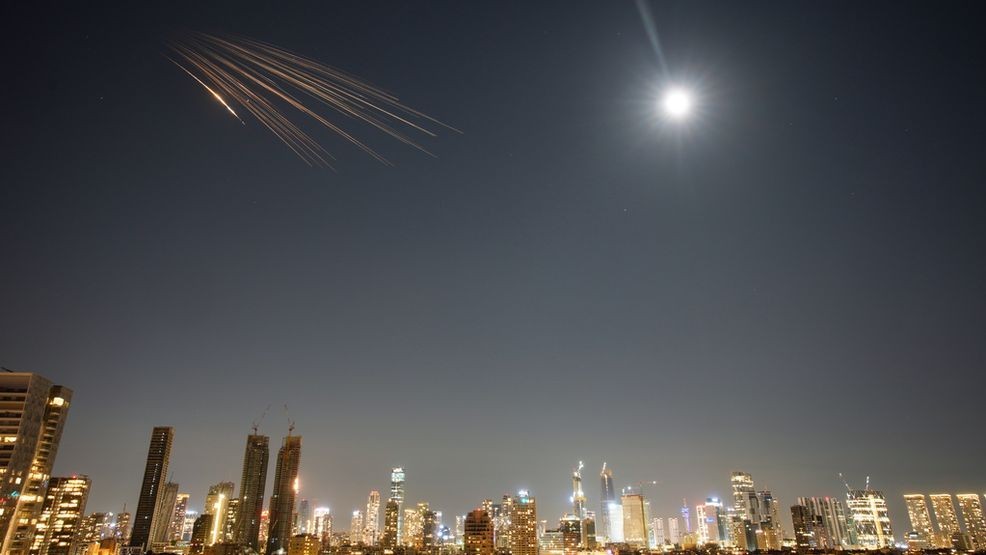
(TNND) — Nearly a week after coordinated U.S.–Israeli strikes on Iran, the conflict continues to intensify across the Middle East.
Overnight, Israeli warplanes targeted Beirut and Tehran, while U.S. forces reportedly struck an Iranian drone carrier at sea. Israeli air forces also reportedly destroyed major Iranian infrastructure targets, including an underground bunker linked to Iranian leadership.
“Some 50 Air Force fighter jets struck this morning, with precise guidance from Military Intelligence and in coordination with Mossad, the underground bunker of former Supreme Leader Ayatollah Ali Khamenei, which was built beneath the leadership compound of the Iranian terror regime in the heart of Tehran,” Israel Defense Forces wrote on X.
The Lebanese health ministry said the death toll has risen to 123 since the resurgence of hostilities between Israel and Hezbollah, which struck Israel in the opening days of the war. Lebanon’s Prime Minister Nawaf Salam slammed both Israel and Hezbollah, saying the Lebanese state and people “did not choose this war.”
Meanwhile, Iran resumed retaliatory strikes against Israel and neighboring Gulf countries — including Kuwait, Qatar, Saudi Arabia and Bahrain — all of which host U.S. forces.
On Iranian state television, Ayatollah Abdollah Javadi Amoli issued a call for violence, urging action against Israel and calling for what he described as “Trump’s blood.”
In Washington, Defense Secretary Pete Hegseth said Thursday that Operation Epic Fury “is advancing decisively,” while President Donald Trump claimed the campaign is “totally demolishing the enemy far ahead of schedule.”
In brief remarks at the White House, Trump urged members of Iran’s Revolutionary Guard, military and police to lay down their arms, warning that “they’re only going to be killed” and saying now is the time to help “take back your country.”
In an interview with Axios, the president said he should be involved in selecting Iran’s next supreme leader after Khamenei was killed in the initial strikes. Trump called the prospect of Khamenei’s son, Mojtaba, taking power “unacceptable,” adding, “We want someone that will bring harmony and peace to Iran.”
Iranian state television reported Friday that a leadership council has begun discussing how to convene the Assembly of Experts, the body responsible for selecting the new supreme leader.
On Capitol Hill, the House voted Thursday to block a war powers resolution aimed at halting Trump’s strikes on Iran. Lawmakers rejected the measure 212–219, marking the second failed attempt in two days after the Senate defeated a similar resolution. The votes underscored deep divisions in Congress over the president’s decision to proceed without a formal declaration of war.
The conflict has also complicated efforts to bring Americans home. Some citizens stranded in the region were able to depart on Thursday after the State Department confirmed charter flights had begun. More than 7,300 Americans have received travel guidance and departure options, with additional flights underway.
Trump said Americans were not warned to leave before the attacks because “it happened all very quickly.”
Beyond the battlefield, the fighting has disrupted oil and gas shipments and complicated commercial traffic through the Strait of Hormuz, a critical route for global energy supplies. Gas prices in the U.S. have remained relatively subdued in recent months but could climb quickly if the war drags on or energy infrastructure is hit.
Analysts estimate that every $10 increase in crude oil adds roughly 25 cents per gallon at the pump — a painful pinch for consumers already grappling with inflation.
_____
Editor’s note: The Associated Press contributed to this article.