
In recent weeks, parents and students from Mashhad, Gorgan, Tehran and other cities across Iran have described schools shifting from educational environments to spaces marked by heightened monitoring and questioning.
A student in the religious city of Mashhad said school officials and affiliated forces had searched students’ mobile phones and, in some cases, searched schoolbags.
After this started, a few of my classmates stopped coming to school, the student added.
 Names against silence: Teachers document student deaths in January crackdown
Similar accounts have emerged from girls’ schools in Gorgan, northern Iran. Several students told Iran International that inspections were accompanied by what they described as an atmosphere of intimidation, leading some families to temporarily withdraw their children from classes.
Rising absenteeism amid safety fears
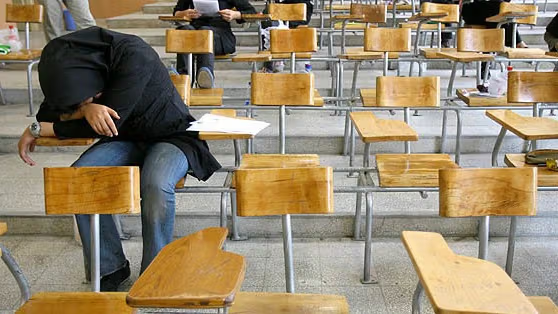
No official figures have been released on attendance rates, but interviews with teachers in Tehran and Alborz province suggest that classroom numbers have dropped in some schools.
“In a class of 25, some days fewer than half are present,” a high school teacher in Tehran said, requesting anonymity due to the sensitivity of the issue. “Parents say they do not consider the situation safe.”
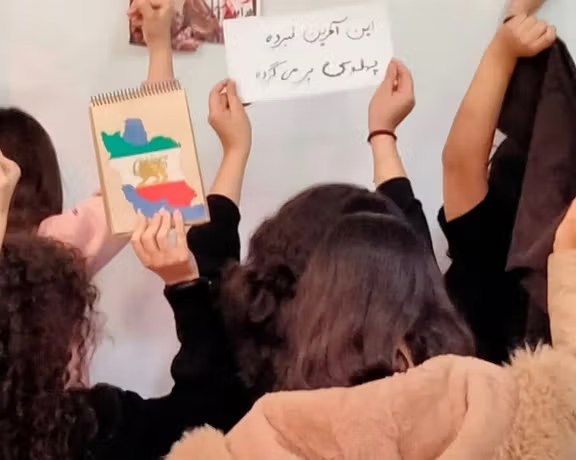 Schoolgirls in Iran raise fists in protest; a handwritten sign reads, “This is the final battle, Pahlavi will return.”
A mother of an eighth-grade student in eastern Tehran said she had allowed her child to stay home for several days. “School should be the safest place for a child,” she said. “When I hear about inspections and questioning, it is natural to hesitate.”
The latest reports follow earlier accounts of security forces and Basij members entering schools in cities including Abadan in the south, Arak and parts of Mazandaran province, north of Iran.
Families previously reported that students were asked to sign written pledges without their parents present. In Bandar Abbas, Malayer and Gorgan, students were questioned about their families and protest-related activities. In Arak and Sari, some educational facilities were said to have been used as bases for security forces.
‘Deep rupture’ between families and schools
Saba Alaleh, a Paris-based clinical psychologist and socio-political psychoanalyst, told Iran International that the developments point to a structural break in trust.
“We are witnessing a profound psychological and social rupture between families and schools,” she said.
“This rupture is not limited to recent events; it is the result of years of accumulated distrust.”
 Rising costs push poor Iranian children out of school, activist warns
Experiences during the Woman, Life, Freedom protests in 2022, when schools were described as spaces of fear and pressure, intensified that mistrust, Alaleh said.
“A school should provide a sense of security. When it becomes associated with surveillance and threat, it transforms into a source of anxiety,” she added.
She warned that exposure to inspections and questioning could have lasting consequences for children. “When students experience constant monitoring, education can lose its meaning,” she argued.
“This can lead to declining motivation, deeper distrust and even identity confusion.”
Healthy psychological development, Alaleh explained, depends on a functional partnership between family and school.
“When that bond collapses, children may find themselves caught between conflicting value systems, complicating their social and identity development,” she added.
Long-term consequences for education
Nahid Husseini, a London-based researcher on women’s affairs and education, said the recent developments reflect a broader crisis within the education system.
“When an educational environment is perceived as unsafe, it is natural for parents to withhold their children,” she told Iran International. “But the result is the deprivation of millions of students from their right to education.”
With Iran’s student population estimated at more than 15 million, Husseini said sustained absenteeism and declining trust in schools could have far-reaching social and economic consequences.
“Schools should be spaces of stability and growth. When they become associated with fear, the cost is borne not only by students but by society as a whole.”
A sanctuary no longer certain
For many families, the issue is no longer limited to temporary absences but to a broader shift in how they view the institution of schooling.
“In the past, even if there were problems, we still believed school was fundamentally safe,” a mother in Tehran said. “Now I feel my child is under pressure there.”
 Iran’s runaway inflation empties tables, pushes children out of school
In the absence of transparent communication about the scope and purpose of security measures inside schools, distrust appears to be widening.
Experts warn that once a school loses its standing as a safe haven, rebuilding that trust may prove far more difficult – with implications that could shape a generation’s relationship with formal education for years to come.