
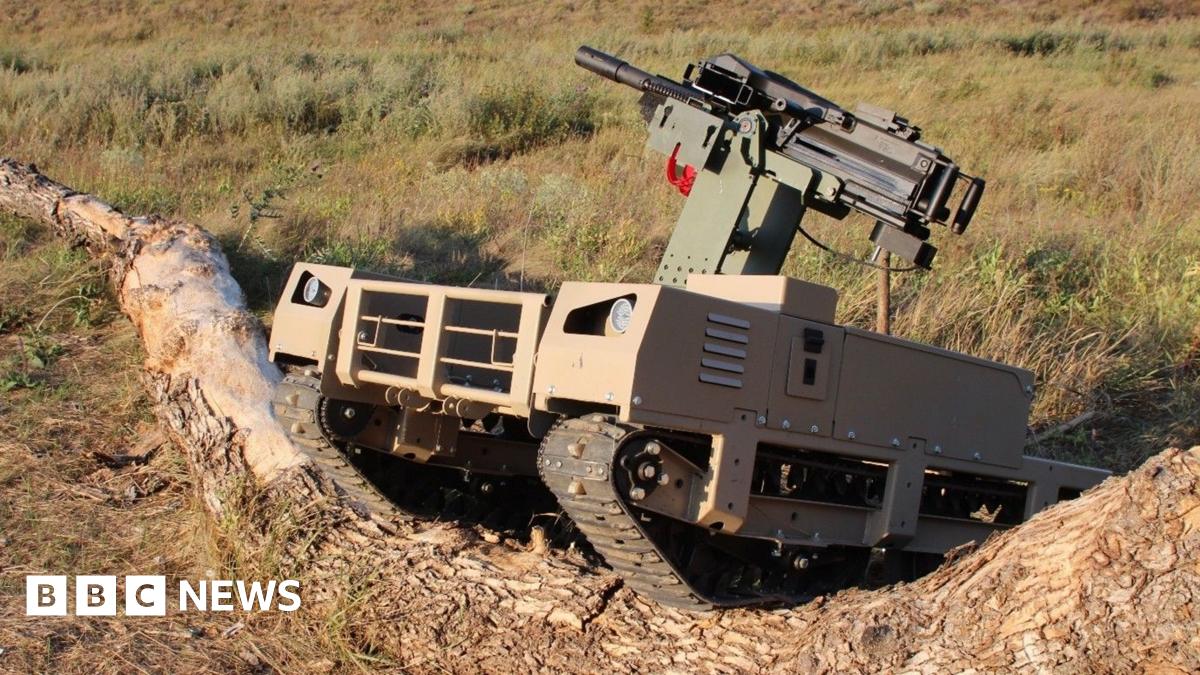
His battalion has also been using explosive-laden, battery-powered kamikaze UGVs to blow up enemy positions and hideouts.
Unlike aerial drones that buzz overhead, they make no sound to warn the enemy of an impending strike.
The deputy commander of the 33rd Detached Mechanised Brigade’s tank battalion, who goes by the callsign Afghan, claims that one Ukrainian UGV armed with a machine gun ambushed a Russian personnel carrier, while a robot defended a Ukrainian position for weeks.
Afghan admits there are limits to the killer robots’ autonomy on the battlefield, and says many of them are self-imposed, because of ethics and international humanitarian law.
“Modern UGVs are part-autonomous. They can move on their own, they can observe and detect the enemy. But still, the decision to open fire is made by a human, their operator,” Afghan says.
“Robots can misidentify the wrong person or attack a civilian. That’s why the final decision must be made by an operator.”
Which means that in most cases on the battlefield armed UGVs are remote-controlled by operators over the internet from a safe distance.
Ukraine’s lethal UGVs can be armed with grenade launchers as well as machine guns, and can also be deployed to plant landmines or barbed wire.
But the vast majority of its uncrewed vehicles are still used for their original purpose of delivering supplies and evacuating the wounded.
The role of armed UGVs will soon grow exponentially, according to Valerii Zaluzhnyi, Ukraine’s former commander-in-chief and now ambassador to the UK.
Speaking at the London think-tank Chatham House about the future of warfare, he described how strike UGVs would be used not just on their own, but as part of large, AI-powered swarms of drones.
“In the near future we’ll see dozens and even hundreds of smarter and cheaper drones attack from various directions and heights, from the air, ground and sea at the same time,” he said.