
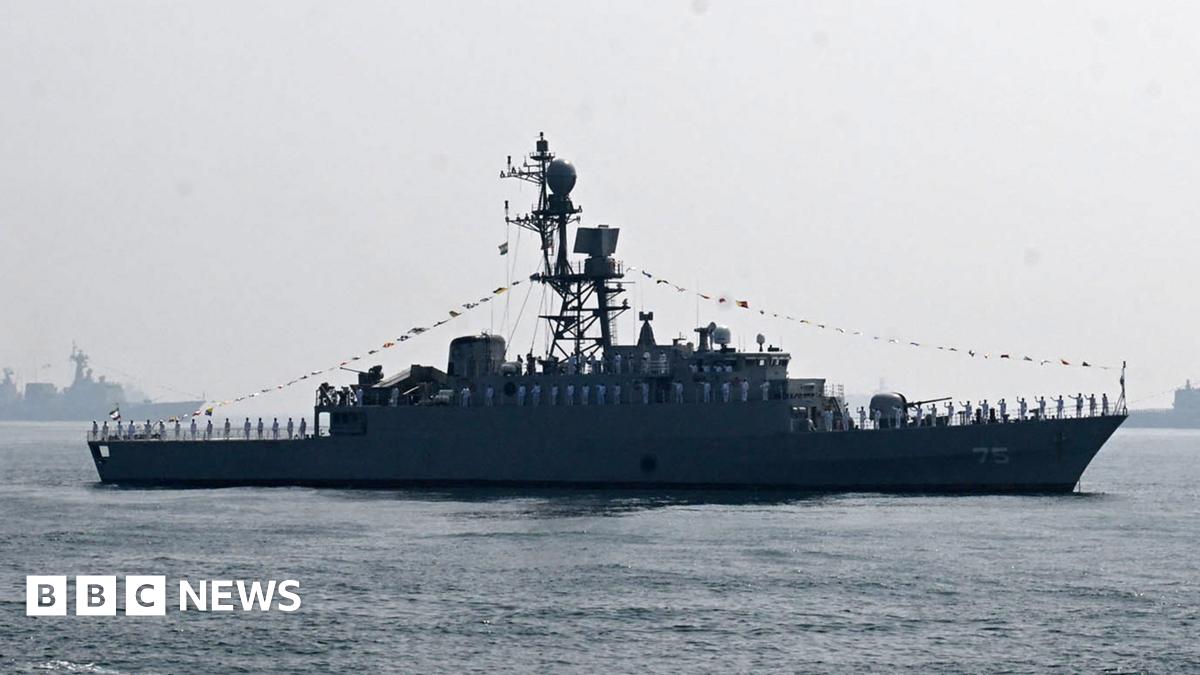
Under the Second Geneva Convention, countries at war are required to take “all possible measures” to rescue wounded or shipwrecked sailors after a naval attack. In practice, however, this duty applies only if a rescue can be attempted without putting the attacking vessel in serious danger.
Singh says submarines are rarely able to help.
“Submarines don’t surface,” he says. “If you surface and give up your position, someone else can sink you.”
Singh suspects the speed of the sinking – and possibly sparse shipping in the area at the time – meant few nearby vessels could respond. “A ship breaking up that fast leaves almost no chance,” he says.
In a shooting war, Singh says, the legal position is blunt.
Fighting between the United States and Iran had been under way since 28 February, with claims that 17 Iranian naval vessels had already been destroyed.
“When a shooting war is on, any ship of a belligerent country becomes fair game,” he says.
Many questions remain. Why was the Iranian warship still in waters near Sri Lanka nearly two weeks after leaving India’s naval exercise? Was it heading home, or on another mission? And how long had the US submarine been tracking it before firing?
For Delhi, the episode is diplomatically awkward.
India has drawn closer to Washington on defence while maintaining long-standing political and economic ties with Tehran – a balancing act the war has made harder.
Indian Prime Minister Narendra Modi has called broadly for “dialogue and diplomacy” to resolve conflicts, but has neither addressed the sinking of the Iranian vessel directly nor criticised the American strike.
Iran’s Foreign Minister Abbas Araghchi described the attack as “an atrocity at sea” and stressed that the frigate had been “a guest of India’s Navy”. Meanwhile Sri Lanka has taken control of another Iranian naval vessel off its coast after an engine failure forced it to seek port, a day after the US attack.
The episode has nonetheless sparked debate within India’s strategic community.
Kanwal Sibal, a veteran diplomat, argued that India’s responsibility may not be legal, but it is moral.