
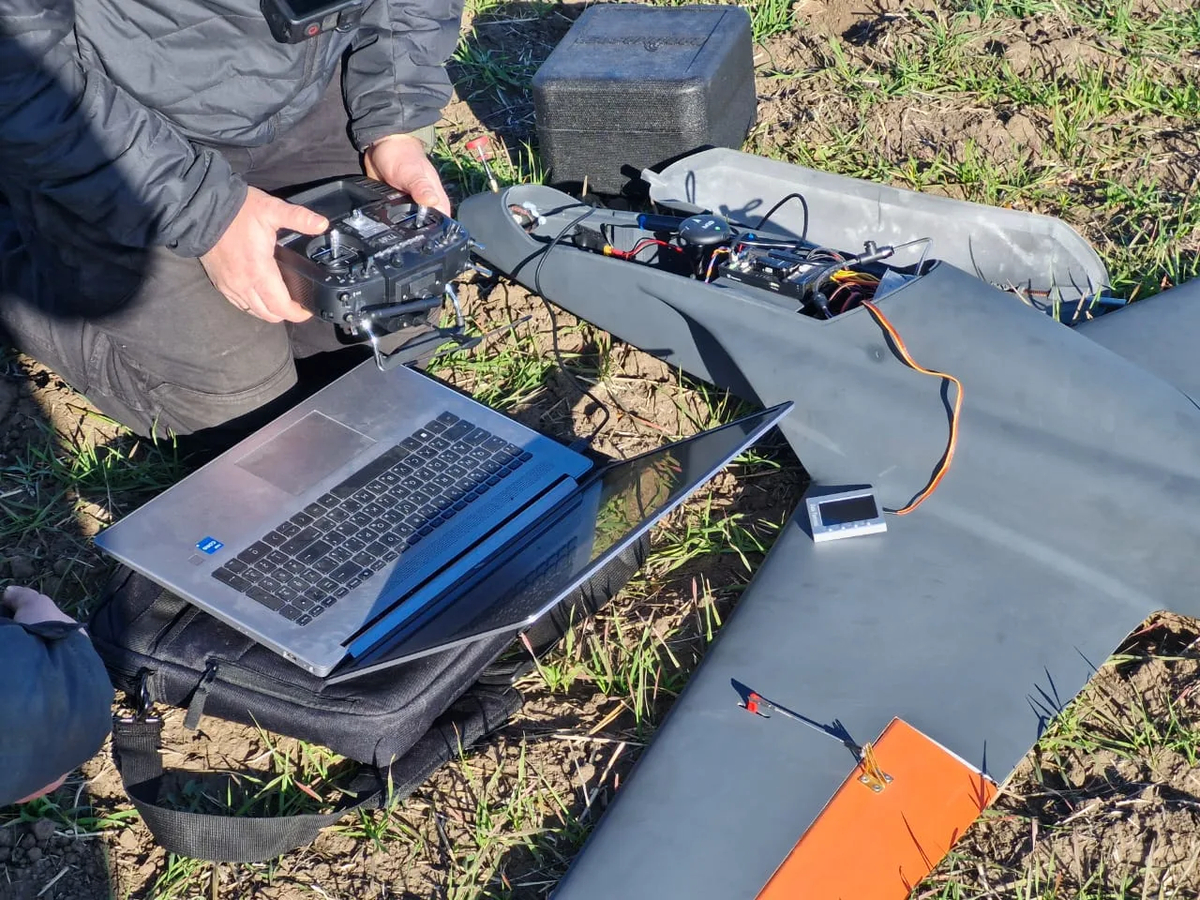
The Odesa-based design bureau “Technari,” which has already developed several products for Ukraine’s Defense Forces, has unveiled its own anti-Shahed drone-interceptor – Mangust (Mongoose) – which was developed with support from the Ministry of Defense’s “Defence Builder Acceleration” Program.
The interceptor is a reusable jet-powered drone that employs an automatic homing system to detect and acquire enemy drones and is fast enough to chase a Shahed until it comes close enough to fire a fragmentation charge from its onboard multi-barreled shotgun to bring it down.
JOIN US ON TELEGRAM
Follow our coverage of the war on the @Kyivpost_official.
Technari CEO Hennady Suldin said his company is not a great fan of “kamikaze” interceptors, saying, “We are rocket engineers, and we would not have entered the [unmanned aerial vehicle] UAV segment at all if we had seen at least one working solution to counter Shaheds.”
Suldin said that almost all kamikaze interceptor drones have a maximum speed of around 250 kph (150 mph), which will soon be outmatched as the Russians are starting to install more powerful propellers and jet engines.
Not only that, but he said that Russia will produce upwards of 200,000 drones a year, meaning that Ukraine will also have to produce the same number of “one-shot” interceptors.
The Mongoose or something similar can carry out multiple missions, and its multi-shot weapon can engage several targets on each launch – meaning fewer will be needed.

Other Topics of Interest
EXPLAINED: How Ukraine Guarantees Its Anti-Graft Independence: 9 Things to Know
To understand Ukraine’s fight against corruption, one has to first understand how the anti-corruption system is designed to function in the first place.
He added that members of Ukraine’s anti-aircraft missile brigades first approached Technari “with a request to create a ‘flying machine’ to shoot down” the Russian attack drones.
The Mongoose’s current jet engine allows it to fly at over 300 kph (190 mph) at a maximum flight altitude of 5,000 meters (16,400 feet), with a combat radius of about 12 kilometers (7.5 miles).
The Mongooses use a thermal detection guidance system designed in-house, which can capture the target at 800 meters (2,600 feet) and is steered by the pilot until, at around 200 meters (650 feet), its auto-guidance system takes over and autonomously completes the interception.
It can then continue to hunt drones until it needs to refuel.
According to the Defender Media website, the drone has already attracted sufficient investment for further development and initial production, but gave no details on whether or when the drone would see service with the Armed Forces of Ukraine (AFU).
Technari says it has produced the equivalent of a squadron’s worth of prototype machines, which will be offered to anti-aircraft missile brigades to trial just in time.
“The deputy commander of one of the brigades calls almost every morning and asks how their ‘plane’ is doing and when we will finally send it,” Suldin said.
While the cost of the interceptor has not been declared, Suldin says that during its lifetime, the Mongoose will be able to complete around a dozen missions, making it more cost-effective than the equivalent number of kamikaze interceptors.