
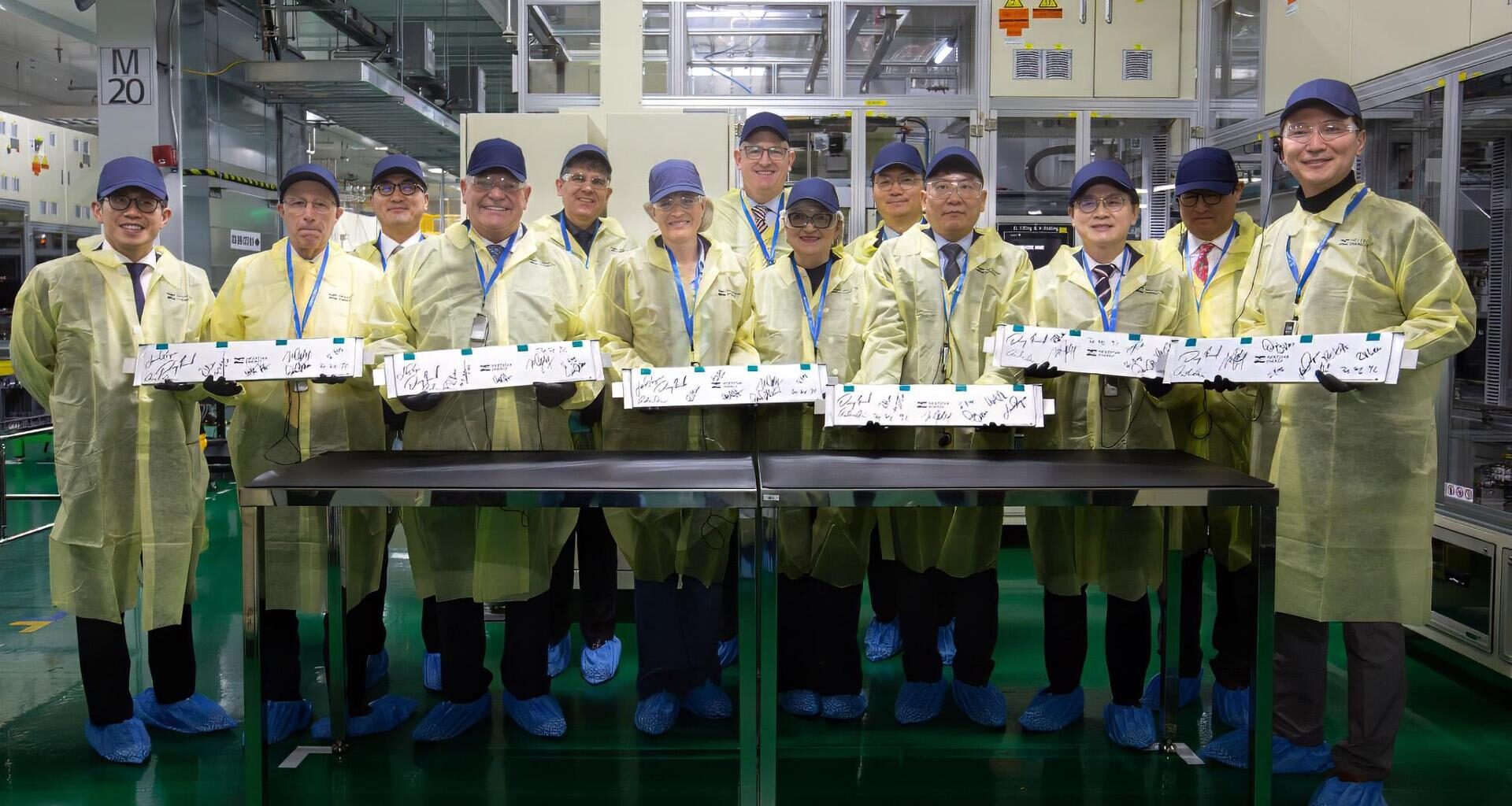
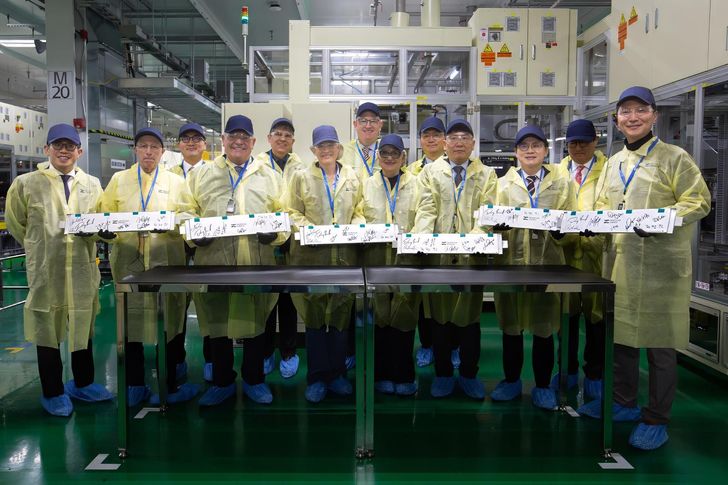
LG Energy Solution (LGES) CEO Kim Dong-myung, fourth from right, displays the company’s battery with Industry Minister Kim Jung-kwan, third from right, and Canadian officials during the grand opening ceremony of NextStar Energy’s plant in Ontario, Canada, Thursday (local time). Courtesy of LGES
LG Energy Solution (LGES) said Friday that NextStar Energy, the Korean battery maker’s Canadian subsidiary, has completed Canada’s first and only commercial-scale battery manufacturing facility, built to produce batteries for electric vehicles and energy storage systems on a 390,000-square-meter site.
During the grand opening ceremony on Thursday (local time), Industry Minister Kim Jung-kwan called the new factory “an important symbol and milestone” of industrial cooperation between Korea and Canada, and asked his Canadian counterpart to continue bilateral collaboration in the submarine sector as well, extending government support for Hanwha Ocean’s bid to win the Royal Canadian Navy’s order for 12 new patrol submarines worth 60 billion Canadian dollars ($43 billion).
At the event, Kim said it was particularly meaningful that the plant was built in Ontario, a province that sent troops to help defend Korea during the 1950-53 Korean War.
“Just as LGES has fulfilled its commitment to investment and employment, let’s build a long-term, trust-based partnership for the future through the submarine project,” he said.
Launched in March 2022 as a joint venture between LGES and Stellantis, NextStar Energy began construction that November and started mass production last November.
Last month, the Korean battery firm announced plans to acquire the carmaker’s stake to make the joint venture a wholly owned subsidiary.
“When LGES decided to become the sole owner of NextStar Energy, we did so with absolute confidence,” LGES CEO Kim Dong-myung said. “As Canada’s first large-scale battery manufacturing facility, NextStar Energy will play a critical role in powering the nation’s next chapter of electrification.”
According to LGES, NextStar Energy has invested more than 5 billion Canadian dollars since its launch in 2022. The facility currently has around 1,300 direct employees and aims to expand the number to 2,500 in the long term.
“This new center of advanced battery manufacturing will accelerate our leadership in next-generation vehicles by powering the cars we build, reinforcing the strength of our energy grids and developing the strategic technologies our partners and allies rely on,” Canada’s Industry Minister Melanie Joly said.
The two industry ministers also met separately to discuss investment plans proposed by Korean companies in exchange for Canada’s potential purchase of Korean-built submarines. Senior executives from Hyundai Motor joined the meeting to outline the carmaker’s plan to invest in Canada’s hydrogen fuel cell infrastructure.
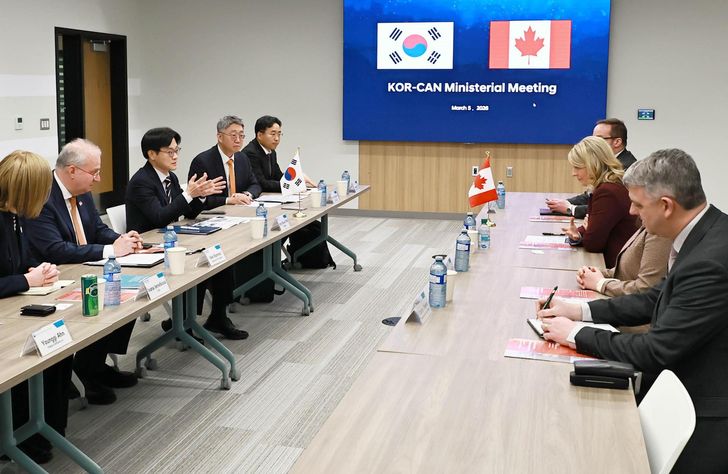
Industry Minister Kim Jung-kwan, third from left, speaks to Canada’s Industry Minister Melanie Joly, third from right, during a meeting in Ontario, Canada, Thursday (local time). Courtesy of Ministry of Trade, Industry and Resources
Ottawa denies split contract
Before departing for Canada, the Korean industry minister told reporters that industrial cooperation with the North American country would not remain the same if the Canadian government splits the submarine contract between Hanwha Ocean and Germany’s TKMS.
On the day of his arrival, however, Canadian officials denied local media reports that Ottawa was considering such a split.
“Right now, as we speak today, we’re looking for a partner. One,” Stephen Fuhr, Canada’s secretary of state for defence procurement, was quoted as saying by The Canadian Press during the Conference of Defence Associations Institute’s annual gathering in Ottawa.
Vice Adm. Angus Topshee, commander of the Royal Canadian Navy, also reportedly said Prime Minister Mark Carney was “pretty clear” last fall that Canada would not split the contract.
However, they did not completely rule out the possibility of deals with two suppliers.
Fuhr reportedly said, “Things can change,” while Topshee added, “Could we do it differently? Sure,” though he agreed it would be more efficient to have a single fleet class.