
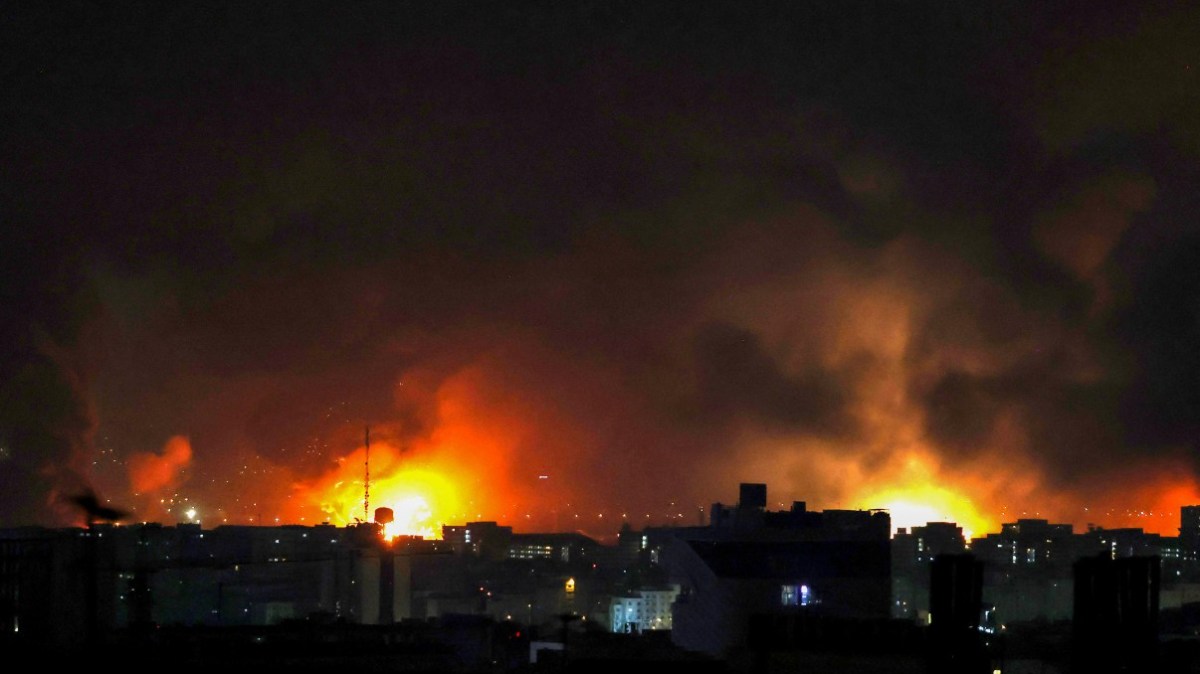
US approves emergency weapons sale to Israel
The US State Department has approved the emergency sale of 12,000 bomb casings to Israel.
The sale, which includes US contract and engineering, logistics and technical support services, has estimated total cost is $151.8 million.
“The proposed sale will improve Israel’s capability to meet current and future threats, strengthen its homeland defense, and serve as a deterrent to regional threats,” the department’s Bureau of Political-Military Affairs said.
The US secretary of state, Marco Rubio, issued a waiver to bypass the needed Congressional approval for US arms sales.
“The secretary of state has determined and provided detailed justification that an emergency exists that requires the immediate sale to the government of Israel of the above defense articles and defense services is in the national security interests of the United States,” the department said.
Iran must ‘exercise wisdom’, Saudi defence minister warns
Saudi Arabia’s defence minister called on Iran to “exercise wisdom and avoid miscalculation” after a series of drone and missile attacks on the kingdom overnight.
Prince Khalid bin Salman said in a post on X that the Iranian attacks “undermine regional security and stability”.
The defence ministry said that a ballistic missile had been intercepted and destroyed as it headed “towards Prince Sultan Air Base” southeast of the capital, Riyadh.
At least 17 drones targeted the Shaybah oil field near the Emirati border but were also intercepted, according to the official Saudi Press Agency.
Dubai airport resumes partial operations
Dubai International Airport has partially resumed operations this morning, less than one hour after announcing they had been suspended over “safety” concerns.
Posting on X, the airport wrote: “We have partially resumed operations from today, 7 March, with some flights operating out of DXB and DWC [Al Maktoum International Airport]
“Please do not travel to the airport unless you have been contacted by your airline that your flight is confirmed, as schedules continue to change.”
Dubai airport suspends operations
Dubai International Airport has suspended operations this morning, citing “safety” concerns, after an evening which saw further Iranian strikes in the region.
Posting on X, the airport said: “For the safety of passengers, airport staff, and airline crew, operations at Dubai International (DXB) have been temporarily suspended. All procedures are being managed in line with established safety protocols.”
The Iranian president, Masoud Pezeshkian, said on Saturday that its temporary leadership council had approved the suspension of attacks against neighbouring countries unless an attack on Iran came from those countries.
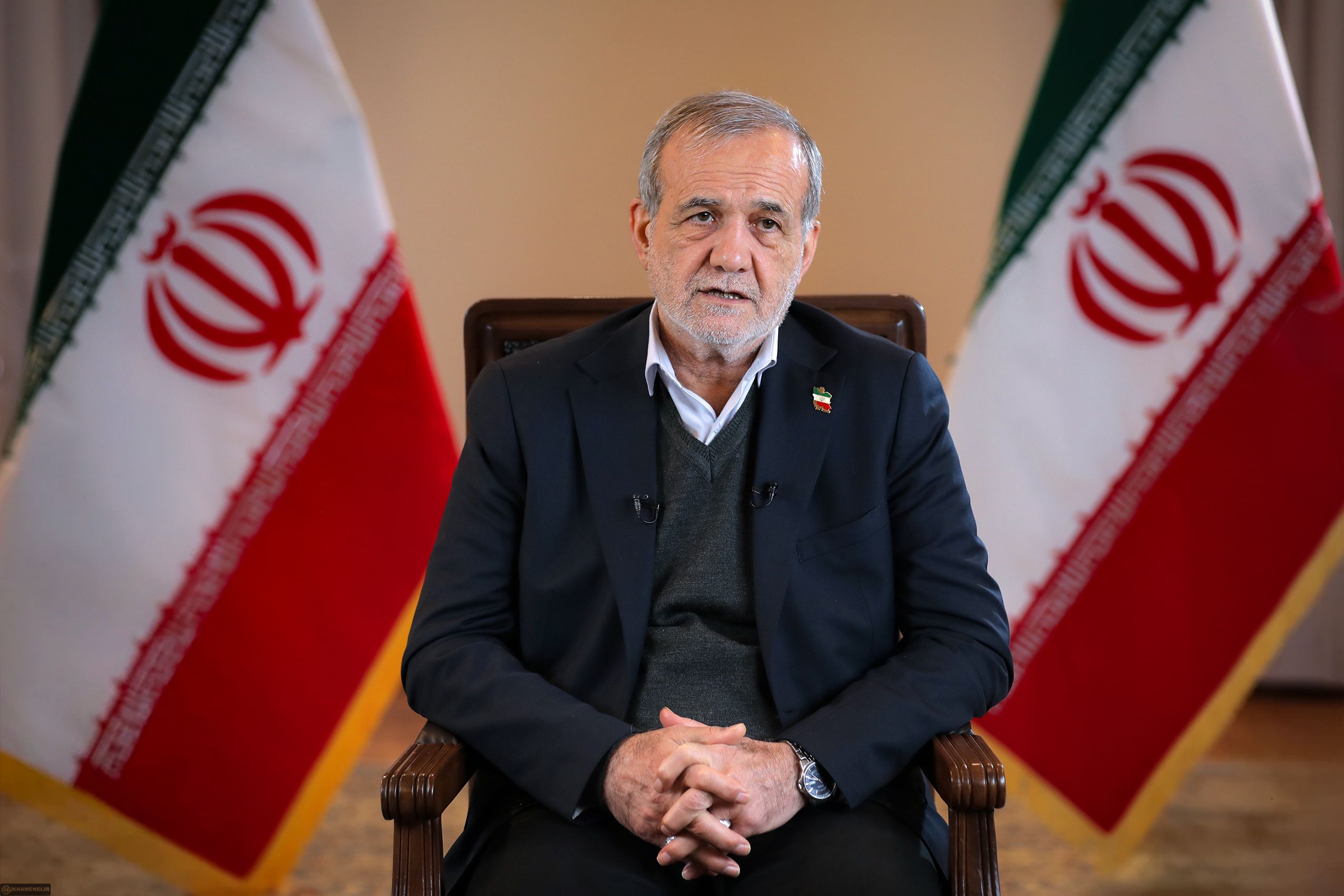
Masoud Pezeshkian
IRANIAN SUPREME LEADER’S OFFICE/ZUMA PRESS/SHUTTERSTOCK
The Iranian president said his country will never surrender to Israel and the US, but apologised to neighbouring countries for launching strikes on them.
Masoud Pezeshkian said in a speech broadcast on state TV on Saturday: “The enemies must take their wish for the surrender of the Iranian people to their graves.”
“I apologise… to the neighbouring countries that were attacked by Iran”, he added. “The interim leadership council agreed yesterday that no more attacks will be made on neighbouring countries and no missiles will be fired unless an attack on Iran originates from those countries.”
Emirates U-turn on Dubai flights suspension
Emirates announced they had suspended all flights to Dubai, only to announce 30 minutes later that their service would resume.
The airline posted on X that all flights to and from Dubai have been suspended until further notice and said “please do not go to the airport”.
But a later statement posted this morning said Emirates had resumed operations, advising that passengers who have confirmed bookings for this afternoon’s flights may proceed to the airport, including customers transiting in Dubai, if their connecting flight is also operating.
It added that customers booked to travel between 28 February until and including 31 March could rebook an alternative flight or request a refund.
Iran ‘suspends attacks against neighbours’
The Iranian president, Masoud Pezeshkian, said on Saturday that its temporary leadership council had approved the suspension of attacks against neighbouring countries unless an attack on Iran came from those countries.
The announcement came after Iran continued to launch attacks in the region in response to US-Israeli strikes on the Islamic Republic. Iranian strikes have hit Bahrain, Saudi Arabia and Dubai.
American bomber lands in Britain
An American bomber landed in Britain as questions linger over the UK’s future role in the American-Israeli conflict with Iran.
The 146ft B-1 Lancer arrived at RAF Fairford in Gloucestershire on Friday evening after Sir Keir Starmer granted permission for “defensive” US action against Iranian missile sites from UK bases.
A second Government charter flight carrying British citizens from Oman also landed at Gatwick Airport at 12.30am on Saturday as efforts to help people trapped in the war zone continue. Around 6,500 Britons have now returned from the United Arab Emirates since widespread conflict began in the region.
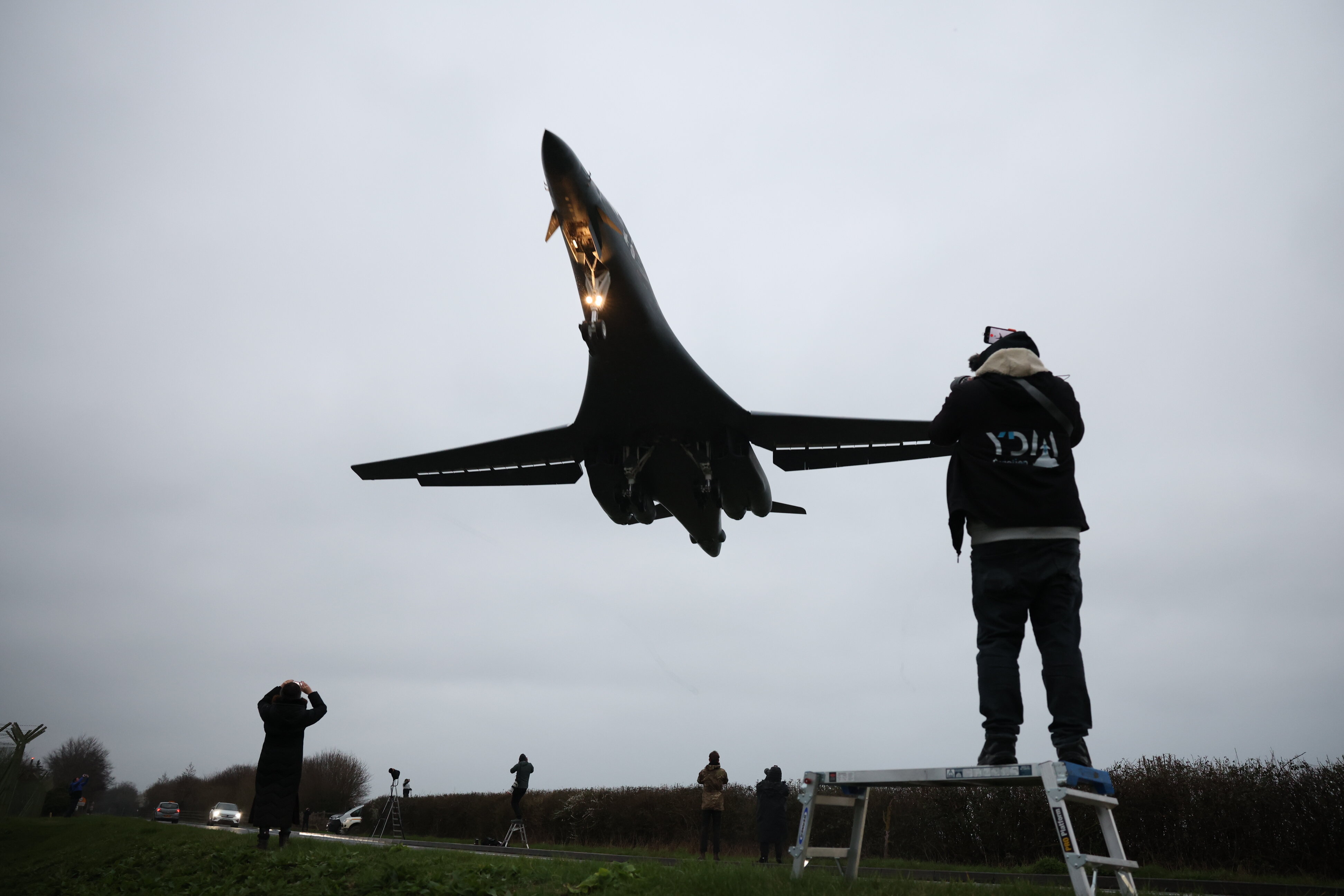
A B1B bomber arrives at RAF Fairford in Gloucestershire
PETER MACDIARMID
Explosions echoed across Iran’s capital, Tehran, on Saturday morning as new airstrikes hit the city.
Reuters reported that explosions had been heard in several parts of the city, amid Israel’s “broad-scale wave of strikes”.
The death toll continued to rise Saturday with at least 1,230 people killed in Iran, more than 200 in Lebanon and around a dozen in Israel, according to officials. Six US troops have been reported killed.
Fire and smoke billow from Tehran’s Mehrabad International Airport
Fire and smoke billowing has been pictured billowing from Tehran’s Mehrabad International Airport after it was hit, during Israel’s “broad-scale wave of strikes” on government sites in the Iranian capital.
Renewed Israeli attacks on Tehran come a day after Israel intensified its air strikes on Lebanon, striking Beirut’s southern suburbs, where the Iran-backed militant group Hezbollah holds sway, and Baalbeck in the east.
Loud booms sound in Jerusalem
Loud booms have sounded in Jerusalem, AP reports, after Iran launched another wave of missiles and drones.
People headed to bomb shelters across Israel early Saturday after hearing loud booms as Iranian missiles attacked more targets.
There were no immediate reports of casualties by Israel’s emergency services.
Six Americans detained in Iran face “unprecedented danger” due to war
Families and supporters of Americans detained in Iran say their loved ones face new dangers during the intensifying war, including the risk of becoming unintended casualties of Israeli and American bombardment or victims of retaliation from Iran’s repressive regime.
“For Americans imprisoned in Iran, this is about as terrifying a moment as it gets,” said Siamak Namazi, an Iranian American who was detained for nearly eight years before being released as part of a deal with the U.S. in 2023. “What these families are facing now is days of war with no clear end in sight.”
The US government would not confirm how many Americans are being held in Iran, but the James W. Foley Legacy Foundation, a hostage advocacy organization, said there are six and that they face “unprecedented danger” because of the military conflict.
Almost 60,000 pilgrims stranded in war travel chaos
The travel chaos from the war in the Middle East has ensnared many of the Muslims who have converged on Saudi Arabia for the Umrah pilgrimage, leaving them stranded and scrambling to find other ways home. Others had to scrap their planned visits altogether.
As of Thursday, more than 58,860 Indonesian pilgrims were stranded in Saudi Arabia, according to Indonesia’s Vice Minister of Hajj and Umrah Dahnil Anzar Simanjuntak.
The government is negotiating with Saudi authorities and airlines to ease the financial burden of hotel and flight costs on the stranded pilgrims, he said. The government also is urging about 60,000 others to postpone their Umrah travel until April for safety reasons, he said.
Which countries were attacked overnight?
Saudi Arabia has said that it intercepted and destroyed 16 drones targeting a large oil field in Shaybah.
Dubai’s media office said there was “a minor incident resulting from the fall of debris after an interception has been successfully contained”.
In eastern Lebanon, Iranian-backed Hezbollah fighters clashed with Israeli forces. Hezbollah said Israel launched airstrikes mid-fighting, although Israel has not addressed the clash.
The Lebanese health ministry said three people were killed and more than a dozen others were injured.
In Bahrain, air raid sirens sounded across the country after an Iranian attack.
Videos also showed explosions in the western part of Tehran, while the IDF said Iran had launched missiles targeting Israel. Israel told its citizens to seek cover.
Drone explodes near hotel in Iraq
A drone exploded near a hotel in Erbil in Iraq’s Kurdistan region hours after the US embassy in Baghdad warned of potential attacks by pro-Iranian militias in the area.
The Kurdistan counter-terrorism service said that drone and at least three others targeting a US military base and the headquarters of an Iranian Kurdish opposition group were shot down, and that no casualties were reported.
“Iran-aligned terrorist militia groups may seek to target hotels frequented by foreigners in the Iraqi Kurdistan Region,” the US embassy had said in a statement hours before the attacks.
“US citizens are strongly encouraged to depart as soon as they are safely able to do so, and reconsider lodging options if choosing not to depart.”
Iran fires more missiles at Israel
The Israeli military said that air defences were responding to an Iranian missile attack on Saturday.
Forces had “identified missiles launched from Iran toward the territory of the State of Israel. Defensive systems are operating to intercept the threat,” the military said in a statement.
Air raid alerts across the country’s north were lifted several minutes later.
Europe could be a ‘legitimate target’
Majid Takht-Ravanchi, Iran’s deputy foreign minister, has said that European countries will be “legitimate targets” if they join attacks against Iran.
“[We] already informed the Europeans and everybody else that they should be careful not to be involved in this war of aggression against Iran,” Takht-Ravanchi told France 24.
“[Any country that] joins America and Israel in the aggression against Iran, they will be also legitimate targets for Iran’s retaliation.”
The minister also said that Iran was striking US-backed Kurdish groups inside Iraq.
“If there is a need to protect our sovereignty, definitely we do it,” he added.
President Trump to pay respects to fallen US troops
President Trump and his wife, Melania, will be travelling to Dover Air Force Base in Delaware to pay their respects to the six US troops who have died in the first week of the US-Iran war.
The dignified transfer, a ritual that involves the transfer of remains of US troops killed on duty, will take place tomorrow.
The caskets of the fallen soldiers, draped with the American flag, will be carried by service members from the aircraft to an awaiting vehicle. The remains are transported to the base’s medical examiner, where they are identified and prepared for their final rest.
US satellite firm delays release of Gulf state images
Planet Labs PBC, a California-based company that produces satellite images, said it is holding back the release of images of Gulf states targeted by Iran.
The company said it would delay the release of images due to its “commitment to responsible data practices and the safety of personnel on the ground.” It did not say if the US government made the request.
“All new imagery collected over the Gulf States and adjacent conflict zones (not including Iran) will be subject to a mandatory 96-hour delay before it is made available in our archive,” Planet said in a statement. “
“This measure is intended to prevent adversarial actors from endangering the safety of allied and Nato-partner personnel and civilians there.”
‘US to blame for strike that killed dozens of schoolgirls’
The US military is to blame for a strike on an Iranian school that killed dozens of girls on Saturday, two US officials told Reuters. Information released by the US and Israeli militaries and an analysis of satellite images by The New York Times and the Associated Press also reached that conclusion.
Iranian officials said that at least 165 people, most of them schoolgirls, died in the attack.
While Israel is thought to have conducted strikes closer to its territory, with no reports of Israeli strikes south of Ishafan, the US is believed to be targeting other regions from its warships in the Arabian Sea, one of which is within range of the Shajareh Tayyebeh Elementary School in the town of Minab, southeast of Tehran.
An official also told the AP that the Pentagon’s investigation into the strike, although not finished, is likely to determine US culpability.
The school was once part of a military base belonging to the Islamic Revolutionary Guards Corps (IRGC), but walls were built to separate it from the base in 2016, and the building was not connected to the base when it was struck. According to satellite photos, strikes hit at least five buildings in the IRGC compound. Experts have said that regardless of its proximity to the compound, the school was a civilian object and an attack to a civilian object is illegal under international law.
“My assumption is that probably there were some activities recently there and they detected and tracked them, but … they weren’t aware or didn’t have an up-to-date database that a girls’ school was there, and they bombed it,” Farzin Nadimi, a senior fellow at the Washington Institute for Near East Policy, told the AP.
Will the US put boots on the ground in Iraq?
The US Army has recently cancelled major training exercises for troops specializing in ground combat, fuelling rumours that the defence department may be preparing for a ground offensive in the Middle East, the Washington Post reported.
More than 4,000 soldiers with the 82nd Airborne Division in North Carolina were told to stay put instead of travelling to Louisiana to join a previously scheduled training element. The 82nd division soldiers are trained in seizing airfield and can deploy within an 18-hour notice.
President Trump on Monday refused to rule out the possibility of deploying US ground troops to Iran, adding that he would make the order “if necessary”. The White House press secretary Karoline Leavitt said on Wednesday that sending ground troops into Iran was “not part of the current plan, but I’m not going to remove an option for the president that is on the table”.
Ali Larijani, the secretary of the Supreme National Security Council of Iran, said in a statement that Iranian troops are “ready to disgrace those corrupt American officials by killing and capturing thousands” if US ground boots are sent. Iran’s foreign minister Abbas Araghchi also told NBC earlier this week that ground offensive would be a “big disaster” for America.
Ben Stiller: War is not a movie
The actor Ben Stiller has condemned the use of footage from a war film he starred in, Tropic Thunder, in clips by the White House about the war in Iran.
Clips from films and video games have been stitched together with war footage. Stiller shared his response above a video from the White House with the caption: “JUSTICE THE AMERICAN WAY.”
He wrote: “Hey White House, please remove the Tropic Thunder clip. We never gave you permission and have no interest in being a part of your propaganda machine. War is not a movie.”
Please enable cookies and other technologies to view this content. You can update your cookies preferences any time using privacy manager.
Enable cookiesAllow cookies onceSocial media clips condemned
Hollywood films such as Star Wars, shoot ’em up video games like Grand Theft Auto and cartoon jokes from Spongebob Squarepants are being used by the White House to promote airstrikes on Iran in clips that millions have viewed online.
The Trump administration has been criticised for supplementing grainy videos of bombs falling on Iran with comic clips from American popular culture.
In one video, the sinking of an Iranian warship by a US submarine, which killed 87 people, was accompanied by footage from Grand Theft Auto showing a gangster walking through the streets based on Los Angeles alongside the caption marking the death of a character: “Wasted”.

Another showed US missiles destroying Iranian lorries, planes and launchers, accompanied by clips from Braveheart, Gladiator and Ironman. “JUSTICE THE AMERICAN WAY,” the White House posted on X.

More than 1,300 people have died in Iran as a result of US and Israeli attacks. The death toll includes 175, many of them children, killed at a girl’s school in Minab. An internal Pentagon investigation has concluded the US was probably responsible.
Chartered flight lands at Gatwick
The second government chartered flight from the Middle East landed at Gatwick Airport at 12.30am on Saturday.
The Titan Airways repatriation flight departed from Muscat International Airport in Oman at 5.33pm before a short layover in Cairo, Egypt, on Friday.
The latest evacuees join 6,500 Britons who have returned from the United Arab Emirates since widespread conflict began in the region seven days ago.
More than 160,000 British nationals have registered their presence in the Middle East with the UK government.
Kurdistan region attacked
Following reports that US-backed Kurdish militants would attempt to cross into Iran, strikes blamed on Tehran have hit the northern Kurdistan region in Iraq.
Meanwhile an oil facility where foreign energy companies operate was targeted in Iraq’s southern port city of Basra, while Baghdad International Airport, which is home to a US diplomatic facility and a military base, “came under a series of attacks,” a security official told AFP.
The official also said “two drones were shot down over the Burjesia oil complex, but a third got through”.
The US Central Command had dismissed reports on Thursday that a US fighter jet was shot down over Basra, calling the rumours “baseless and not true”.
‘War could last four to six weeks’
Karoline Leavitt, the White House press secretary, said on Friday that Operation Epic Fury should be finished within four to six weeks.
But according to a memo seen by Politico, Central Command is asking the Pentagon to send intelligence officers to support operations against Iran for at least 100 days.
The notification also suggested preparations are being made for the campaign to last until September.
We’ve hit 3,000 targets and 43 warships, US claims
Operation Epic Fury has struck more than 3,000 targets and destroyed or damaged 43 Iranian ships, the US Central Command said in its report of the operation’s first week on Friday.
The agency said its focus is to dismantle Tehran’s security apparatus by prioritizing the strike of targets that pose an imminent threat.
Targets include Iran’s control and command centres, the Islamic Revolutionary Guard Corps’ joint and aerospace headquarters, integrated air defence systems, missile sites, Iranian Navy ships and submarines and military communication capabilities.
The commander of Central Forces, Admiral Brad Cooper, and the secretary of war Pete Hegseth, said on Thursday that the US has delivered devastating blows to Iran’s military, cutting back missile attacks “by 90 per cent since day one”.
“In just the last few hours, we hit an Iranian drone carrier ship roughly the size of a World War Two aircraft carrier. And, as we speak, it’s on fire,” Cooper said at a press conference.
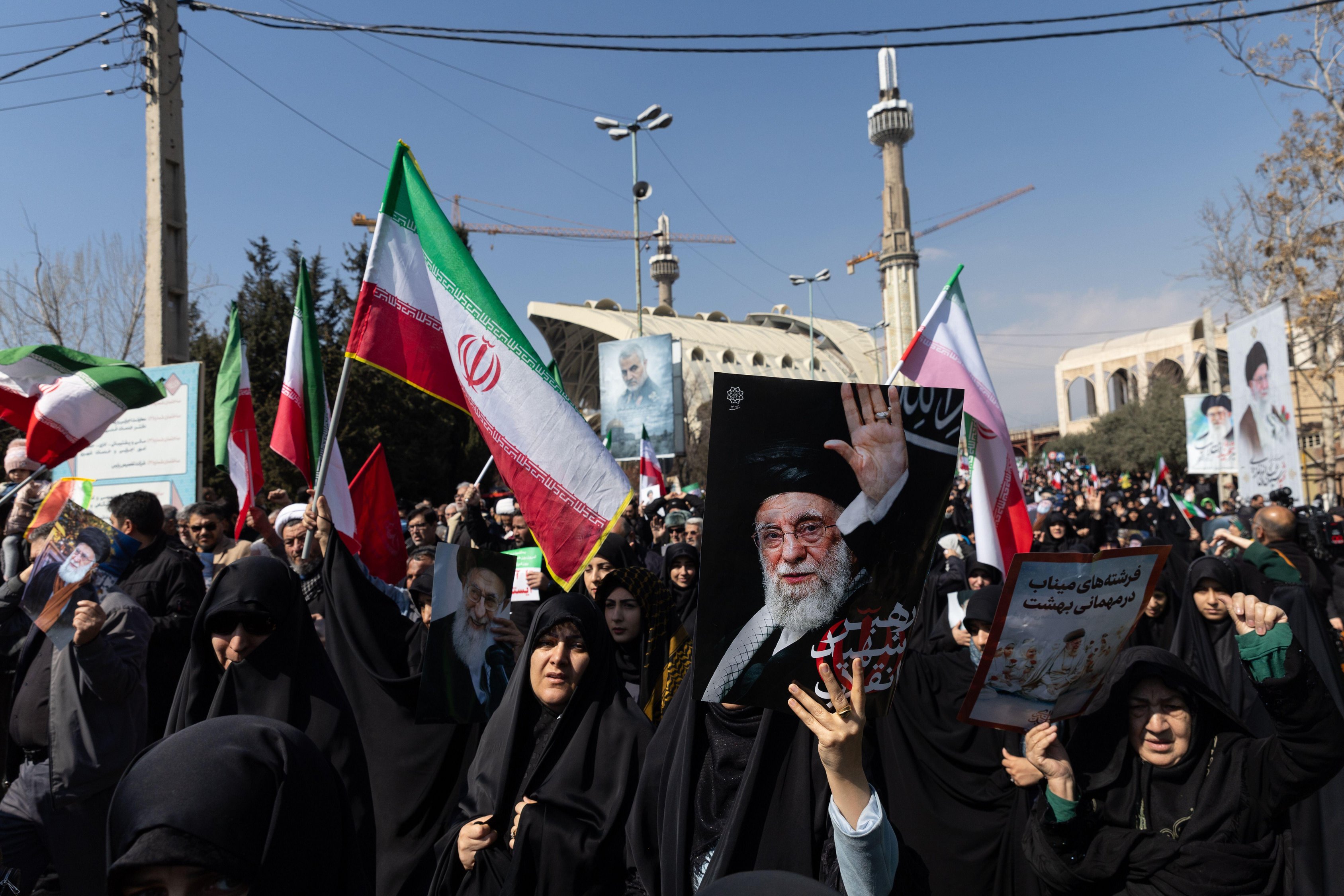
SOBHAN FARAJVAN/PACIFIC PRESS
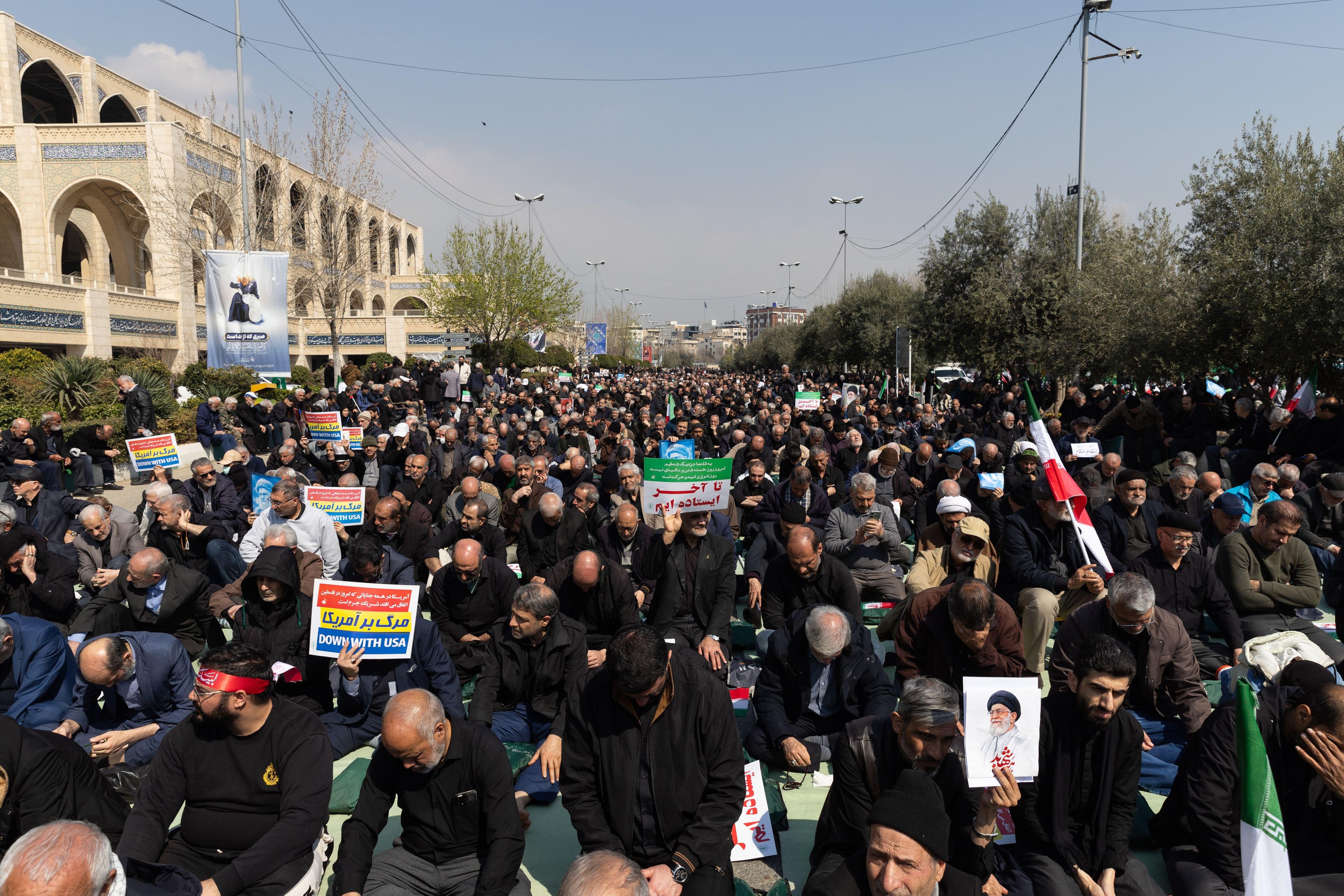
SOBHAN FARAJVAN/PACIFIC PRESS
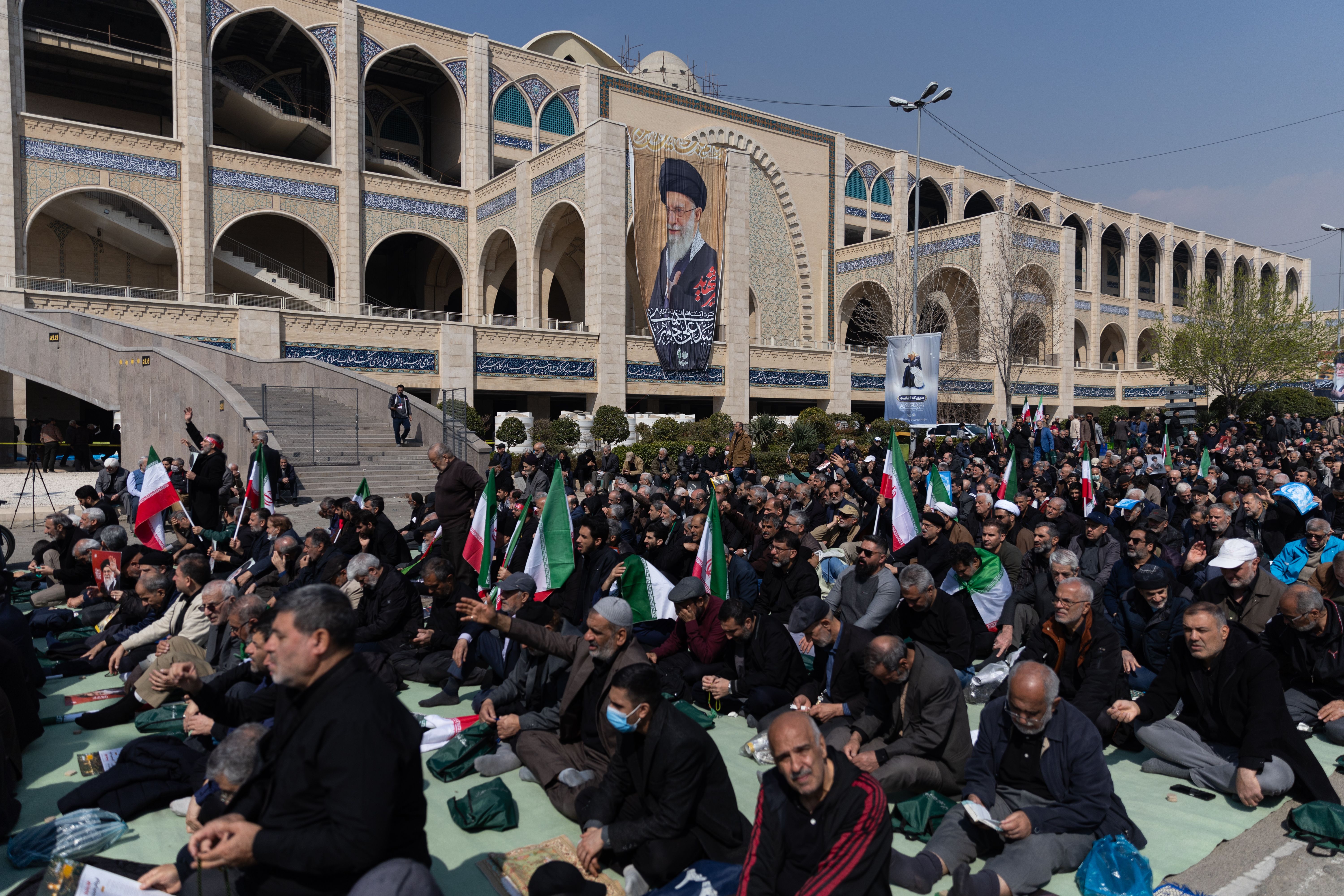
SOBHAN FARAJVAN/PACIFIC PRESS
Israel has come under attack again, with explosions heard around the southern city of Beersheba as well as in Tel Aviv.
The Home Front Command issued an early warning to residents in central Israel alerting them to incoming missile fire from Iran, for a seventh consecutive night.
Several explosions were also heard above Tel Aviv as air defence systems were activated, but there was no immediate reports of damage or casualties.
Shortly before the alerts were raised, Israel said it was launching new “broad-scale” strikes on targets in Tehran.
The Iranian state broadcaster reported an explosion in the western part of the city.
“The IDF has begun a broad-scale wave of strikes” on government targets in the Iranian capital, an Israeli military statement said.
RAF strikes on Iranian sites ‘would be entirely legal’
It would be legal for RAF jets to strike Iranian missile sites which could target Britons, David Lammy said.
The deputy prime minister stressed that the present operations involved British planes shooting down missiles and drones which were already in the sky over allied nations.
But he indicated they could lawfully be used to hit targets within Iran to prevent the launch of attacks. He told BBC Breakfast: “It is entirely legal to protect our people and protect our staff, and therefore all operational capability is available to us in those circumstances.”
Asked if that meant the UK could attack Iranian missile sites from our bases he said: “I’m not here to act as a lawyer, but I think your viewers will understand that in response to being attacked, yes, we can take down sites that are anticipating attacking our people across the region.”
Analysis: UK households face a renewed energy crisis
If the predictions of Qatar’s energy minister come to fruition, it could leave UK household budgets staring down the barrel of a renewed energy crisis, turning an international war into a serious domestic problem (Megan Harwood-Baynes writes).
Britain produces about 45 per cent of the gas it uses, and imports the rest. Our markets are more sensitive to disruption in the Middle East than our European counterparts, in part because we possess little long-term gas storage (holding about 12 days of winter supply compared with Germany’s 89).
With many businesses and households still recovering from an energy crisis triggered by the war in Ukraine, the surge in costs also threatens to trigger a new wave of inflation, which could result in Britons paying more for transport, manufacturing and consumer goods.
Ofgem’s price cap dictates how much energy companies can charge those on variable tariffs, as the price has already been set for April, higher wholesale costs will not be reflected until July.
But prices are already higher than they were before the 2022 crisis began, leaving Britons very little room to absorb any further increases. About 40 fixed-rate energy deals have already disappeared from the market, and while the situation (and wholesale prices) may stabilise over the next few weeks, there could be a rush as customers try to lock in their energy prices by fixing their tariff rates now.
Iran war ‘could bring down world’s economies’
Qatar’s energy minister has warned that war in the Middle East could “bring down the economies of the world”, suggesting that all Gulf energy exporters would shut down production for weeks and drive oil to $150 a barrel.
Saad al-Kaabi said that that even if the war ended immediately it would take Qatar “weeks to months” to restart deliveries of liquid natural gas (LNG) after an Iranian drone strike at its largest plant. Qatar is the world’s second-largest producer of LNG.
He said Europe would feel significant pain as Asian buyers outbid Europeans for whatever gas is available on the market.
“This will bring down the economies of the world,” he told the Financial Times. “If this war continues for a few weeks, GDP growth around the world will be impacted. “Everybody’s energy price is going to go higher. There will be shortages of some products and there will be a chain reaction of factories that cannot supply.”
Trump demands ‘unconditional surrender’
President Trump said on Friday that there will be no deal with Iran “except unconditional surrender”.
“After that, and the selection of a GREAT & ACCEPTABLE Leader(s), we, and many of our wonderful and very brave allies and partners, will work tirelessly to bring Iran back from the brink of destruction, making it economically bigger, better, and stronger than ever before,” he wrote on Truth Social.
“IRAN WILL HAVE A GREAT FUTURE. MAKE IRAN GREAT AGAIN (MIGA!).”
He later elaborated and told Axios: “Unconditional surrender could be that [the Iranians] announce it. But it could also be when they can’t fight any longer because they don’t have anyone or anything to fight with.”
Russia ‘giving Iran intelligence on US targets’
Russia has provided Iran with information that could help it to strike American warships, aircraft and other assets in the region, officials say. US intelligence had not, however, found that Russia was directing Iran on how to use that information.
The White House downplayed the suggestion. Karoline Leavitt, the press secretary, said: “It clearly is not making any difference with respect to the military operations in Iran because we are completely decimating them.”
Leavitt declined to say if President Trump had spoken to President Putin about it or if he believed Russia should face repercussions.
Dmitry Peskov, the Kremlin spokesman, said that Tehran had not asked Russia for military assistance. “We are in dialogue with the Iranian side, with representatives of the Iranian leadership, and will certainly continue this dialogue,” he said.
‘British ministers didn’t do enough’
A former British diplomat who was up until recently working at the UK embassy in Tel Aviv, told Sky news that ministers “didn’t do enough” to prepare for the war in Iran.
Ameer Kotecha said the ambassador based in Tel Aviv, Simon Walters, is well plugged in to to Israeli movements and reported back to London that it was highly likely the US and Israel were going to strike Iran.
“He was following Israeli intentions vis-a-vis Iran for weeks, and it was highly likely that the Israelis and the Americans were going to strike Iran … He was reporting those conversations back to London.”
Asked what action was taken in the UK, Kotecha said: “Officials can do some things, but ultimately ministers need to make the really big judgment calls around, for example, deploying military assets.
“And clearly we didn’t do that.”
“They didn’t do enough,” he said, referring to the decision to increase British military assets in Cyprus and Qatar, but not, for example, to deploy the warship HMS Dragon which will set sail next week.
“Partly it was poor planning on the part of the government but I think yes, if you boil it down what it really comes to is we haven’t invested enough in our military capabilities.”
He said the decision not to deploy a destroyer sooner was “ultimately with the prime minister, the foreign secretary and the attorney general”.
“It’s the politicians that make those really big calls. We could have done a lot more but ministers seem to have either been caught off guard or actively, didn’t want to take those steps.”
A government spokesperson told Sky: “As the prime minister outlined, the UK moved defensive assets to Cyprus and Qatar in January and February including jets, air defense missiles and advanced radar.”