
Unlock the White House Watch newsletter for free
Your guide to what Trump’s second term means for Washington, business and the world
Donald Trump’s administration is considering additional sanctions on Russia’s “shadow fleet” of oil tankers if President Vladimir Putin does not agree to a ceasefire in Ukraine by Friday.
Blacklisting vessels in the fleet would mark the first time the US has imposed sanctions aimed at Moscow since Trump returned to the White House in January.
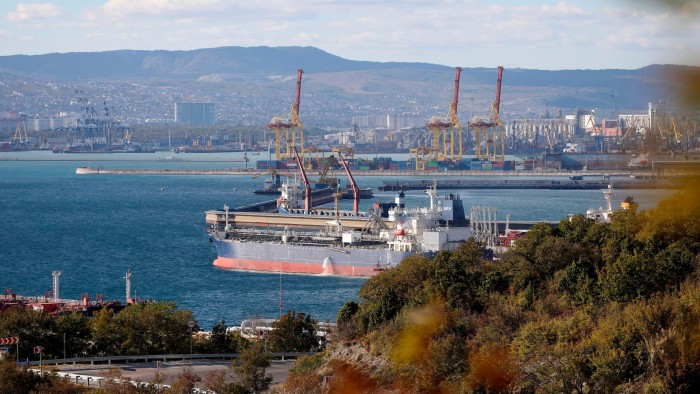
Russia has used a shadow fleet of largely ageing tankers to ship oil around the world in an attempt to evade western restrictions imposed in the wake of Moscow’s 2022 full-scale invasion of Ukraine. Proceeds from these crude exports have helped to finance the conflict.
The term “shadow fleet” refers to vessels whose ownership is hidden and which avoid using services from western companies. Enforcing sanctions against their owners is difficult, although measures targeting the ships themselves have recently proven effective.
Two people familiar with the White House’s deliberations said additional US sanctions on the shadow fleet were seen as an easy first step to impose costs on Russia. A third person close to the administration said it was considering a range of options, including sanctions on the fleet.
Joe Biden’s administration added 213 crude, chemical or product tankers to the sanctions list. Trump has held off imposing further sanctions on Russia in an effort to secure a negotiated settlement to end the war.
But he has grown increasingly frustrated with Putin’s refusal to agree to a ceasefire, and gave the Russian leader an ultimatum to change tack by Friday or face tougher sanctions.
Further US penalties on the fleet would bolster the EU’s recent steps against the fleet, said Kevin Book, managing director of research with ClearView Energy Partners. The bloc sanctioned more than 100 ships last month, bringing the total to 415.
Under the terms of the sanctions regime, western-linked companies are prohibited from buying seaborne oil priced above a G7 price cap fixed at $60 a barrel for crude. The shadow fleet has allowed Russia to ship oil above the cap — mainly to China and India.
In early 2024, Biden administration officials were surprised to realise that listing individual ships — rather than their owners or managers — proved to be effective, with buyers of Russian oil reluctant to deal with vessels that had been named. The EU and UK took up the practice as a result.

A Financial Times analysis of 115 crude tankers sanctioned by the US shows they became much less productive afterwards. Data from Kpler, a cargo analytics platform, reveals the vessels shipped a monthly average of 48mn barrels of Russian crude in the six months prior to their listing, but an average of only 13mn barrels in the six months afterwards.
Benjamin Hilgenstock, head of macroeconomic research and strategy at the Kyiv School of Economics Institute, said: “Aggressively going after the shadow fleet is a straightforward way of making things harder for Russia, and reinforce the message that the EU and UK have been sending.”
The Kremlin has disregarded a number of deadlines set by the US president to agree to a ceasefire and in recent weeks has significantly stepped up its attacks on Ukraine.
Trump has grown increasingly frustrated with his Russian counterpart and people close to the administration said Moscow would pay a price if it did not come to the negotiating table.
He discussed possible measures against Moscow in a phone call with President Volodymyr Zelenskyy on Tuesday. “We talked about sanctions against Russia,” said Ukraine’s leader. “Their economy continues to fall and that is why Moscow is so attentive to this prospect . . . This can change a lot.”
The US president on Monday also announced plans to increase tariffs on India, one of the leading buyers of Russian oil. “They don’t care how many people in Ukraine are being killed by the Russian war machine,” the president said in a post on social media.
Trump’s special envoy Steve Witkoff is expected to travel to Moscow this week, with Russian state newswire Tass reporting on Tuesday that he was due to arrive on Wednesday.
Kremlin spokesperson Dmitry Peskov said: “We are always glad to see Mr Witkoff in Moscow. We view such contacts as important, substantive and very useful.”
Trump will probably decide on what potential costs to impose on Moscow when his envoy returns, said the person close to the administration.
“It depends on what Witkoff brings back,” the person said. “If Witkoff comes back empty-handed, with absolutely nothing, Trump is going to go ballistic.”
Anna Kelly, White House deputy press secretary, said: “The president has been clear that there will be biting sanctions if Putin does not agree to end the war. We will not get ahead of the president on specifics.”
Other options for the administration include more stringent enforcement of existing sanctions, or joining the EU’s new dynamic floating price cap on Russian oil which is set to take effect in early September, experts said.
Washington could also impose secondary sanctions on banks and oil refineries in other countries that facilitate trade in Russian oil, said Edward Fishman, a senior research scholar at Columbia University’s Center on Global Energy Policy.
“There’s incredible latitude right now to actually impose hard-hitting oil sanctions on Russia,” he added.
A bill put forward by Senators Lindsey Graham and Richard Blumenthal calling for tariffs of upwards of 500 per cent on countries that continue to buy Russian energy products has also gained widespread bipartisan support among lawmakers on Capitol Hill.
Trump has said he is “very strongly” considering supporting the bill, although analysts have questioned whether such steep tariffs could be sustainably enforced.
Additional reporting by Courtney Weaver in Berlin and Christopher Miller in New York