
Every big story in this country has fingerprints on it. You learn that fast. You also learn something else: Even when you walk into an interview convinced that you understand the personal layers, you still get surprised by how personal it is once the door closes and the conversation starts.
That was the feeling I got sitting across from Mikhael Mirilashvili, a man who does not chase microphones and does not need them for business yet somehow keeps ending up in the middle of Israel’s loudest arguments.
He agreed to speak in a mix of Hebrew and Russian, with translation layered in where it mattered. His Hebrew, I noticed, has sharpened since I last encountered him a few years ago. He searches for fewer words and lands sentences with more confidence. He also opts for Russian when he seeks precision or when a point holds significant weight and he wants to avoid diluting it.
People have described Mirilashvili as a businessman, a philanthropist, a Jewish communal figure, and a controversial figure. Recently, he also became something else in the Israeli imagination: the name people reach for when they argue about Channel 14, the right-wing pro-Netanyahu TV station that has turned itself into a daily force in Israeli politics and culture. The channel is officially associated with Mirilashvili’s son, but in Israel formal and official lines rarely satisfy public curiosity.
So, I came with the obvious questions. I also came up with a less obvious one: When the legal system has left scars on you, when law enforcement has treated you as a target, when the courts in one country kept you behind bars for years and another country’s police unit treated you with suspicion, how does that shape your worldview?
Because here is the thing Israelis often pretend to forget: People do not argue about institutions in the abstract.

They argue about institutions through biography.
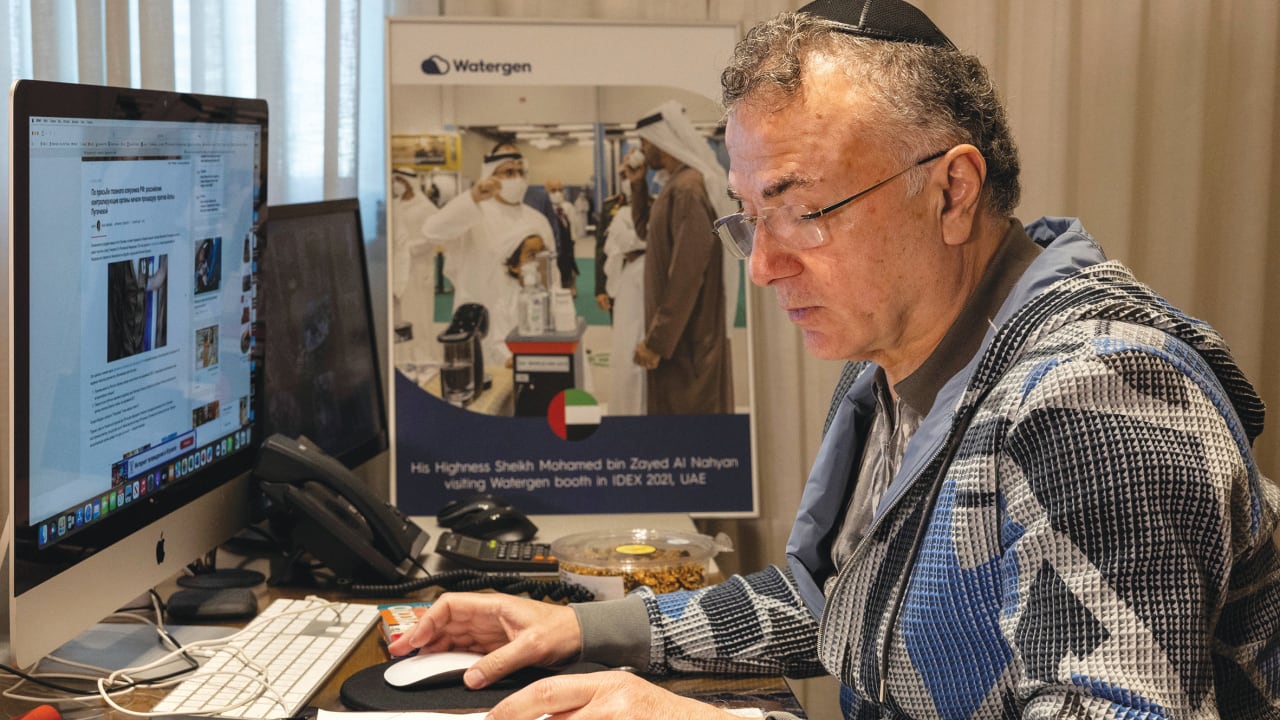
Mirilashvili, a businessman and Jewish communal leader who has lived in Israel since 2009, begins with the two areas he says define his current priorities: Watergen’s water-from-air technology, and his work on behalf of Jewish communities in the former Soviet sphere and beyond.
“For the past 16 years, I have lived in Israel, and I continue to do business,” he said. “I have many friends here as well. I like the emotional, dynamic business atmosphere here.
“I have started to look a bit differently at what I do. An idea can be more important than earnings. That is why today, my top-priority project is developing Watergen technology, which makes it possible to extract water from the air. We have a joint venture with Arab sheikhs. It is a vivid example of cooperation that is incomparably better – and more profitable – than war.
“And my No. 1 priority remains the development of Jewish Diasporas on a global level.”
A victim of legal double standards
Mirilashvili spent years fighting one of the most dramatic chapters of his life – his arrest and imprisonment in Russia after the 2000 kidnapping of his father, a case he says was politically driven and later found by the European Court to have violated fair-trial standards.
Judging by your biography, you have already had to become a victim of politics and legal double standards.
Yes, it is an expensive experience in every sense.

In August 2000, my father was kidnapped in broad daylight on a street in St. Petersburg. With the help of God, he was freed more than a day later.
You would think investigators should have been looking for the criminals. But instead, in January 2001, they arrested me on the absurd charge of ‘kidnapping the kidnappers.’ It was a planned operation. Now I know the name of the person who ordered it.
Back then, the public rose to defend me, and not only the Jewish public – cultural figures, scholars, progressive members of parliament, simply people of goodwill. They were unable to defeat the legal lobby and the wall of mutual cover-up.

Without any evidence, I was sent to prison for eight years, and I served the entire term from start to finish.
The European Court found a violation of Article 6(1) of the European Convention on Human Rights in my criminal case. The court said it ‘did not meet the requirements of a fair trial.’ I was entitled to monetary compensation, but I refused any payments. No amount of money can compensate for years spent behind bars, away from my family.
Looking back today, which materials or facts do you consider key to understanding that you did not commit the crimes for which you were convicted? And are you prepared to make them public?
The European Court has already established the main point: The procedure itself was unfair. Today, there are significantly more documents, expert opinions, and testimonies that demonstrate the weakness of the accusations. Some are already known to specialists. I am not a supporter of turning the past into an endless public trial. But if the public interest requires full transparency, I am prepared for that. I have nothing to hide.

Mirilashvili said a later encounter with Lahav 433, the Israel Police’s elite national crime and anti-corruption unit, revived his distrust of legal institutions, even as he stressed that Israel and Russia are fundamentally different systems and should not be compared as equivalents.
In Israel, you were also questioned under caution by the Lahav 433 unit. How did you experience that, and what differences did you feel compared to what you went through in Russia?
What happened in Russia and in Israel cannot be compared. A great deal has already been written and said about what I went through in Russia.
In Israel, I believed I clearly understood my status, my rights, and the limits of the investigators’ authority. Pressure was applied on me. Otherwise, why question me for many hours, asking the same question over and over again?
Those events left an unpleasant impression. Investigators came to my home in the middle of the night, presented a warrant, and searched my apartment and office. After that, I was subjected to a lengthy interrogation at the police station – about six hours. I was asked about donations to a nonprofit organization, an amuta, where Arye Deri’s wife worked.
The amount in question was insignificant compared to the overall scope of my charitable activities. I supported that organization not because I needed anything from her husband but because that is how I have always acted, helping where I believe it is appropriate.
I emphasize that I am not accusing anyone. I am simply describing the questions I was asked.
You are careful not to accuse specific investigators, but you are clearly implying misuse of power. What, specifically, crossed the line in your view – the procedure, the duration, the seizure of property, or the premise of the questions themselves?
The main issue was a combination of things: the way it was done, the hours of repeated questioning, the confiscation of my phone for months, and the underlying assumption that a charitable donation must have been tied to some future political benefit.
At the time, Deri was not a minister; he had just been released from prison. Nevertheless, it was suggested that by making a donation, I was allegedly expecting some future benefit, based on the assumption that he might once again hold a ministerial post.
I was disappointed. My phone was confiscated and not returned for several months. Obtaining official confirmation that there were no claims against me also took several months. On a personal level, it was an unpleasant experience.
If legal procedures turn into instruments of political or ideological pressure, I believe we move away from the rule of law.
Critics claim that your tough stance toward the judicial system, including on Channel 14, is driven by personal trauma and a sense of past persecution. What is your response?
I do not see my condition as post-trauma. I know the truth, and I can defend it through legal means. If this were only about my personal biography, I would have stopped dealing with this issue long ago. But the problems discussed by Channel 14 are not about me. They concern the balance of powers, freedom of speech, and the state’s responsibility toward its citizens.
Like everything that has happened to me in life, this experience strengthened me spiritually and morally. I deeply believe that all the trials a person faces are sent by God and that each one has its own meaning.
Judicial reforms and criticism
The judicial reform debate, which split Israel over the balance of power between the courts, the government, and the Knesset, is a central part of Mirilashvili’s worldview, and he frames his criticism of the legal system as a constitutional question, not only a personal grievance.
How do you reconcile the principle of equality before the law with your criticism of the judicial process against the sitting prime minister?
Equality before the law does not mean ignoring important details. The state is obliged to take national interests into account.
The general rule should be simple: If a trial causes direct harm to the country’s security and governability, its format and timing should be reconsidered, regardless of the defendant’s name.
Channel 14 has indeed changed the Israeli media market. As a Zionist, how much do you identify with the sharp and, sometimes, offensive rhetoric directed at certain public figures and groups?
I identify with the right to an alternative point of view.
An alternative point of view is one thing. Repeated personal attacks, humiliation, and inflammatory language are another. Where do you draw the line, and can you point to cases where Channel 14 went too far?
I am not a supporter of insults, and I do not consider aggression a positive trait. I understand where the sharp tone comes from, but I do not glorify it.
In my opinion, Channel 14 emerged as a response to the long-standing monopoly of a particular worldview in the Israeli media. When only one voice exists for a long time, any other voice begins to sound louder – sometimes too loud.
The sharp tone is a reaction to years of being ignored, silenced, and treated with arrogance. Over time, the media market will regulate its own tone. The main thing is that diversity of opinion and freedom of speech are preserved, without double standards.
Channel 14, ownership, and editorial boundaries
Channel 14, which grew from a niche broadcaster into one of Israel’s most influential and polarizing news channels, sits at the center of many of the claims made about Mirilashvili, who insists the channel was built by his son and says he has no role in its editorial decisions.
Critics say your views on the legal system are reflected in Channel 14’s editorial line. What is your role there, in practice?
I want to emphasize something fundamentally important: I am not the owner of Channel 14 and, therefore, do not influence its editorial policy. My son also does not interfere in editorial decisions.
Even if you are not involved in editorial decisions, you are still publicly identified with the channel and benefit from its political positioning. Do you accept any public responsibility for the culture it helped create in Israeli media?
I accept responsibility for my own public statements, and I support media pluralism. Editorial responsibility belongs to journalists and editors.
Let me give a brief example. At the very beginning of the channel’s activity, an acquaintance of mine approached me and said that a report was being prepared about him, which he believed to be false and unfair. He asked me to use my son to influence the editorial staff so the report would not be aired.
I called my son, and he answered very simply: ‘Dad, I’m sorry, but if your acquaintance believes there is falsehood or unfairness in the report, he should file a lawsuit. I cannot and will not influence the decisions of journalists and editors.’
That was the only time I ever allowed myself to have such a conversation. Since then, I have never made such requests to anyone. That is how I understand the boundary between personal life, business, media, and politics.
There are many rumors about your influence over the channel. How do you answer them?
Everything they claim to know about me comes from smear websites, where there are more errors than text. And they falsely claim that the channel belongs to me. I have been involved and continue to be involved in other projects. Channel 14 was built by my son, Yitzchak. At first, it was an educational channel with programs about Jewish history, culture, and spiritual heritage. But soon Yitzchak felt that Israel’s media space lacked objective television news and professional analysis.
He began developing this new direction, and it turned out that Israeli viewers truly wanted to see an objective picture of the world. Ratings grew quickly, and the presenters became stars.
Many Israelis love Channel 14 today. As for me, I still do not even know the staff there or where the studio is located.
I prefer to remain just a viewer and a father proud of his son.
In my view, Yitzchak’s main quality is humility. He gives God praise for everything he has accomplished. And God truly helps him because Yitzchak is honest and talented.
You speak a lot about pluralism and respect across political lines. Is that how you live personally as well?
It is fundamentally important for me to emphasize that political views have never determined my attitude toward people nor influenced my professional or personal relationships.
Among my close friends and colleagues, there are both right-wing and left-wing individuals.
For example, the director of my holding company was Yitzhak Ilan, the former deputy head of the Shin Bet [Israel Security Agency]. We not only worked together but were also friends. He strongly criticized Prime Minister Benjamin Netanyahu, and this did not affect either our professional relationship or our personal one. After his passing, together with his family we published a book about him.
Another example is Jackie Eshel, who served as the head of security for my company. Only recently did I learn that he is a witness in Netanyahu’s trial and a close friend of the government’s legal adviser. Neither before this became public nor afterward did my relationship with him change in any way. For me, people matter, not their political roles.
Defamation, lawsuits, and mandatory apologies
After years of online accusations and political attacks, Mirilashvili says he shifted from silence to legal action, pursuing defamation claims against several critics and arguing that public smears require public correction, including apologies and court-ordered remedies.
Some Israelis view you with caution. Why do you think that is? And does it affect you?
Caution is a natural Jewish trait. But everything is good in moderation.
I have no reason to complain about how people treat me. In most cases, the attitude is respectful and friendly. My acquaintances, especially those who know me well, treat me even better than I deserve.
I have lived in Israel since 2009. My family moved here even earlier. My grandchildren were born and raised here, and recently I became a great-grandfather.
I consciously stay out of party politics, and for that reason, I can allow myself to speak directly about what is happening, without regard for political convenience. That, too, makes some people cautious.
But overall, the wary attitude of a minority of Israelis toward me is the result of deliberate defamation, for which the courts have finally begun to hold people accountable.
In Russian literature there is a famous question, ‘And who are the judges?’ I will ask differently: Who are the defendants?
A few of the most active defamers – their hatred toward me is a manifestation of insecurity and an unwillingness to take responsibility for their own failures. Strong people look within themselves to correct their shortcomings. Weak people look outside themselves.
The Torah says, ‘Hatred and envy consume a person.’ I see this in the case of those who slander me and strongly dislike Channel 14. None of them have ever dealt with me personally. We are not even acquainted.
In your view, what signs prove the campaign’s coordination?
The synchronization of publications, identical wording, and a unified set of false talking points. There are several key figures from whom the content spreads outward. This is not spontaneity; it is a system.
Why do you consider mandatory public apologies to be a justified measure?
Because defamation is usually public. The damage is done in the open, so the correction should take place there as well.
It is not about revenge. It is about restoring public balance and reminding people of the price of words and responsibility for their actions.
You agree with your son that slanderers should be pitied, yet you have sued them. Is there a contradiction there?
No. This was done for the good of the society in which we all live and, in some sense, for their good as well.
I prefer agreements to court. My lawyers initially offered the potential defendants an opportunity to remove the defamatory content. No one responded.
Then I turned to the court. Immediately, lawyers for several of the slanderers contacted my attorneys. Their clients understood they had no real arguments to defend against the claims. They promised to clean up the media space, issue apologies, and donate a small sum to charity.
I was prepared to withdraw the lawsuit on those terms, but after that no one contacted my lawyers again.
Apparently, the most influential defamers forbade them from signing a settlement and breaking ranks. If two or three step out of line, the whole system collapses.
If, amid such active work, you found time to sue slanderers, then they must bother you after all.
Not as much as they think. I am certain slander harms them more than it harms me.
I waited too long because I believed people would understand the rumors were false. That was a mistake. If you repeat the same lie many times, eventually, people believe it.
The slanderers took my silence as weakness and crossed every line. They forgot that freedom of speech is the right to express an opinion, not to publish deliberate falsehoods. Now I am defending my good name and reputation in court for the sake of my family, friends, partners, and colleagues.
By the way, the most absurd accusation spread by these people is that I am undermining Israeli democracy, while many of them treat democracy as an empty word.
Are you referring to opposition leader MK Yair Lapid’s attacks against you?
Among others. But his attacks harm the State of Israel, and any citizen of the country is obliged to prevent that.
Remember, when Lapid was prime minister, part of Israel’s territorial waters passed to Lebanon. Strong external pressure does not justify betraying national interests, harming the economy, undermining security, or compromising the country’s territorial integrity.
Lapid is the leader of the opposition and has great ambitions. There is nothing wrong with that. But in his public speeches, there is too much emotional aggression and too little restraint, which is essential for a statesman.
He speaks about me in an insulting and cynical manner, using parliamentary immunity. If he is ready to answer for his words under the law, let him waive his immunity, and we will meet in court. There, I will prove that Lapid is just as much a slanderer as the other defendants.
Netanyahu, leadership, and term limits
Like many Israelis who sharply criticize state institutions while still backing the current government, Mirilashvili offers a layered view of Prime Minister Benjamin Netanyahu, praising his economic and strategic record, rejecting parts of the legal campaign against him, and still acknowledging the need for rules that ensure political renewal.
Let’s take another angle. There are rumors that you are an admirer of Netanyahu. Is that true?
I am not an admirer of Netanyahu. I give him credit where it is due.
Try to name another leader who for so many years has consistently strived for Israel’s victory on both military and political fronts, achieving such remarkable results.
For example, according to the Organization for Economic Cooperation and Development, Israel’s GDP growth in 2025 was 3.3%. For 2026, the organization forecasts 4.9% for us, and for 2027, some 4.6%. At the same time, other OECD countries are expected to see growth of only 1.7% and 1.8%, while the global economy is projected at 2.9% to 3.1%.
Our country has moved beyond the confines of the Middle East and holds leading positions in technology, education, culture, and the fight against terrorism. Students come to study here, countries buy from us, and developed nations want us as full-fledged partners.
All of this is the achievement of many Israelis, not Netanyahu alone, but his role in Israel’s successes is difficult to overestimate.
You are emphasizing Netanyahu’s strategic and economic record. What is your strongest criticism of him – one decision, one failure, or one pattern of leadership that you believe has harmed Israel?
My strongest criticism is not one dramatic headline; it is the broader problem that Israel needs leadership renewal.
There needs to be a periodic change of power. New faces are needed on television screens; new leaders with fresh energy and constructive ideas are needed.
Netanyahu is accused of not preparing anyone to succeed him and not allowing others to fully prove themselves. I am not his lawyer, and I do not know how fair these accusations are.
It is possible that Netanyahu could have mentored a successor. But teaching is a separate profession, and a talented person may be a poor mentor.
Do you think Netanyahu will return to the post of prime minister? And would you support limiting the prime minister to two terms?
Predicting Israeli politics is a thankless task. But I do not rule out the possibility that Netanyahu could be elected again.
His support is based not only on personal charisma and an understanding of Israeli society but also on the perception that in critical moments, he is capable of making decisions that benefit the country.
As for term limits, I am not opposed to the idea itself. Change of power in a democratic society is beneficial.
However, any limitations must not be introduced for a specific individual or applied retroactively. The rules must be principled, transparent, and applied equally to everyone.
Listening to you, one might think you work closely with Netanyahu after all.
I try to be objective and to say more good than bad. In Judaism, there is a prohibition against harmful speech, lashon hara. I do not share all of Netanyahu’s views, and I do not always agree with him.
About eight years ago, he spoke at the UN and listed Israeli innovations that are changing the world for the better.
Among them was Watergen technology developed by my company, and even cherry tomatoes bred in Israel. I do not know how tomatoes advance progress, but Watergen extracts water from the air and improves quality of life around the world. [Netanyahu was later criticized for allegedly promoting Mirilashvili’s business. He stopped mentioning Watergen, although he continued to speak about tomatoes.]
I do not divide people into Right and Left. Among both groups there are worthy people, patriots of Israel, with whom I maintain relationships.
As for Netanyahu, talk of our friendship is not true. I think Netanyahu does not have friends at all. He has no time for them; he is too busy.
People demand that the prime minister constantly explain his strategy. He says his strategy is victory, prosperity, security, and peace for Israel. His critics demand details. Should the prime minister publicly explain what is being done against Iran, Hamas, Hezbollah, and others, so our enemies immediately learn all our military and political plans?
The opposition demanded that Netanyahu stop the military operations in Gaza, leave Lebanese terrorists alone, and refrain from confronting Iran and its proxies. That would have led to defeat for Israel and strengthened interconnected enemies.
If international terrorists are not eliminated and if attention is diverted from Iran even briefly, a repeat of the Oct. 7 tragedy would become inevitable.
Netanyahu is called a dictator. Yet this ‘dictator’ goes to court repeatedly. The trial costs enormous sums of money, and he spends hours answering questions about champagne and cigars instead of focusing on state affairs.
In my view, it is obvious that when someone goes to a respected person with a bottle of wine, they choose a drink according to their means. An engineer’s bottle will be less expensive, a businessperson’s more expensive. But Netanyahu’s accusers apparently believe he should reject any expensive gift on sight, and this kind of absurdity follows him into court again and again.
Trump and the proposed ‘super-prize’
Moving from Israeli politics to global diplomacy, Mirilashvili outlined his support for US President Donald Trump and revived his idea for a one-time, ultra-high-value international peace prize, which he argued should honor concrete geopolitical outcomes rather than symbolic recognition.
For similar reasons, do you support US President Donald Trump? The idea of creating a super-prize, far more significant than the Nobel Peace Prize, is yours. And you have not hidden the fact that it should be awarded to Trump.
The Nobel Peace Prize has become too politicized. Increasingly, it is awarded in advance, for talk about peace rather than for concrete results in achieving peace.
Trump’s merit lies in bringing a clear, pragmatic business logic into international politics. Where diplomats for years performed complicated dances with no visible results, he proposed effective and understandable solutions.
Many dislike this because Trump’s actions devalue paper resolutions and disrupt comfortable arrangements.
But let us look at what he has managed to achieve.
The Abraham Accords between Israel and the Gulf states were signed. Gaza, in his view, moved from a dead-end discussion toward a concrete redevelopment framework with major funding ideas behind it.
Trump helped secure the return of living hostages and the return of bodies of those who had been killed, even when many believed no breakthrough was possible.
Through Trump’s efforts, peace dialogues were established between India and Pakistan, Rwanda and Congo, Thailand and Cambodia, Armenia and Azerbaijan, and Serbia and Kosovo. He also points to movement toward talks between Russia and Ukraine.
Economic and, with Israel’s help, military blows have been dealt to Iran’s ‘axis of evil,’ which is weaker than ever before.
Under Trump, financial chains linking international drug trafficking to terrorist structures have begun to be systematically dismantled.
Some of the achievements you are listing are highly disputed, and some are still incomplete. What standard are you applying here: public declarations, signed agreements, measurable outcomes, or your own political judgment?
I apply a practical standard, whether a leader moved a conflict toward an outcome, changed the reality on the ground, or created a framework that others could not create for years. I look at results and direction, not at whether every file is fully closed.
The US president has not received the Nobel Peace Prize, but in my view he has long surpassed the scale of that award, especially compared with many other laureates.
That is why I propose creating a prize for an outstanding historical contribution to saving lives and strengthening peace. It should not be awarded on a schedule but individually and in exceptional cases – perhaps once in a century.
Its monetary value could be, for example, $100 million. I have no doubt the recipient would direct the entire sum to charitable programs. This would send a powerful message to humanity: The world values those who truly prevent wars and suffering.
I hope leading businesspeople and world leaders will hear this initiative. As for me, I have no doubt that since World War II, Donald Trump deserves such a prize more than any other politician.
Public image, criticism, and optimism
In closing, Mirilashvili returned to themes that ran throughout the interview: Jewish identity, faith, public hostility, and resilience, presenting himself as a figure shaped by conflict but focused on long-term continuity and national strength.
So you look to the future with optimism?
Of course.
Israel is a unique country. It is no coincidence that President Trump says hostility toward Israel ends badly and calls on others to befriend us.
The Jewish people are not only chosen but unique, and our strength lies in unity. When we are united, our enemies are afraid not only to fight us but even to show hostility, and the Almighty supports Israel clearly and openly.
I believe we will overcome our divisions and that everything will ultimately be good. And if everything is not yet good, it means this is not yet the end.