
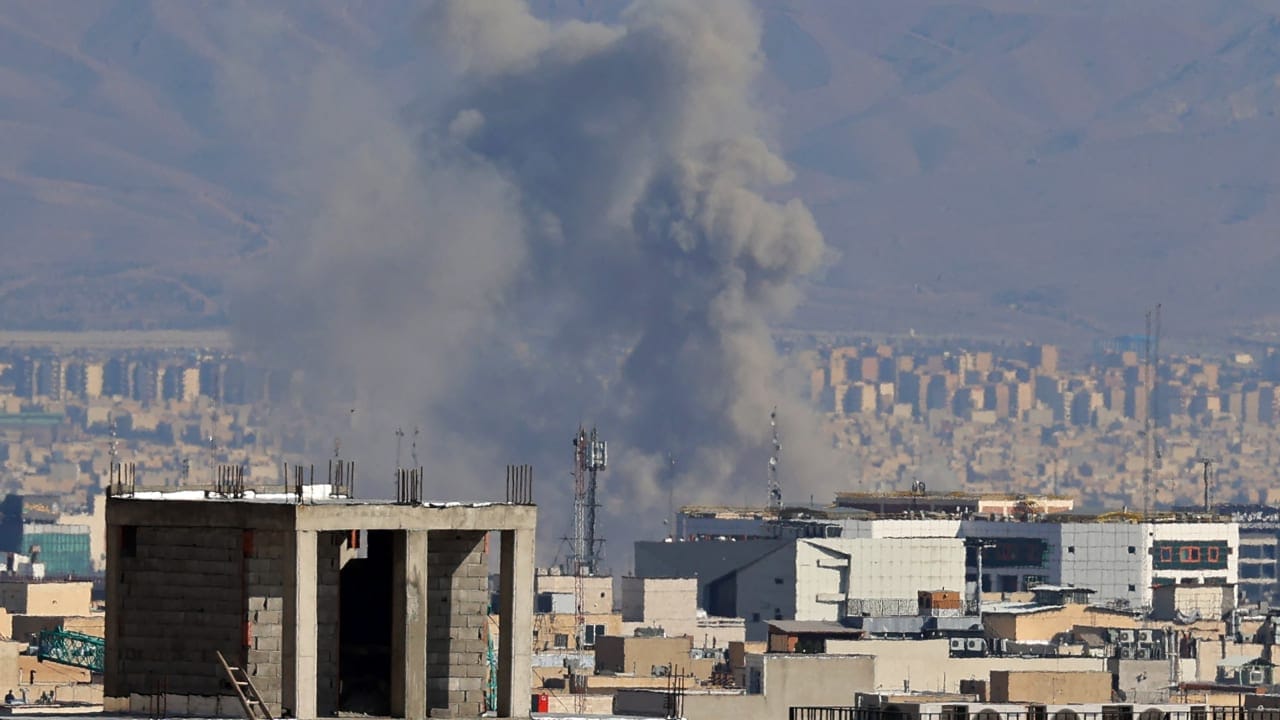
Although the US-Israeli war with Iran is still unfolding, it is obvious that we are facing one of the most significant turning points in the region’s modern history.
For decades, the Islamic Republic structured its foreign policy around preparations for a regional war that would destroy Israel. It committed enormous resources to its strategy of erecting a “ring of fire” around Israel composed of several armed militias, including the Houthis in Yemen, the Popular Mobilization Forces in Iraq, Hezbollah in Lebanon, Islamic Jihad, and, partially, Hamas, in the Palestinian territories.
At the order of the former supreme leader of Iran, Ayatollah Ali Khamenei, these forces would overwhelm Israel with rocket, missile, and drone fire as well as through cross-border infiltration.
Even before a major regional war, the militias were positioned as a persistent threat to Israel that could serve as spoilers to progress made on Israel’s normalization with Arab and Muslim countries and Israel’s subsequent regional integration.
This automatically gave Iran and its allies veto power against expanding Israeli diplomatic relations throughout the region. A central goal of this strategy was to isolate Israel and weaken it until it collapsed from within.
Iran got its regional war, but not the way it was envisaged.

The Islamic Republic’s mortal enemies – the United States and Israel – initiated the war on their own terms while Iran was in its most vulnerable position. The axis that Tehran spent decades cultivating has been largely eliminated or severely weakened following the events of the October 7 massacre. As a result, Iran and its allies have so far been able to provide little to no help to Iran against Israel and the US.
Interestingly, it’s Iran that made the strategic choice to make this war regional. Tehran quickly responded with missile and drone attacks targeting US bases and embassies in Bahrain, Kuwait, Qatar, the UAE, and Saudi Arabia.
In many instances, Iran hit civilian centers as well as oil and gas infrastructure in these countries, causing numerous casualties.
Iran’s strategy is to wear down the resolve of the Gulf countries and to cajole them to pressure the US to stop the war and return to negotiations.
The Gulf states’ initial responses appear to communicate the opposite trajectory. The GCC (Gulf Cooperation Council) has already signaled that it may be on the verge of responding to Iran’s “reckless and indiscriminate” attacks on its countries.
The decision for the Gulf countries to end their neutrality in a US-Israel war with Iran would constitute a historic own-goal for the Islamic Republic. Until now, the option of expanding normalization in the region was understood as becoming increasingly distant from reality.
After the 12 Day War, the strategic weakening of Iran and its axis produced an ironic result for Israel’s stance in the region. Iran’s crushing loss in the war decreased the perception of Iran as a strategic threat to Arab countries in the region.
At the same time, in the aftermath of the October 7 attacks, Israel’s effort to restore deterrence – particularly through what is widely perceived as a willingness to employ overwhelming and potentially unconstrained force – heightened concerns among regional powers. They began to view Israel as moving in an expansionist direction and increasingly as a destabilizing actor that may need to be balanced or constrained.
However, now the countries of the GCC are siding with the US and Israel in a war they certainly did not choose. As a result, this could very well give us a glimpse of the post-Islamic Republic regional order.
This is a regional order that will be almost entirely pro-US, with Israel dominant and integrated following normalization with Saudi Arabia. This could be a realistic scenario even if the regime survives, but is left on life support.
To realize this possibility, Israel needs to do two things.
First, Israel needs to signal to the Arab countries in the region that it possesses the will and ability to restrain the immense power it has employed following the October 7 massacre and demonstrate that it prefers cooperative relationships based on mutual interests rather than expansionist aspirations.
Second, Israel must decide on a strategy for altering the trajectory of the Palestinian issue towards stability and away from periodic confrontation.
In this way, Jerusalem can, on the one hand, neutralize the spoilers of its integration in the region and, on the other hand, communicate that Israel’s trajectory is not to become a preponderant regional hegemony that merely replaces Iran as a strategic threat but as a partner for preserving regional stability.
Both of these measures can be incorporated into a mega deal after the war led by the US. This should be the strategic objective of the war that would alter the history of Israel and the region. It would hopefully prevent major wars involving Israel for decades to come. This would produce the quintessential victory against not only the perpetrators of the October 7 massacre but against all those who wish for its demise.
The writer is the director of Research and Policy at the Economic Cooperation Foundation (ECF) and a PhD candidate in International Relations at the Hebrew University of Jerusalem.