
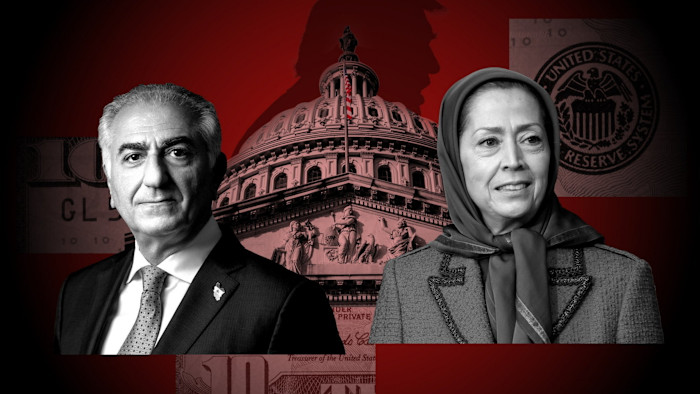
Mujahedin-e Khalq, an Iranian opposition movement in exile, has spent decades cultivating ties with some of Washington’s most powerful politicians. It is about to find out if its investment was worthwhile.
The group says it is on the cusp of a breakthrough, as the war in Iran threatens a regime it has been fighting since the 1980s and provides an opening for it to wield real influence in its homeland after decades in exile.
“It’s our moment,” said Alireza Jafarzadeh, deputy director of the US office of the National Council of Resistance of Iran, a coalition of Iranian dissident groups widely seen as MEK’s political arm.
MEK’s new confidence reflects the euphoria that has swept through Iranian exile communities since US and Israeli planes began bombing Iran on February 28, as hopes rise that the war will sweep aside the Islamic regime and usher in a new democratic era.
On the first day of the war, NCRI leader Maryam Rajavi announced the formation of a provisional government that would transfer sovereignty to the Iranian people and establish a democratic republic.
 Maryam Rajavi at a rally against the Iranian regime in Rome last July. © Filipo Monteforte/AFP/Getty Images
“Any scenario that involves a conference of interested parties and stakeholders, they’re certainly at the table,” said Robert Torricelli, a former Democratic senator who is one of MEK’s legal representatives. “It’s the only diaspora group with a broad reach internationally and . . . they have taken real action against the government.”
But many believe MEK is deluded if it thinks the war will catapult a group that was on the US terror list till 2012 and fought on the side of Iraqi dictator Saddam Hussein during the Iran-Iraq war into a position of power.
“I see them as having absolutely zero role or potential,” said Michael Rubin, an Iran expert at the American Enterprise Institute think-tank. “And their supporters in the west are going to have a lot of egg on their face when they see just how irrelevant these people are.”
MEK is not the only exiled force trying to raise its profile. Also vying for attention in Washington is Reza Pahlavi, son of the late Shah of Iran, who has also positioned himself as a unifying leader capable of rallying all democratic forces in the nation should its theocratic regime be toppled.
Pahlavi has been working hard to increase his visibility in the US capital in recent months, reaching out to US lawmakers and foreign diplomats in an effort to project himself as a future powerbroker.
Allies say he is not using any lobbying or public relations firm, though he has won backing from two powerful bodies — the conservative Foundation for Defense of Democracies, a Washington-headquartered think-tank, and the National Union for Democracy in Iran (NUFDI), which claims to represent the Iranian-American community.
So far there is little evidence his efforts are paying off. President Donald Trump has said the crown prince “looks like a very nice person” but that “it would seem to me that somebody from within maybe would be more appropriate”.
 People sing during a rally in New York last Sunday in reaction to US and Israeli strikes on Iran and in support of Reza Pahlavi © Adam Gray/AP
Moreover, Pahlavi has not done himself any favours with a PR blitz critics describe as amateurish.
“His most recent campaign, to have his minions spam policymakers with near identical emails, is a mistake a student council president wouldn’t make, let alone a would-be shah,” said one person close to the Iranian exile community who has known Pahlavi for close to three decades.
MEK, in contrast, is much better organised, the person said. “Most cults are,” he added.
MEK’s journey to political influence in Washington has been a long one. Formed in 1965 as a leftist-Islamist group, it waged an armed struggle against the Shah and participated in the 1979 revolution that unseated him.
But after losing a power struggle with the clerics it went into exile in Iraq, later fighting alongside Iraqi forces in the Iran-Iraq war. Tehran responded by executing thousands of MEK’s members in jail.
Analysts say the group has little support inside Iran, where many regard it as a cult with roots in terrorism. Its violent attacks on senior regime officials and institutions often led to frequent civilian casualties.
“Rajavi leads a radical Marxist-Islamist group with the blood of a lot of Iranians and Americans on its hands,” said Saeed Ghasseminejad, director of the Iran Prosperity Project and an adviser to Pahlavi.
The NCRI is equally dismissive of its rival. Jafarzadeh said: “The only connection Reza Pahlavi has to Iran is his deposed father, a dictator who was swept from power in a genuine revolution.”
MEK’s image in the west improved markedly after 2002, when the NCRI scored a huge coup by revealing the existence of Iran’s nuclear facilities, including the Natanz uranium enrichment plant. The US state department removed it from a list of foreign terrorist organisations in 2012 after a long legal battle.
Over the years it won the backing of a long list of conservative heavyweights, including Newt Gingrich, the former Speaker of the House, former New York mayor Rudy Giuliani and Mike Pompeo, secretary of state in Trump’s first term.
“For many of us who became involved [with MEK] so many years ago, it was simply that the enemy of my enemy is my friend,” said Torricelli. That later developed into “enormous” respect for Rajavi and the other MEK leaders for “their real devotion to their country and the hardships they’ve endured”.
Torricelli said he worked closely with the group for years, helping them get off the US terror list and move their members from a camp in Iraq to eventual safety in Albania.
He denies “lobbying” for them, though admits to having “given them advice on how to communicate with the US government”, as well as having “talked to people in the US government on their behalf” and “spoken at their rallies”.
From 2012 to 2025, the NCRI paid Torricelli’s firm Rosemont Associates $2.8mn in fees, according to financial disclosures made to the Department of Justice, though he says the amounts were “overstated”.
Though the sources of its funding are murky, NCRI’s pockets are clearly deep. Official records show John Bolton, national security adviser from 2018 to 2019, was paid $40,000 for a speech at an NCRI rally in Paris in 2017 while former vice-president Mike Pence received $190,000 for a speech in Albania in 2022.
 Robert Torricelli, a former US Democratic senator and a legal representative of MEK, speaks at a rally in Brussels in 2023. From 2012 to 2025, the NCRI paid $2.8mn to his firm Rosemont Associates © Laurie Dieffembacq/Belga Mag/AFP/Getty Images
Mohsen Sazegara, an Iranian journalist and pro-democracy activist, recalls a conversation with the late Democratic senator Joe Lieberman, who asked him if he had been right to accept money from NCRI to make a speech in Paris.
“He said they . . . buy you a first-class ticket, [put you up] in a five-star hotel for a week in Paris and pay you $50,000 for a 10-minute speech,” he said. “So you can’t refuse it.”
He told Lieberman that in future, “he should take my advice before going, not after”.
Jafarzadeh insisted it is the strength of MEK’s arguments that has won conservative American politicians to its cause, not the fees it pays.
“The key to success is not lobbying at all [but] the substance,” he said. “All of the people who are involved in national security matters . . . they look at the facts and say this is the movement that has been fighting the regime, and that’s been on the good side . . . We’re the engine for change in Iran.”
He claimed MEK had an “extensive network” inside Iran, in the form of “resistance units” that “engage the Revolutionary Guards and the forces of repression”.
Such claims have been widely contested by experts. But the effectiveness of MEK’s networking is hard to ignore. In recent years Congress has passed a number of laws which Jafarzadeh said are all closely aligned with NCRI goals, such as those tightening sanctions on Iran over human rights abuses and missile exports and on Chinese banks purchasing Iranian oil.
Recommended

He also pointed to a resolution passed last year by Congress endorsing Rajavi’s 10-point plan for the future of Iran, which calls for its transformation into a democratic, secular and non-nuclear state.
But despite all the success, MEK’s influence might be on the wane. “Years ago they had much more support in Washington,” said Ervand Abrahamian, an expert on Iran and professor of history at Baruch College in New York. “Now it’s fizzled out. And some of that support is obviously going to the Shah.”
Indeed, Pahlavi’s stock has risen since the mass protests at the start of this year, when thousands of Iranians chanted his name. “He is the only leader who can mobilise the people — he brought millions of people on to the streets on the day and time of his choosing,” said his adviser Ghasseminejad. “His confidence has grown.”
Still, some observers think he hardly figures in the Trump administration’s or Israel’s plans for a postwar Iran.
“People in Washington may be clueless,” Abrahamian said, “but Mossad [Israel’s spy agency] is smart enough to know that . . . you can’t just parachute the Shah in and say, you know, change a regime.”