
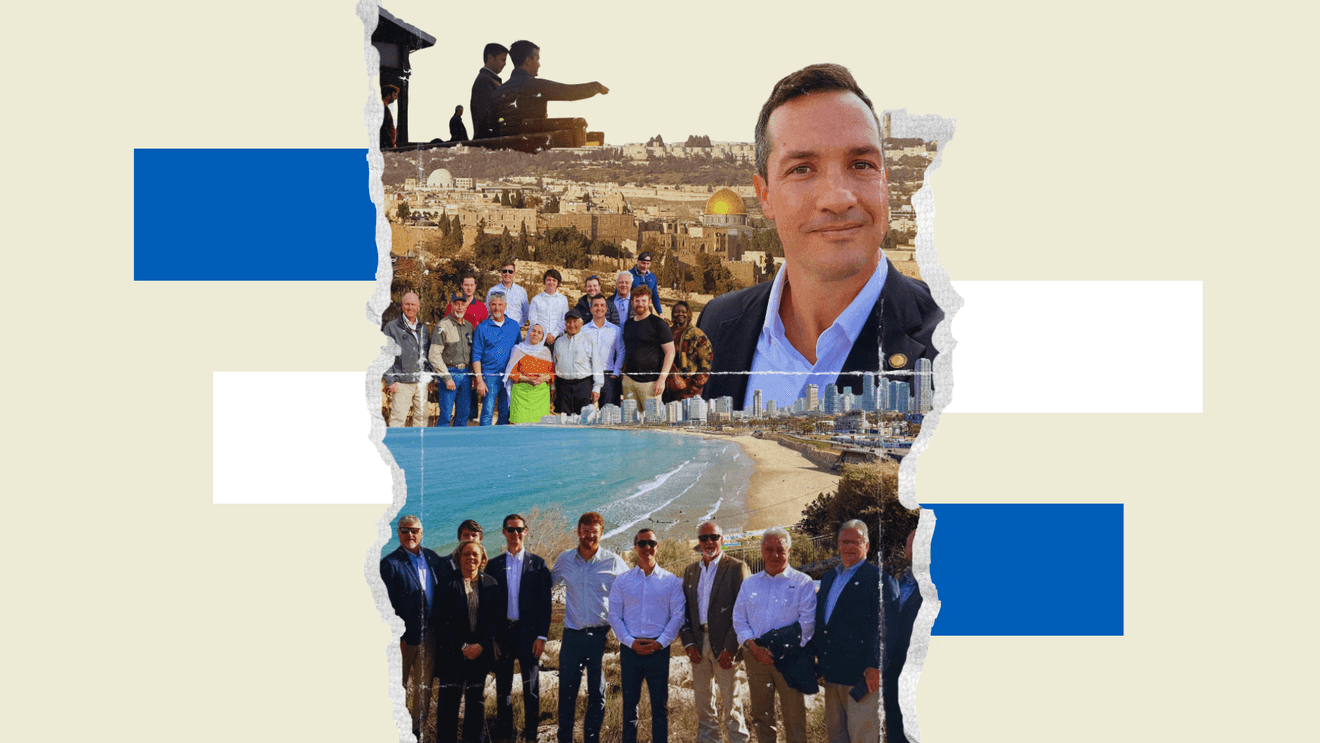
CHARLESTON , S.C. (WCIV) — Charleston City Councilman Ross Appel knows Israel is a complicated place.
“It’s not the type of place that can get distilled into these very simple narratives,” he said in a sit-down interview after his most recent trip to the Middle East. “I think that when you go there and you meet with people and you see the sights and you interact and you see how other people are interacting, it helps to sort of disabuse some of those very simplistic conceptions that people might have.”
Appel is an attorney and fourth-generation Charlestonian who has served on the city’s council since being elected in Nov. 2019. He is a board member for several nonprofits, including the Charleston Jewish Community Center and the Hebrew Benevolent Society of Charleston, S.C., the oldest Jewish philanthropic organization in the country.
He was part of a bipartisan legislative delegation that visited Israel in early December. The trip was organized and paid for by the Israeli Ministry of Foreign Affairs and Israeli Consulate in Atlanta, and other local leaders like State Senator Ed Sutton, Charleston County Council Chair Joe Boykin, and Representative Roger Kirby were included amongst those invited.
“There were Democrats on our trip, there were Republicans on our trip, there were Jews on our trip, Christians on our trip, white people on our trip, African Americans on our trip, so our trip was very diverse in a lot of ways,” he said. “And I thought that was a very fulfilling way to experience a very diverse and dynamic country.”
What’s a city councilman doing 6,000 miles across the globe?
“People at home might be thinking, ‘what are a bunch of state and local elected officials doing going over to Israel?” Appel posited. He said the answer lies in the opportunity for collaboration on business issues, economic development, and religious and cultural exchange.
“There’s a lot we can learn from Israel on in South Carolina,” he continued. “Their roads are so great over there, their public transportation is fantastic, [their] healthcare system is great.”
Appel was one of two Jewish members of the delegation, and in Israel he said he saw Jews, Muslims, Christians, and Druze living and working side by side amidst the tenuous Gaza war and its oft-violated ceasefire, and rising violence in the West Bank.
“I think that Israelis just want to live in peace. They just want to live and thrive in their ancestral homeland and do so in a way that allows for the inclusion of others,” he said, citing the approximately 2 million Arabs living in Israel who make up around 21% of the nation’s population, according to the Israel Central Bureau of Statistics. He also pushed back on anti-Zionist criticisms of Israel as an exclusionary state, which have grown under Prime Minister Benjamin Netanyahu’s far-right government. “It’s a very diverse country and it’s not a white supremacist ethno-state,” Appel said. “These are the kinds of simplistic narratives you hear sometimes from the activist world and I think those views get shattered the moment you walk on the beach in Tel Aviv and you see every possible skin color, you can imagine every different type of religion, all coexisting very peacefully and in a beautiful part of the world.”
Through it all, Appel said he met people who wanted to coexist in hopes of building a more prosperous future.
“I think at the end of the day, most normal people are simply trying to live life and get along and raise families and be productive people,” he emphasized. “They don’t live their lives through such rigid, hyper-sectarian lenses, and that’s the hope and the prospect for peace, not just in Israel, but everywhere. When people can relate to each other as humans, acknowledging differences but not allowing those differences to create insane levels of hostility and things of that nature. That exists on the Israeli side, I have no doubt it exists on the Palestinian side.”
The 2020 Abraham Accords, which saw the United Arab Emirates and Bahrain become the first Arab states to formally recognize Israel and Sudan and Morocco normalize relations with Israel, represented a hopeful opportunity for peace in the Middle East, according to Appel. “Hopefully there’s more of that to come,” he said. “I think that the more you get into that realm, the more that part of the world can be sort of put on a much more sustainable, peaceful footing moving forward. That would be the hope.”
What set those ambitions back, Appel said, was the events of Oct. 7, 2023.
A heightening of tensions after Oct. 7
On Oct. 7, Hamas, formally the Islamic Resistance Movement which has governed the Gaza Strip since 2007, launched a southern border surprise offensive into Israel. Almost 1,200 people were killed, both Israeli citizens and military personnel, and a further 251 were captured and taken back to Gaza, which Human Rights Watch condemned as a war crime. 168 of those taken captive have subsequently been returned alive to Israel across several agreements, and the bodies of the remaining 83 killed in captivity by Hamas, Israeli airstrikes, and friendly fire have been repatriated to Israel.
Appel said he saw the scars left behind from that day firsthand in the kibbutzes near the southern border that were attacked. He described the kibbutzes as “collective farms” originally built by the Jews from the Soviet Union and Eastern Europe who founded Israel. The residents there prior to Oct. 7 were left-leaning and “felt very strongly” about connecting with Gazans through programs across the border, especially education and healthcare, according to the councilman, and he said that the realization by those residents that some of the people they were engaged in outreach with had gathered “intel” for the Oct. 7 attacks “shattered” their views.
“I think that that has caused a heightening of tensions and heightening of frictions, which is very unfortunate because when events like Oct. 7 happen, the voices for peace on both sides get marginalized,” he said.
Between Oct. 7, 2023 and Oct. 11, 2025, Israeli forces destroyed an estimated 123,464 structures and damaged a further 74,809, leaving 81% of all structures in the Gaza Strip damaged or destroyed, according to satellite imagery analysis by the United Nations. Preliminary indications from that analysis also indicate that over 320,000 housing units have been damaged. UNRWA estimates that over 1.4 million people of the 2.1 million living in Gaza have been displaced and are living in overcrowded tent camps. The World Health Organization further estimates that over 63,000 Gazan children were enrolled in treatment for malnutrition in 2025 after the destruction of much of the enclave’s energy, water, and healthcare infrastructure. The Palestinian Ministry of Health has reported 72,072 people have been killed in the Gaza Strip since Oct. 7, 2023 as of Feb. 21, with over half of that number being women, children, and the elderly. A further 171,741 have been injured.
As Americans watched those figures grow in real time in the news and on social media, support for Palestinians grew in the US. So too did extremist voices in support of Israel’s war efforts. Appel didn’t vilify pro-Palestinian activists, he ultimately offered understanding for their activism, but he urged supporters of the Palestinian cause to visit the region and root their care in education about the Middle East and the people that live there today.
“I understand why many people are engaged in the sort of activism that we see on the pro-Palestinian side because when you come at this situation without a lot of historical understanding, without having been there, without having a deep knowledge of the history over in that part of the world, and you see people that are being [raised] through war time, conflict, and things of that nature, it is a natural and human urge to have a response of care, compassion, [and] sympathy,” he said. “There’s also a natural human inclination to side with the little guy, that’s why the movie Rocky works. It’s a natural thing in our DNA and so I understand the inclination, especially by young people, to get out and support what they view to be an injustice, I just think that it’s very important to become more educated about the situation over there, to go over there if you can, because it’s oftentimes not as simplistic as some of these themes and narratives might suggest.”
Looking forward
Appel’s trip came before Jared Kushner’s unveiling of proposals to turn Gaza into a technocratic emirate like Dubai, dubbed colloquially as the “Gaza Riviera” by President Donald Trump’s team. Looking to the future, the councilman said he doesn’t agree with the president on everything, but Trump has “an eye for real estate” and Gaza has “a lot of opportunity.”
“There’s no reason why it couldn’t be something along the lines of what some of the Gulf states have been able to accomplish, and hopefully that allows for the situation where the quality of life of the average Gazan goes through the roof,” he said, highlighting education, healthcare, and “all the different positive things” that come with “being a first world country or an emerging first world modern country,” but he said he believes that Hamas must be left behind for the enclave to thrive.
“In order for them to get to that place, they need to abandon the Hamas ideology,” he said. “It prevents that society from really emerging and taking steps to sort of join the modern world, and that’s hopefully where it can go,” he added.
Above all, Appel said he believes any hope of peace between Israel and Palestine requires an outlook of accord beyond endless war.
“I’m somebody who believes that Oct. 7 was an unbelievable horror and tragedy, and there needed to be a very firm response, but at the same time, there ultimately has to be some vision for peace,” he said. “You cannot exist in a perpetual state of warfare forever, and I think that when you talk to most Israelis, both in the military and outside of the military, they will tell you that they long for a day when they’re not having to serve as much as they have to, where their economy doesn’t have to be as heavily weighted towards this military footing.”
Human toll aside, Al Jazeera reports that the Bank of Israel has estimated over $112 billion (352 billion shekels) has been spent on the war, with $21.7 billion in military aid coming from the United States since Oct. 7. With the Bank of Israel estimating it costs around $12,000 per month in lost production for Israel’s economy per reservist, of which 465,000 exist and over 300,000 deployed to Gaza in the first year after Oct. 7, a large sector of the country’s economy has been eaten up by military spending. As Appel earlier alluded to, he believes the citizens of Israel would prefer trends to continue in that direction.
“I think that the vast majority of Israelis, like the vast majority of people around the world, just want to live in peace and hopefully that’s where we can get,” he said. “And I know there’s good people on both sides, and we just [have] to get to a point where that becomes the focus as opposed to the more extreme views that lead to these conflicts.”