
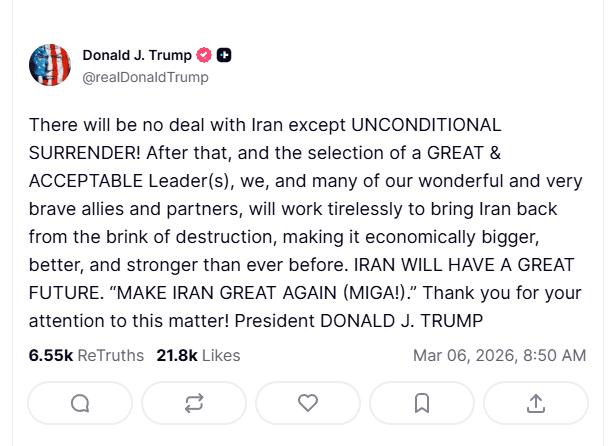
Iran’s war with the United States and Israel escalated sharply over the weekend, as Washington hardened its demand for Tehran’s “unconditional surrender” and Iran moved closer to formalizing a new supreme leader amid spiraling attacks on critical infrastructure, drinking‑water facilities, and oil depots.
Iran’s Assembly of Experts has named Mojtaba Khamenei, the hardline son of the late Ayatollah Ali Khamenei, as the country’s new supreme leader. State-linked media and officials signaled over the weekend that Mojtaba, a mid‑ranking cleric with close ties to the Islamic Revolutionary Guard Corps (IRGC), had been chosen after days of closed‑door deliberations that continued even as airstrikes rocked Tehran.
The apparent choice comes amid public vows by senior Iranian figures to avenge the killing of Ali Khamenei in earlier strikes and to preserve the continuity of the Islamic Republic’s leadership at a moment of existential military pressure. Israeli and U.S. officials, meanwhile, have openly suggested that any successor will be treated as a legitimate military target, with Israeli voices saying they intend to “pursue every successor” at the top of the system.
President Donald Trump has repeatedly ruled out negotiations, saying he will accept nothing less than Iran’s unconditional surrender. In public remarks over the weekend, he demanded that Iran halt all attacks and indicated that he is prepared to intensify U.S. strikes, including the possibility of sending American troops into Iran, even as he continues to frame his policy as ending “endless wars” in the Middle East.
U.S. and Israeli forces have coordinated a series of heavy bombardments on Iranian targets, including Tehran and the nearby city of Karaj, hitting oil depots, fuel sites, and military infrastructure and triggering massive explosions that lit up the night sky. Iran has responded with missile and drone barrages not only against Israel but also against U.S. partners and bases in the region, with recent strikes reported against Qatar, the United Arab Emirates, Saudi Arabia, and other neighboring states.
One of the most alarming shifts over the weekend has been the targeting of desalination plants, facilities that are crucial for producing drinking water across the arid Persian Gulf region. Bahrain accused Iran of striking one of its desalination plants, warning that attacks on such infrastructure threaten water supplies for large civilian populations in multiple desert countries that depend on seawater purification.
Iranian officials, however, say the escalation began when a U.S. airstrike damaged a desalination plant on Qeshm Island in the Strait of Hormuz, which they claim cut water access to some 30 villages, and they argue that Washington “set this precedent, not Iran.” Regional governments and humanitarian organizations are increasingly worried that the war is moving into a phase where water systems, not just oil and military sites, are at risk, potentially triggering a secondary crisis of thirst, displacement, and disease.
Israeli forces struck Iranian oil facilities and storage depots around Tehran for the first time early Sunday, sending towers of flames and thick smoke over the capital and nearby areas. Iranian authorities reported that several oil tankers and a petroleum transfer terminal were destroyed and that fires at a major north Tehran oil depot were so intense that residents said daylight appeared dimmed by smoke.
Iran’s Red Crescent and other agencies have warned of severe air pollution and the risk of acid rain after the oil fires, advising people in Tehran to take precautions as contaminants spread through the atmosphere. Officials say roughly 10,000 civilian structures across the country—including homes, schools, and medical facilities—have been damaged so far, and lawmakers caution that the war’s impact on Iran’s oil industry could soon make it significantly harder to produce and export crude in an already volatile global energy market.
Iranian and regional sources say at least 1,200–1,330 people have been killed inside Iran since U.S.–Israeli strikes began, including large numbers of civilians and children. Thousands more have been wounded, though exact injury figures vary across official and humanitarian tallies.
Around 10 people have been reported killed in Israel, almost all civilians, with nine deaths coming from a single Iranian missile strike on Beit Shemesh near Jerusalem. Israel has also reported soldiers wounded in recent fighting, and on the latest reporting it has acknowledged at least some military fatalities.
The Pentagon has publicly confirmed at least six to seven U.S. service members killed so far, most in an Iranian drone or missile strike on facilities linked to operations in Kuwait and in a later attack in Saudi Arabia. U.S. officials say they expect more American casualties as the conflict continues.
Ali Larijani, the secretary of Iran’s Supreme National Security Council, has said he has been informed that “several American soldiers” were captured during the latest round of fighting. Iranian media and some regional outlets also allege that the U.S. is labeling these personnel as combat deaths to hide the captures.
The Trump administration and Pentagon spokespeople have categorically denied that any American troops are in Iranian custody, calling Tehran’s statements “lies and deceptions” and saying every known missing U.S. service member has either been accounted for or is formally listed among the dead or wounded.
In interviews and social‑media videos this month, Trump has acknowledged that Americans could “die at home” if the Iran war spirals or if Iran or its proxies manage to retaliate directly against the United States, but he has framed that as a risk he is trying to prevent through overwhelming force overseas.