
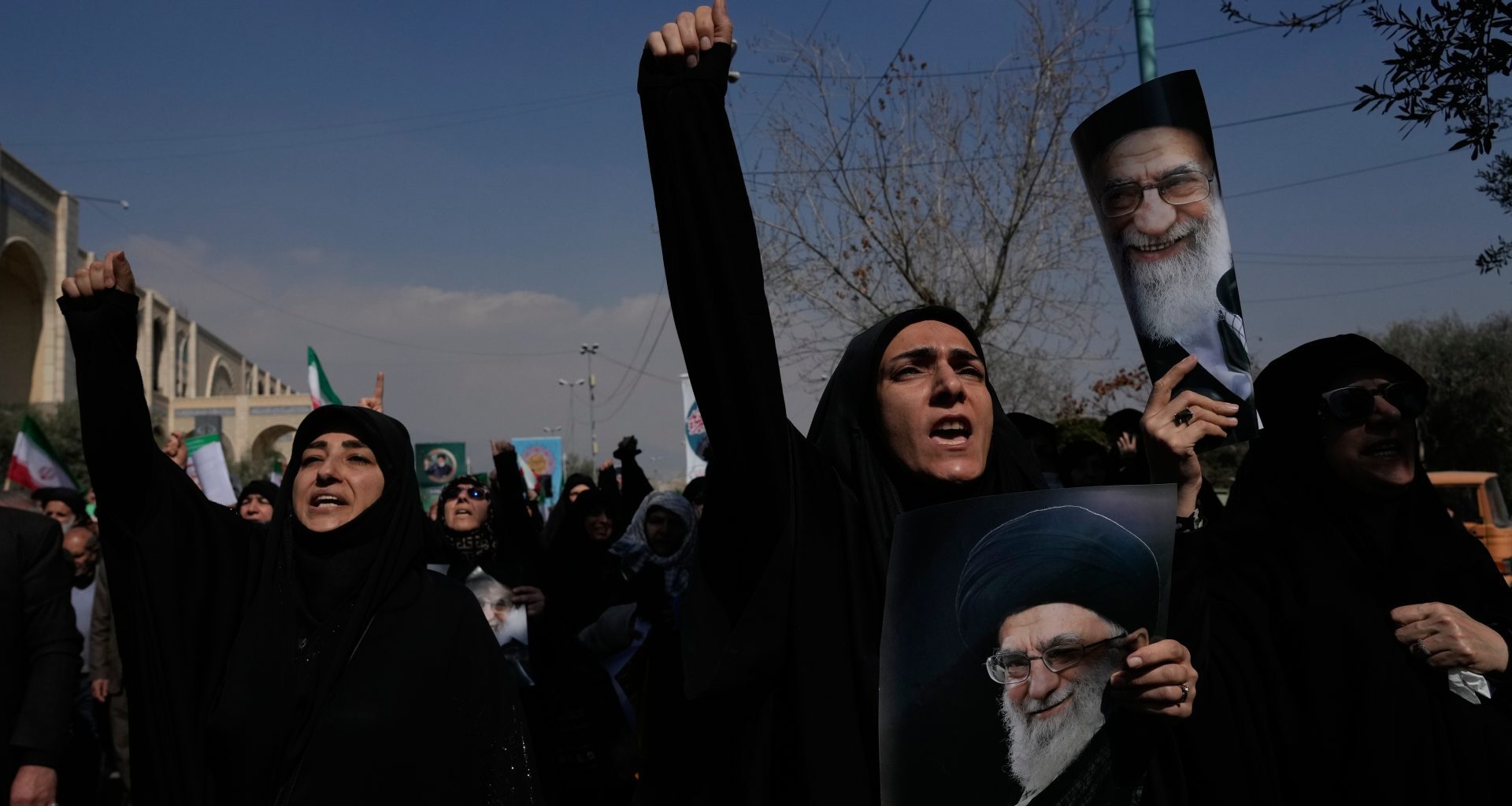
Students and staff at DePaul are concerned as the U.S. and Israel continue to bomb Iran, which has responded with its own attacks in the Middle East.
Last weekend, the U.S. and Israel began striking targets inside Iran, killing its Supreme Leader Ayatollah Ali Khamenei, dozens of high-profile figures and over 1000 innocent civilians.
Missiles struck a girls’ primary school in Minab, Iran, and killed 165 people, most of them children. Neither the U.S. nor Israel have taken responsibility.
Jasleen Aguilar, DePaul freshman studying marketing, is among those at DePaul who believe the U.S. should not have gotten involved.
“It was completely avoidable,” Aguilar said.
Rafael Barron, another DePaul freshman studying marketing, said although he doesn’t know much about the conflict between Iran and the U.S., he thinks starting a war is not the answer to bringing peace in the Middle East.
Barron said he has little faith that the U.S. will avoid further complicating the situation with Iran, pointing to the military’s past involvement in Venezuela as an example.
“Things will probably stay the same (that) we saw with Venezuela,” Barron said.
On Jan. 3, the U.S. military captured Venezuelan president Nicolás Maduro and his wife, Cilia Flores. Venezuela is now facing political instability that has led to a crisis with people being caught between uncertainties of what comes next.
Barron predicts the war with Iran will continue with even more aggression.
“I understand why they are retaliating. I just hope for peace in that region,” Barron said.
For the past few weeks, the U.S. has built a large military presence in the Middle East as President Trump pressures Iran to stop its nuclear program despite his claim that it was obliterated by the U.S. last year.
In a post on Truth Social, Trump said the U.S. has begun major combat operations against Iran. He said the strikes were aimed at destroying Iranian missiles and taking out Iran’s navy. He warned that American lives might be lost in the process and, so far, six members of the U.S. military have died from Iranian strikes hitting a base in Kuwait housing American troops.
“Our objective is to defend the American people by eliminating imminent threats from the Iranian regime,” Trump said in the video on his social media.
The interventions have placed the Iranian people at risk, raising fears about their safety and livelihood.
Iran state television said the country has launched a counterattack on U.S. bases across the Middle East. Iran also launched a missile attack on Israel, killing at least nine people and injuring 27.
Weeks before the U.S.-Israeli attacks, Iranian citizens had held the largest protests against the Islamic Republic. The Iranian government crushed the protests with crackdowns that killed thousands of people.
Scott Hibbard, a DePaul political science professor and an expert on American foreign policy in the Middle East, said to understand this current conflict, it is important to understand the events of 1953, when the U.S. and Great Britain overthrew Iran’s prime minister, Mohammad Mosaddegh.
Hibbard explained that Mosaddegh nationalized Iran’s oil industry, causing alarm between Great Britain and the U.S. during the Cold War. The CIA created an operation to support protests and political pressure that led to Mosaddegh being overthrown. The CIA then helped bring Shah Mohammad Reza Pahlavi to power, who would later be overthrown, leading to the Islamic Revolution.
Hibbard believes this current war was avoidable because Iran was not an imminent threat to the U.S.
“They don’t have ballistic missiles. They don’t have nuclear capability,” Hibbard said.
Hibbard also noted that under international law, there is a distinction between preemptive war and preventive wars. Preemptive wars are a response to imminent threats, often used as a defense measure. They are legal under international law. Preventive war is an action taken by the military to prevent a potential future threat.They are not legal unless they are in self-defense.
“This is the basis for why people are saying this war is illegal,” Hibbard said.
While the ultimate impacts of this war remain to be seen, Hibbard said he doesn’t think the Iranian people will overthrow their government anytime soon.
“The real concern is that there is going to be a greatly weakened secular government that will be strong enough to retain control within the country,” Hibbard said.
Aguilar, one of the DePaul freshmen, believes that it is not too late to stop this war through communication. She said some students are worried about getting drafted and having to fight in a war. But she thinks those concerns might be a little premature.
“That’s a bit extreme for now,” Aguilar said.
Related Stories:
Support Student Journalism!
The DePaulia is DePaul University’s award-winning, editorially independent student newspaper. Since 1923, student journalists have produced high-quality, on-the-ground reporting that informs our campus and city.
We rely on reader support to keep doing what we do. Donations are tax deductible through DePaul’s giving page.