
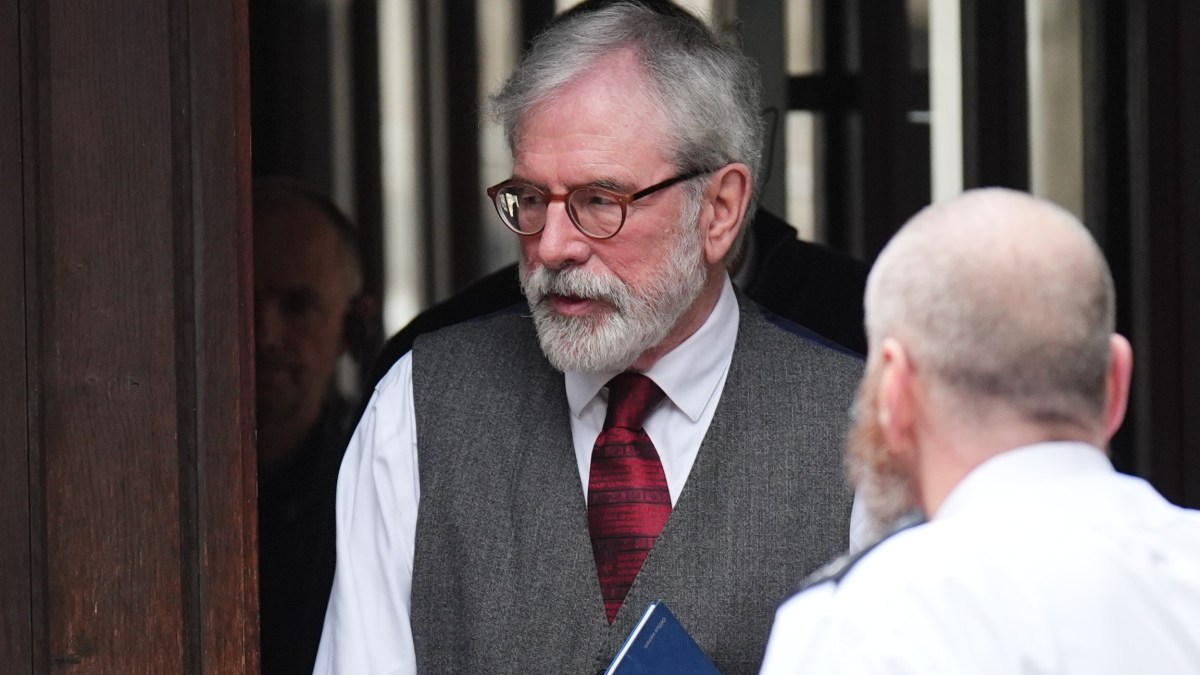
Gerry Adams was “directly responsible” for the IRA’s bombing campaign on the British mainland over a period of more than two decades, the High Court has heard.
Victims of IRA attacks on English soil are suing the former Sinn Fein leader — who attended court in what appeared to be a stab-proof vest worn beneath his waistcoat — over his alleged role as an IRA leader, a claim he has spent half a century denying.
The claimants alleged that Adams was “instrumental” in the attacks, pointing to a “jigsaw of evidence” from the British Army, police and past members of the IRA. The seven-day trial will scrutinise the alleged role played by Adams in the IRA’s armed campaign before a British judge for the first time.
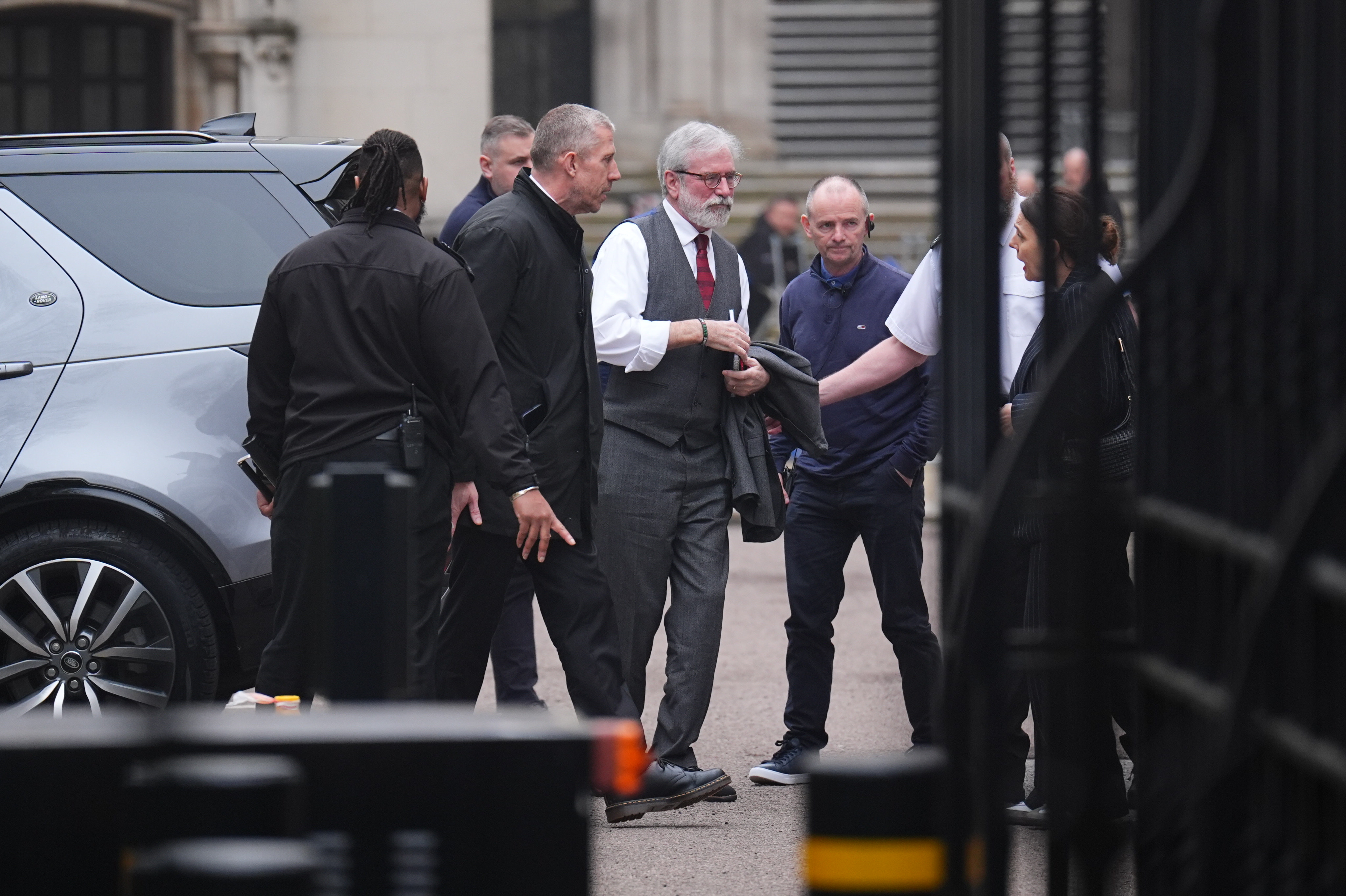
Adams, 77, appeared at the Royal Courts of Justice with a Palestinian flag badge pinned to the lapel of his grey suit, flanked by a team of bodyguards.
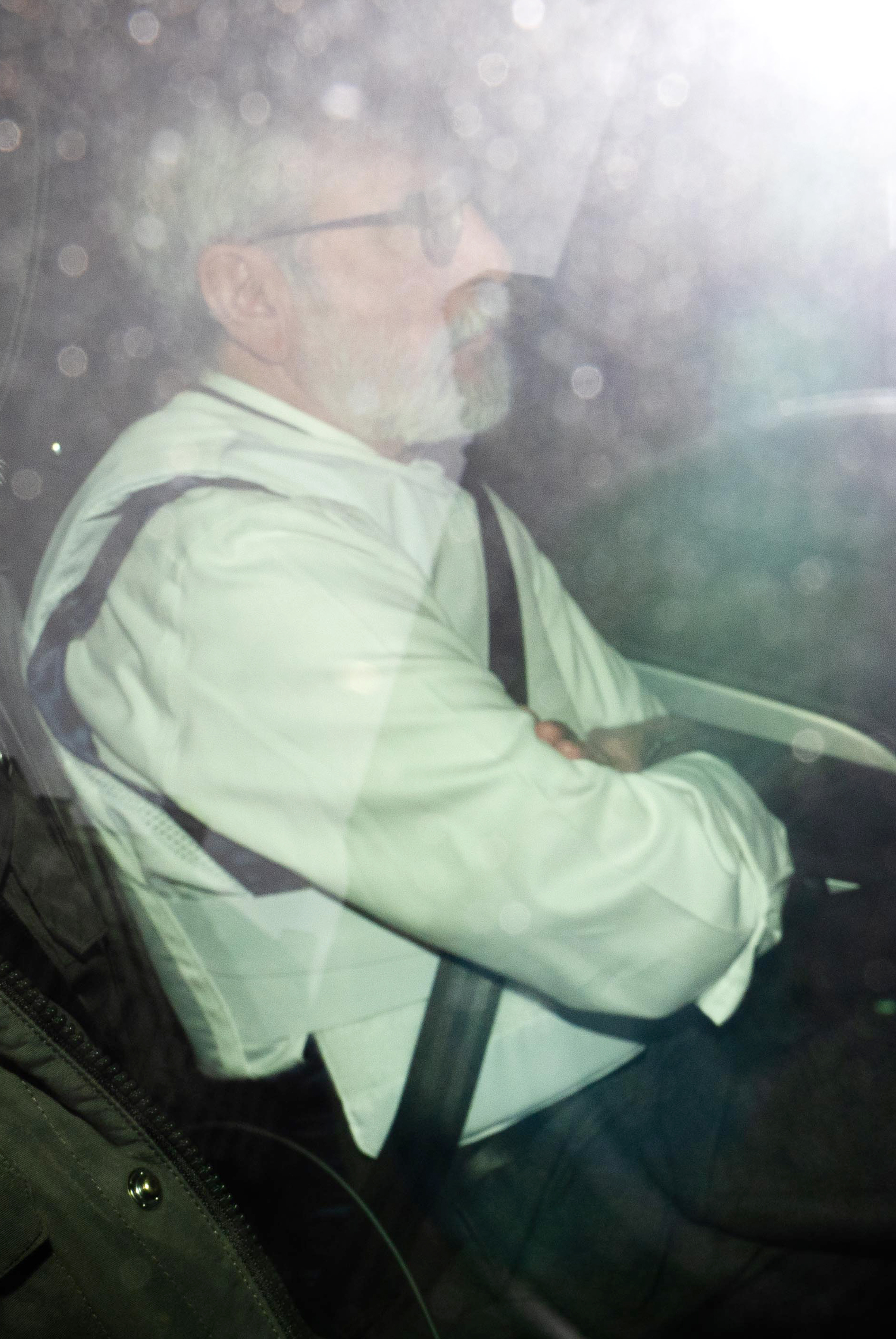
Adams was wearing protective clothing when he arrived at court
JAMES MANNING/PA
The case is led by three men who were injured in IRA attacks, including the paramilitary group’s first and last strikes on mainland Britain during the period now commonly known as the Troubles.
The trio of victims are seeking “vindicatory damages” of £1 in what their lawyer Anne Studd KC acknowledged was an “unorthodox” claim brought to “shine a light upon” Adams’s role in the violence that marred that 30-year conflict.
John Clark, an off-duty police officer, was among more than 200 people who were injured in 1973, when an IRA bomb exploded outside the Old Bailey in a co-ordinated attack on the capital.
His fellow claimant, Jonathan Ganesh, was injured when a 3,000lb IRA bomb that had been planted in a lorry devastated London’s Docklands area in February 1996. Two staff members in the newsagents run by Ganesh’s family, Inam Bashir, 29, and John Jeffries, 31, were killed.
In June 1996, Barry Laycock, a former rail worker, was among dozens who were injured when the IRA bombed the Arndale shopping centre in Manchester.
In a written opening to the case, Studd said that “none of these bombings … took place without the knowledge and agreement” of Adams. She said this knowledge came through his IRA membership and his place in its seven-man army council, adding: “There is no doubt that the defendant contributed to the peace in Northern Ireland, but the claimants say that on the evidence he also contributed to the war.”
The legal action was instigated by the group in 2022 before laws enacted by the Conservative government ending Troubles-era court cases came into effect. The case could be the last time that Adams is asked under oath about his IRA links.
Losing the case would prove deeply embarrassing for Sinn Fein and for Adams, whose image as an international peacemaker remains of huge value to the party.
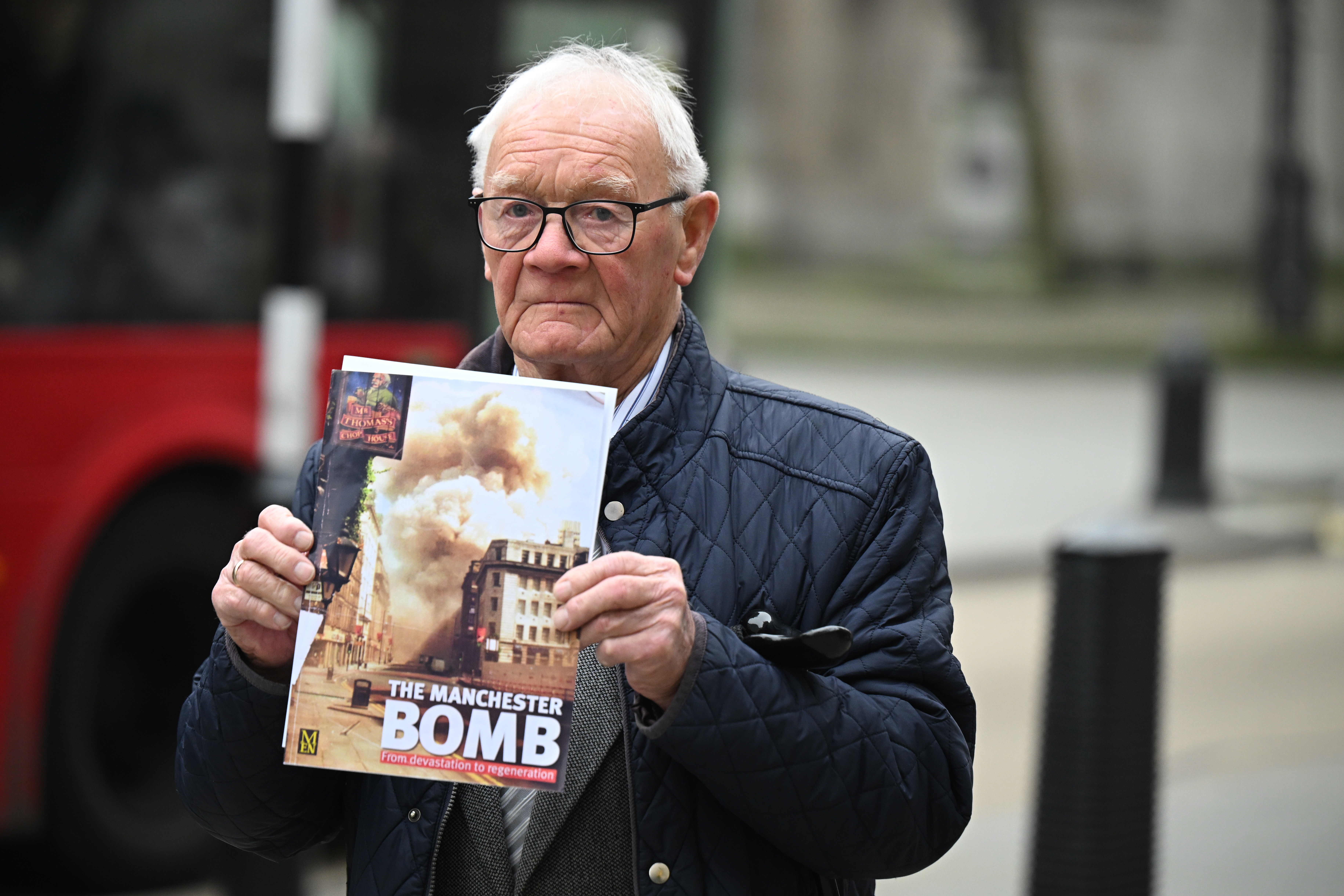
Barry Laycock at the Royal Courts of Justice. He was injured in the bombing of the Arndale centre in Manchester in 1996
LEON NEAL/GETTY IMAGES
But it is highly unlikely to have any repercussions in the criminal courts. The court will make its judgment on the “balance of probabilities”, the civil standard of proof that is lower than in criminal cases.
Troubles prosecutions are currently prevented under legacy laws, although the government is in the process of repealing this legislation and establishing a revamped investigations body for Troubles crimes. The cold-case investigations body already faces a mountain of cases with little reliable evidence available on which to base prosecutions.
The claimants’ case is based on an array of evidence from former republicans and members of the security services pointing to Adams’s alleged IRA activities. They have pointed to “detailed intelligence” seen by Richard Kemp, the former British army colonel, that focused on Adams’s role at the heart of the IRA machine.
The case stated that the information seen by Kemp, a former member of the Cabinet Office’s joint intelligence committee, “explicitly named” Adams as a member of the army council.
Two witnesses, a former member of the British Army’s intelligence section and a former member of the Royal Ulster Constabulary’s special branch, will give evidence anonymously. The former police officer said intelligence showed that Adams was a “senior member of the IRA army council and the de facto leader of the IRA”, the claimants’ opening stated.
Born in Belfast to a republican working-class family in 1948, Adams began his activism when the Troubles erupted in 1969. Having been interned without trial, he was released in 1972, aged 23, as part of a republican delegation secretly flown to London for negotiations with ministers over a possible IRA ceasefire.
The claimants rely on an account by the IRA’s then chief of staff, Seán MacStíofáin, who said that the team was from the IRA. A fellow Sinn Fein leader, Martin McGuinness, who died in 2017, was also in attendance at the meeting. He has publicly acknowledged his role as an IRA commander.
However, Adams insisted he was there as a member of Sinn Fein. The claimants said that Adams “had had a foot in both camps” of the IRA and Sinn Fein.
Among thousands of pages of evidence is an official document from March 1997 in which John Major, the prime minister, said that “Adams and McGuinness were both on the army council and had been so for many years”.
Adams has strenuously denied the claims that he had any involvement in the bombings.
Edward Craven KC, for Adams, told the High Court: “Mr Adams emphatically, unequivocally and categorically denies any involvement in the bombings. And he emphatically, unequivocally and categorically denies that he was ever a member of the IRA.”
He added: “Neither the law nor the facts support the claimants’ case against Mr Adams.”
Craven said that the claimants had “not adduced a single piece of direct evidence or contemporaneous documentary evidence” to show that Adams played any role in the bombings.
He further criticised the intelligence reports cited by witnesses for the claimants, adding: “Not a single page of any of those ‘intelligence reports’ has been disclosed.”
The legal case was based on “predominantly anonymous hearsay evidence”, Craven said. There was “no shortage of people with an axe to grind” against Adams, citing the British government and IRA volunteers opposed to peace.
Craven pointed out that Adams had never been arrested in connection with any of the bombings. Addressing wider claims about his alleged IRA role, he said that an IRA membership charge against him was dropped in 1978.
Craven also referred to Adams’s arrest by the Police Service of Northern Ireland over the 1972 murder of Jean McConville, a mother of ten children who was abducted from her west Belfast home never to return.
After being questioned for four days, prosecutors decided there was insufficient evidence to charge Adams, who criticised a “sustained, malicious, untruthful campaign” over his alleged involvement.
The claimants had originally sought to sue the IRA but this was struck out by a judge who ruled that it was not a legally entity.
Speaking outside court, Adams said: “I am here to defend myself and to challenge the allegations which have been made and we will let the court get on with its business.
“The only thing that I am guilty of is being an Irish republican, in believing in an end to British rule on our island.”
Adams said he chose to attend “out of respect to the claimants”.
“They were grievously hurt and three people were killed in these particular incidents. So I could have stayed away but I thought, in fairness, that I should come and face up to the charges which have been made,” he said.
The trial continues.