
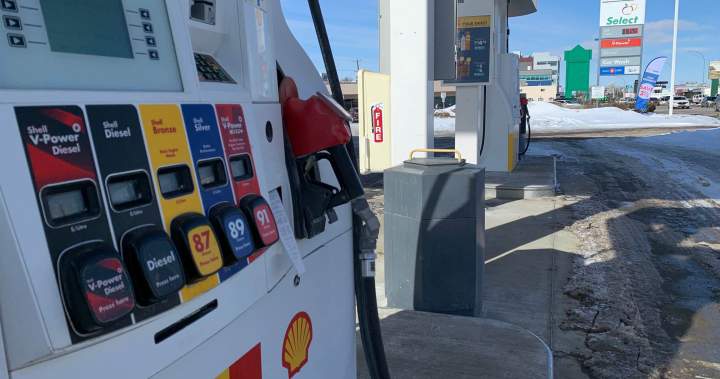
Wild swings in global oil prices are prompting renewed calls for the Alberta government to provide affordability relief, even as provincial officials say the current volatility makes decisions about tax measures difficult.

Alberta Finance Minister Nate Horner said the rapid changes in oil markets have already altered the province’s fiscal outlook since the government released its 2026 budget last month.
“The questions have changed a lot just in 10 days since I tabled the budget,” Horner said Monday.
The price of West Texas Intermediate oil hit nearly US$120 per barrel over the weekend before settling back below $100 late Monday. The peak was around $60 higher than the days before the U.S. and Israel launched the first wave of strikes on Iran on Feb. 28.
When the price of oil goes up, typically gas and other fuel costs rise too.
Story continues below advertisement
Despite the surge, Horner said it is still unlikely the province’s fuel tax relief program will be triggered.
Alberta’s fuel tax is 13 cents per litre for regular gas, and four cents per litre for marked gasoline and marked diesel.
Under Alberta’s relief program, quarterly reductions to the provincial fuel tax are introduced when WTI averages at least US$80 per barrel over a set review period of 20 trading days.
How the relief program works, according to the Alberta government:
The fuel tax will be suspended whenever prices are at or above $90.A partial fuel tax of 4.5 cents per litre will be applied whenever prices are $85 to $89.99.A partial fuel tax of nine cents per litre will be applied whenever prices are $80 to $84.99.The fuel tax will be fully reinstated whenever prices fall below $80.Fuel tax rates cannot increase by more than nine cents per litre per quarter when oil prices fall.

Get breaking National news
For news impacting Canada and around the world, sign up for breaking news alerts delivered directly to you when they happen.
The province is currently in a monitoring period that ends this week. Horner said only a sustained and unusually high price over the final days would make a difference.
“If oil were to average, say, above $110 for the last five days, it could trigger the lowest level of relief.
Story continues below advertisement
“So unlikely but not impossible.”
Alberta suspended the fuel tax for six months at the beginning of 2023 to help residents with costs due to inflation. The discount was extended to the end of that year before being reinstated Jan. 1, 2024, as energy prices softened.

1:59
Alberta government reinstating gas tax in 2024
The new volatility is already showing up at the pumps.
Gasoline prices rose across Alberta last week to around $1.50 a litre for regular, while diesel also rose about 40 cents, which experts say has a broader ripple effect, as the heavier fuel is at the core of the global economy.
The across-the-board fuel price increases are raising concerns about the wider cost of living because higher fuel prices can ripple through supply chains.
More on Economy
More videos
Story continues below advertisement
“Everything that moves around — if you put it on a truck and move it around — it’s going to get more expensive,” said Samir Kayande, the Alberta NDP’s affordability critic.
Although Canada is a net oil exporter, domestic fuel prices are tied to global benchmarks and reflect international volatility.
At the same time, the Canadian oil patch often benefits from higher global prices, which can boost revenues and investment even as consumers face higher costs at the pump.
1:58
Sheer calls on Liberals to ‘cancel the fuel standard tax’ amid global oil price surge
The increase also boosts the Alberta government’s bottom line, as resource royalties are a major source of income.
The province’s next fuel tax review period is scheduled for June, when officials will again evaluate whether relief should be applied.
However, Horner said the government is cautious about cutting a revenue source after projecting a $9.4-billion deficit, based predominantly on what, at the time, were sagging oil prices of US$60.50 per barrel.
Story continues below advertisement
“We can give that relief, so we stand by that, but any decrease in revenue — you saw the size of the deficit,” Horner said on Monday.
The Canadian Taxpayers Federation argues the province should act sooner, noting global instability continues to threaten energy markets.
“I know a lot of people are bracing themselves. Anything could happen in the Middle East,” said Kris Sims with the Canadian Taxpayers Federation.
The government says it is not ready to make a decision yet.
“Given the volatility of everything that’s going on, we’re going to take our time before making any decisions,” said Nathan Neudorf, Alberta’s minister of affordability and utilities.
Officials say the unpredictable oil market continues to shape the province’s fiscal outlook and the financial pressures facing Albertans.
© 2026 Global News, a division of Corus Entertainment Inc.