
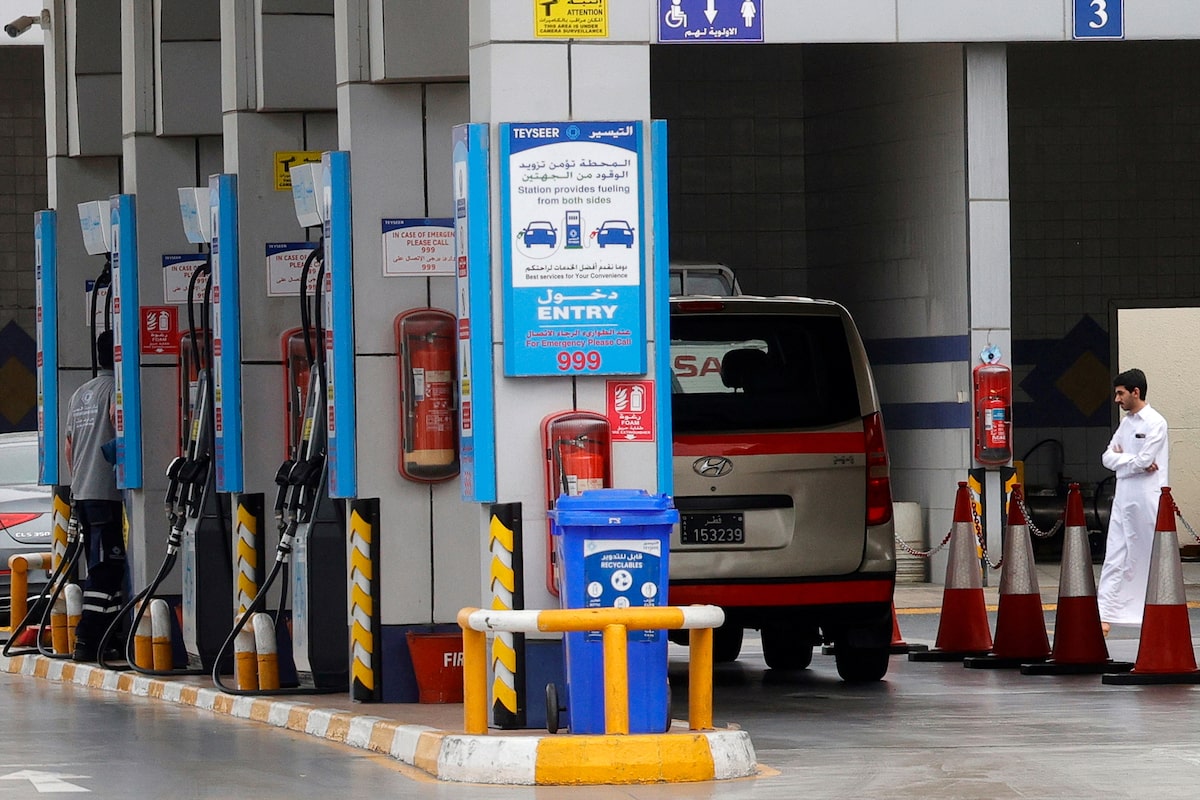
Drivers stop at a gas station in Doha, Qatar, to fill their vehicles. The Middle East war sent oil prices spiraling above $100 a barrel on Monday.-/AFP/Getty Images
John Rapley is a contributing columnist for The Globe and Mail. He is an author and academic whose books include Why Empires Fall and Twilight of the Money Gods.
When the North American markets opened on Monday morning, the oil price was up a further 10 per cent and stocks and bonds were down. However, the near-panic that had greeted the opening of Asian markets earlier in the day, when oil was heading north of US$110 a barrel, had subsided. This still looked like an orderly sell-off rather than the much-feared rush for the exits. By the end of the day, markets turned positive.
Traders had been somewhat soothed by the announcement the G7 would look into a co-ordinated release of strategic oil reserves. Although the U.S. reserve is depleted, Japan could release a lot onto the market, so the price rises could be contained for now. More generally, investors were still pricing in a relatively short war – and they could be right. U.S. President Donald Trump said Monday afternoon the war could end soon. The futures markets indicated that traders expect world oil prices to begin falling by the summer and to have largely settled back down by the end of the year.
By and large, the world’s stock markets are now more or less where they were at the start of the year. Meanwhile, interest rates on government debt, while rising, aren’t skyrocketing. To date, therefore, the oil shock coming out of the Middle East is causing some setbacks but doesn’t look to be anything like what the world experienced in the 1970s.
Elevated energy prices in store as Middle East conflict intensifies
Nevertheless, there are signs that things could turn worse. Iran’s hardliners made a show of loyalty to new Supreme Leader Mojtaba Khamenei on Monday, telegraphing that it was not backing down. Mr. Trump, who wants a say in choosing Iran’s new leader, has called Mr. Khamenei unacceptable. The signals are thus conflicting.
The longer the war continues, the longer it will take for supply chains to normalize and backlogs to clear. Prices on fertilizer have risen sharply, which may well lock in higher food prices later in the year. Prices on aluminum and shipping are also up, owing to shortages from regional production and rising insurance costs. And even though futures traders expect oil prices to have come back down by year’s end, they also expect them to settle at a higher level than previously anticipated.
In short, the rest of the year will likely feature at least moderately higher inflation across the world. While the scale of that shock won’t be remotely like what happened in the 1970s, when the outbreak of war in the Middle East caused inflation to more than double in two years and shoot into the teens, this particular shock hits the world economy at a delicate time.
That’s because the three big engines of the world economy – China, Europe and the United States – are all starting to sputter. China last week dropped its growth target below 5 per cent, in recognition that its economy is slowing and that raising the consumption share of its economy will be more difficult and take longer than previously thought. Meanwhile, its export-led model will run into obvious difficulties as global consumption, affected by even a modest increase in inflation, will take a hit.
South Korea to impose first fuel cap in nearly 30 years as Iran war sends cost of oil soaring
Europe, for its part, is still in a funk, and is being especially hard hit by the energy price rises. Rather foolishly, in hindsight, the continent followed U.S. President Donald Trump’s cue last year and slowed down its planned energy transition in order to buy gas from the U.S. and the Middle East. Now, with gas supplies cut off, energy prices are soaring there, which will boost inflation and slow growth.
Meanwhile the U.S. economy appears to be slowing. As last week’s job report revealed, the labour market is weakening rapidly – in fact, no new jobs have been created in the American economy in nearly a year. Yet there are also signs inflationary pressures are building, and the rise in oil prices will add further fuel to that fire.
That will make it harder for the Federal Reserve to stimulate a weak job market with rate cuts – it bears noting that bond yields kept rising on Friday, despite the bad employment report. That, in turn, could put a further brake on the stock market. It’s been trading sideways since the autumn, and even if it withstands the oil shock, it may not rise that much this year.
If it doesn’t, the wealth effect that has kept rich Americans spending lavishly over the last year will evaporate. Already their less fortunate compatriots have been forced to run down their savings and tighten their belts, so if the weakening consumption in the bottom half of the population is now joined by a similar trend in the top half, the economy will slow considerably. And yet the U.S. stock market entered this war with expectations of future profit growth very high, leverage high and stocks richly valued. It is, in short, priced for perfection. If the economy turns out to be less than perfect this year, there could yet be a sharp correction.
The U.S. economy needs this war to end fast and stability to return to the Middle East. If it doesn’t, the whole world will get caught in the downturn.