
 Play Brightcove video
As Trump claims the war against Iran is nearly over, ITV’s Bulletin Reporter Philip Sime, GMB Presenter Ranvir Singh and GMB Correspondent Nick Dixon have the latest.
Trump has told reporters that the war will be over “very soon” and confirms “very good” call with Putin
Earlier, oil prices skyrocketed to nearly $120 (£89.87) a barrel – the highest in four years – before falling again
At least 1,205 civilians have been killed in Iran since the conflict began, according to the US-based Human Rights Activists News Agency (HRANA).
Chancellor Rachel Reeves said the conflict is “likely to put upward pressure on inflation” in the UK, as a second ship is being prepared for deployment
Iran has fired more drones and missiles at Gulf Arab countries, as US President Donald Trump sent contradictory signals about how long the war could last.
On a day in which oil prices rose to a four-year high, before falling slightly, Trump wrote online on Monday that Iran will be met with “Death, Fire and Fury” if Tehran prevents the transport of oil across the Strait of Hormuz.
In addition to firing missiles and drones at Israel and at American bases in the region, Iran has also been targeting energy infrastructure, which, combined with its stranglehold on the Strait of Hormuz, has sent oil prices soaring.
Trump wrote on Truth Social on Monday night that “If Iran does anything that stops the flow of Oil within the Strait of Hormuz, they will be hit by the United States of America TWENTY TIMES HARDER than they have been hit thus far.
“Additionally, we will take out easily destroyable targets that will make it virtually impossible for Iran to ever be built back, as a Nation, again — Death, Fire, and Fury will reign upon them — But I hope, and pray, that it does not happen!”
Speaking on Tuesday, Israeli Prime Minister Benjamin Netanyahu said the US-Israel military campaign was “breaking their [Iran’s] bones”.
A thick plume of smoke rises from an oil storage facility hit by a U.S.-Israeli strike in Tehran, Iran, March 8, 2026. Credit: AP
Trump, who has previously said that the war could last for a month or longer, sought to downplay growing fears it could become a long-term regional conflict, saying the war against Iran will be over “very soon”.
The war began with joint US-Israeli attacks on Iran on February 28 and has since escalated to the wider region, with Iran striking its Gulf neighbours and Israel launching an offensive in southern Lebanon and Beirut.
On Tuesday, Iran fired missiles into the United Arab Emirates and Bahrain, while Saudi Arabia said it had destroyed two drones over its oil-rich eastern region and Kuwait’s National Guard said it had shot down six drones.
What has Trump said?
Speaking to reporters on Monday night, the US president said the military is ahead of its initial timeline “by a lot” as he indicated fighting could soon come to an end – despite the Pentagon posting on social media the same day: “We have Only Just Begun to Fight.”
“We are achieving major strides towards completing our military objective – some might say they are pretty much complete,” Trump said.
Trump also repeatedly referred to the war as an “excursion” and claimed it was “protecting the world from what these lunatics are trying to do”.
He said that Iran’s missile capability had been reduced to a fraction of what it was and that its navy had been destroyed.
“We are winning decisively,” he added.
When asked to clarify whether it is the end or the beginning of the war, Trump responded: “It’s the beginning of building a new country.”
Iran has effectively stopped tankers from using the Strait of Hormuz, the shipping lane between the Persian Gulf and the Gulf of Oman — the gateway to the Indian Ocean — through which 20% of the world’s oil is carried.
Attacks on merchant ships near the strait have killed at least seven sailors, according to the International Maritime Organisation.
President Trump has claimed the war against Iran will be over “very soon”. Credit: AP
Netanyahu has vowed to continue striking in Iran, and continued attacks in southern Lebanon were reported on Tuesday.
Iran launches drones at Saudi Arabia and Kuwait
Iran fired drones towards Saudi Arabia and Kuwait early on Tuesday morning.
The Saudi Defence Ministry said it destroyed drones in the king’s oil-rich eastern region, as the National Guard in Kuwait confirmed it shot down drones in the country’s northern and southern areas.
Incoming missile sirens sounded across Dubai as well as Bahrain.
The United Arab Emirates said on Monday it had detected 253 ballistic missiles since the conflict began, of which 233 were destroyed and 18 fell into the sea. Two missiles fell on the country’s territory, the country’s Ministry of Defence said.
Four people have been killed, and 117 others have suffered minor injuries, the statement said.
The country has also detected 1,440 Iranian drones, 81 of which fell within the country and 1,359 of which were intercepted.
Iran’s Revolutionary Guard says it will determine when the war ends
The parliamentary Revolutionary Guard said on Tuesday that the end of the war will be determined by Iran.
Spokesperson Ali Mohammad Naini said in a statement published across various Iranian state media and apparently in response to Trump’s comments on Monday that “Iran will determine when the war ends.”
The country is currently experiencing a toxic “black rain” in Tehran, following Israeli and US strikes on oil depots, which is “indeed a danger” for Iranians, the UN health agency says.
Iranian authorities are advising people to stay indoors.
Around 20% of the world’s oil supply travels through the critical Strait of Hormuz Credit: iStock
UK brings second ship to “heightened readiness”
Britain is preparing to deploy the RFA Lyme Bay, a Bay Class Landing Ship, in the Eastern Mediterranean, the Ministry of Defence said on Tuesday.
The ship is capable of offloading troops and armoured vehicles to shore, and is “well-suited for humanitarian and disaster relief missions”, according to the Ministry of Defence (MOD).
The UK said last week it was sending warship HMS Dragon to Cyprus after a British base on the island was hit by a drone.
Oil prices fall back after soaring to a four-year high
An estimated 20% of the world’s oil supply has now been disrupted as a result of the conflict in the Middle East.
Oil prices soared to nearly $120 a barrel – a four-year high – fuelling global fears of rising inflation as the escalating conflict entered its second week on Monday, but hours later had fallen back significantly to below $90.
Before the war began, oil was priced at around $60-70 per barrel.
Concerns regarding the impact on UK households’ bills remain, as energy bills are forecast to rise by 10% from July.
Trump commented several times on the price of oil on Monday, seeking to alleviate concerns about a prolonged price increase.
He told journalists that any attempt by Iran to stop the globe’s oil supply would mean it would “get hit at a much, much harder level”.
Israeli forces target Hezbollah’s financial arm
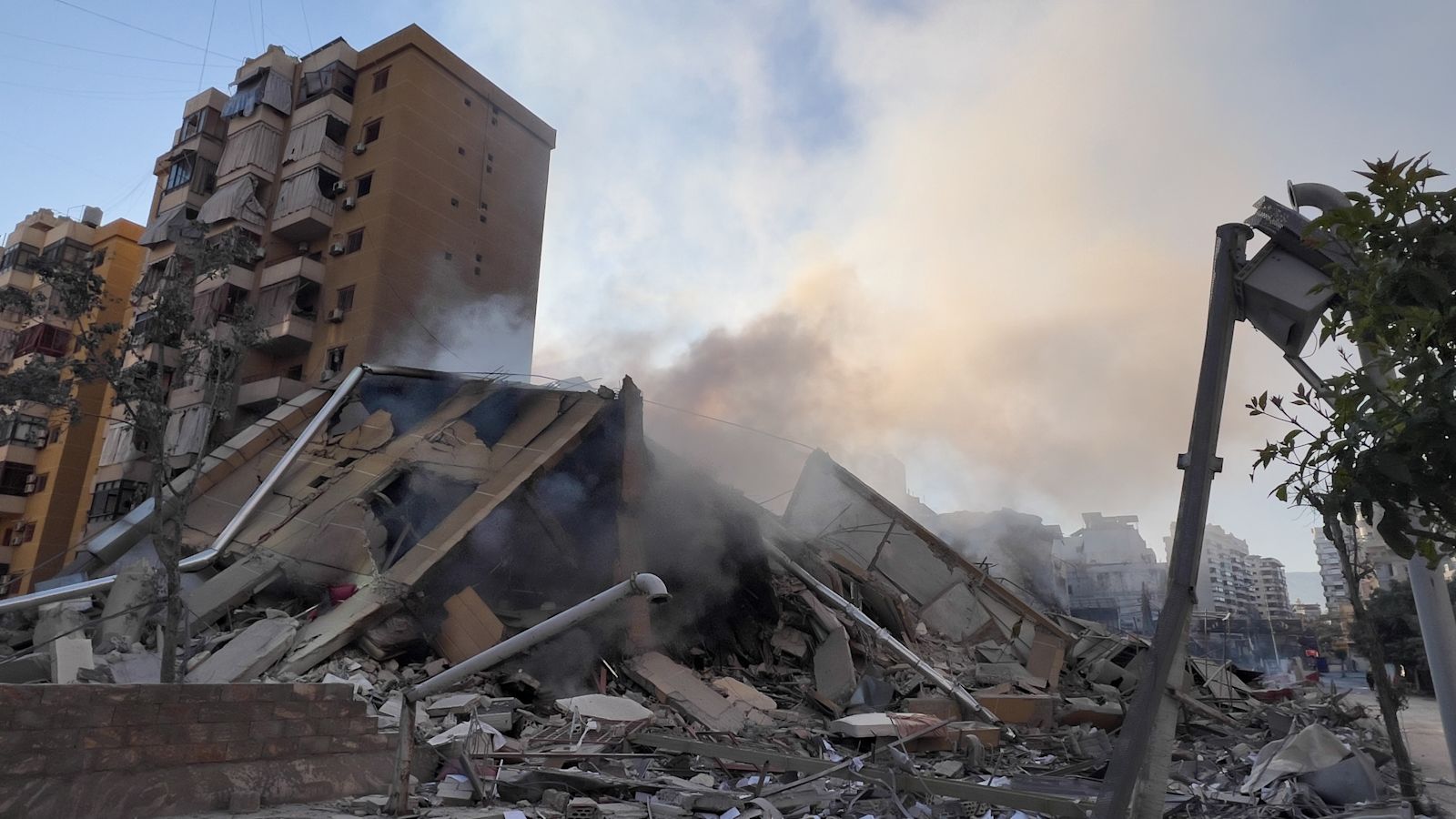
The Israeli military reiterated calls for residents in the south of Lebanon to evacuate their homes as it planned to “operate forcefully” in the area against Hezbollah forces.
Nearly 700,000 people, including around 200,000 children, have been forced to leave their homes in the last week, the UN Children’s Fund (UNICEF) said in a statement.
The death toll rose to 486, with 1,313 people injured, the Lebanese Health Ministry said Monday evening.
It comes as Israel says it has completed a series of strikes which targeted Hezbollah’s financial arm, al-Qard Al-Hasan.
Israel says Hezbollah uses al-Qard Al-Hasan to finance its military activities.
A destroyed building that housed a branch of Al-Qard Al-Hassan, run by Hezbollah which was hit by an Israeli airstrike. Credit: AP
US behind strike on Iranian school, investigation suggests
A video clip “appears to contradict” Trump’s claim that Iran was responsible for a February 28 strike on an Iranian school that killed more than 165 people, investigative group Bellingcat has said.
The footage shows a Tomahawk cruise missile – which only the US is known to possess in this war – falling on a building and sending a dark plume into the air. Both Bellingcat and AP geolocated the video to a site near the school.
Speaking about the attack on Monday, Trump claimed many countries had Tomahawk missiles, including Iran.
When pressed by journalists on the issue, he said: “I just don’t know enough about it.”
He added that “whatever the report shows, I’m willing to live with that report”.
Defence Secretary Pete Hegseth said the US was investigating what happened.
Rescue workers and residents search through the rubble in the aftermath of a strike on a school Credit: AP
Subscribe free to our weekly newsletter for exclusive and original coverage from ITV News. Direct to your inbox every Friday morning.
Australia grants asylum to five members of the Iranian women’s football team
Five members of the Iranian women’s football team were granted asylum after calls for the Australian government to help the women.
Trump joined Iranian groups urging the Australian government to help the women after they were knocked out of the tournament over the weekend and faced the prospect of returning to a country under bombardment and possible punishment by the regime for not singing the national anthem before their opening match.
Five members of the Iranian women’s football team, who have been granted asylum in Australia. Credit: AP
Iran’s new supreme leader
Crowds gathered on Monday, holding Iranian flags in support of Iran’s new supreme leader.
Mojtaba Khamenei was named as the next supreme leader to succeed his father, according to state media, after his father Ali Khamenei was killed in US-Israeli strikes on February 28.
“The valuable choice of Ayatollah Seyyed Mojtaba Hosseini Khamenei is a manifestation of the people’s will in governance,” Iran’s president Masoud Pezeshkian said in a post on X.
Mojtaba Khamenei has not been seen publicly since the war began, while Iran’s state TV appeared to refer to him as the “injured veteran of Ramadan” on Monday, causing some media outlets to report he had been wounded in conflict.
People march in support of Ayatollah Mojtaba Khamenei as successor of his late father Ayatollah Ali Khamenei, as supreme leader. Credit: AP
Seventh US service member killed in Iran brought home in dignified transfer
US Vice President JD Vance joined the family of a Kentucky man who was the seventh US service member to die in combat.
The dignified transfer, an event that honours US service members killed in action, took place at Dover Air Force Base in Delaware for Army Sgt. Benjamin N. Pennington, 26, of Glendale, Kentucky.
He died on Sunday after being wounded during an attack on the Prince Sultan Air Base in Saudi Arabia, the Pentagon said.
Vice President JD Vance joined the grieving family of a Kentucky man who was the seventh US service member to die in combat. Credit: AP
How did we get here?
Israel and the US launched what they described as “pre-emptive” strikes against Iran just before 6.30am on February 28, which they view as intent on acquiring nuclear weapons, shortly after a round of negotiations.
Iran denies seeking nuclear weapons, and some legal experts have said the attack violated international law. The Islamic Republic has responded by striking Israel and several targets in Gulf states allied with the US.
The war’s stated goals and timelines have repeatedly shifted as the US has at times suggested it seeks to topple Iran’s government or elevate new leadership.
While US President Donald Trump previously dismissed the idea of boots on the ground in Iran, he did not rule it out when asked on Saturday.
He said US troops could “possibly” be sent on the ground in Iran, as the war continues, but there would have to be a “very good reason”.
Reporting History sees journalists join News At Ten anchor Tom Bradby to revisit their remarkable on-the-day reports of the defining events of the modern age. Listen to the episodes below…