
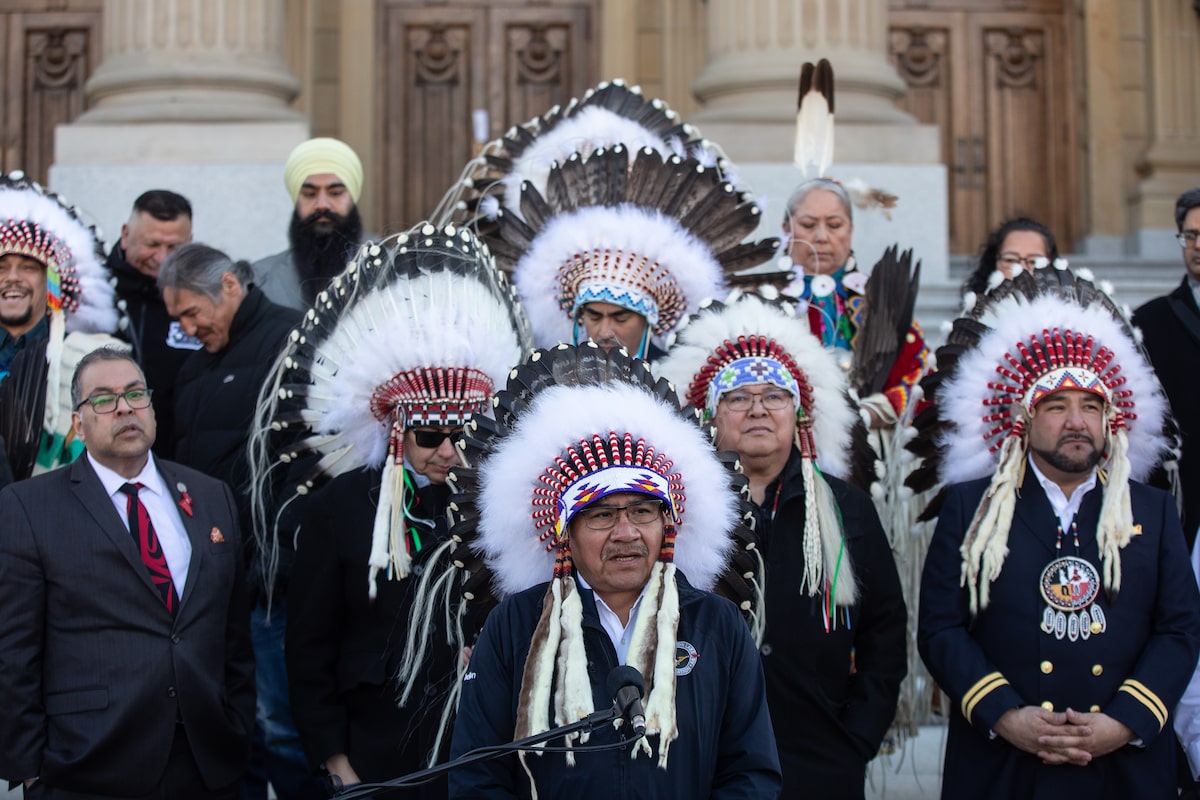
Chief Sheldon Sunshine speaks as First Nations chiefs, band councillors and elders gather to call on Premier Danielle Smith’s government to stop a push for the province to leave Canada, at the Alberta legislature in Edmonton, on Monday.JASON FRANSON/The Canadian Press
About a dozen Alberta First Nation chiefs sat quietly in the gallery at the provincial legislature during Question Period on Monday as talk of separation from Canada dominated the back-and-forth between the Official Opposition and government.
But the chiefs, guests of the Alberta NDP, were there to show their opposition to the looming separatist petition that’s trying to force Albertans to vote later this year on whether to remain a part of Canada or form an independent state.
Wearing their traditional headdresses and garments, the chiefs watched the sitting, often glaring at Premier Danielle Smith as she defended her government’s response to the independence movement that the New Democrats have described as tepid.
“This is not a game about pick-and-choose where you want to go,” said Athabasca Chipewyan First Nation Chief Allan Adam after Monday’s session.
“If you want to go somewhere, you come and tell us if it has something to do with us, because we are not in favour of the colonial behaviour that treated us and mistreated us for 127 years.”
Opinion: Alberta cannot just up and leave Canada
The province is careening toward the early-May deadline for separatists to collect the nearly 178,000 signatures required to force a referendum on Alberta leaving Confederation. Independence leaders haven’t shared how close they are to reaching that mark, but have been running signature collection events across the province for weeks.
Ms. Smith, meanwhile, has scheduled a wide-ranging referendum on immigration and constitutional issues for mid-October, which she has said would include the independence question if the petition is successful.
The gathering of the chiefs in Edmonton was the latest in a number of symbolic and legal protests against the separatist movement and the governing United Conservative Party. They have argued the independence petition would trample their treaty rights, and in late February, the Assembly of Treaty Chiefs of Treaty 6, 7 and 8 unanimously passed a symbolic vote of non-confidence in the UCP government, saying the province has failed “to meet Treaty-based constitutional and governance responsibilities” with the prospect of an independence referendum.
In the House, New Democrat Leader Naheed Nenshi and his caucus used their allotted time in Question Period to press the provincial government on separatism, arguing an independence referendum would be unconstitutional and ignores First Nations’ concerns.
“The Treaty chiefs have said and believe that this UCP government cannot responsibly and respectfully govern this province. They say that this conversation about separatism is leading to political instability and that the relationship is fundamentally broken,” Mr. Nenshi said.
Smith defends Alberta separatists after Eby’s ‘treason’ remarks
The Premier said her government has met regularly with many of the First Nations leaders and has partnered with them on a variety of areas of joint responsibility. She then pointed to the Canadian Constitution and argued Alberta remains concerned with the province’s relationship with Ottawa.
“I think we need to be clear that sovereignty is not the same as separation,” Ms. Smith said. “Sovereignty is the federal government respecting our areas of jurisdiction.”
Alberta Indigenous Relations Minister Rajan Sawhney later defended the province’s legislation that allows citizen-led referendums, saying the province has no obligation to implement citizen-led petitions that violate the Constitution.
As the large group of First Nation leaders gathered on the steps of the legislature, flanked by members of the NDP caucus, many of them took aim at Ms. Smith and her government.
Siksika Nation Chief Samuel Crowfoot said the sitting government has not consulted First Nations on issues including but not limited to separatism. In his prepared remarks, Mr. Crowfoot also said Monday’s demonstration was not a partisan issue.
“Our presence here today is being about pro-treaty, about pro-coexistence, pro-rule of law, about honouring the historical covenants that allowed for the expansion of Alberta in this modern-day iteration today,” Mr. Crowfoot said.
First Nations leaders urge Albertans to oppose separation
First Nations have roundly denounced the movement and legislative changes Ms. Smith’s government has pursued to make it easier for citizen-led referendums to reach a ballot.
In late January, a coalition of First Nations chiefs, some of whom were at the legislature Monday, urged Albertans to stand against independence, saying that allowing a separatist petition to proceed is a direct violation of both treaty agreements and the Canadian Constitution.
The First Nations are also hoping to quash the potential independence referendum by seeking an injunction from the courts.
Sturgeon Lake Cree Nation, a band in northwest Alberta, in January filed a lawsuit in the Court of King’s Bench against the Alberta and Canadian governments and Alberta’s chief electoral officer in an effort to suspend the separatist petition.
In the suit, Sturgeon Lake argues that separation would be impossible without First Nations’ consent, and that an independence referendum would be fertile ground for foreign interference.
An affidavit filed by national-security expert Wesley Wark with the Sturgeon Lake lawsuit said separatist leaders’ meetings with the U.S. – which were condemned in January as “treason” by some political leaders – are one of several foreign-interference threats that would be invited by an independence referendum.
Mikisew Cree First Nation has also filed a lawsuit against Alberta’s referendum and citizens’ initiative legislation.
Ms. Smith has set Alberta’s referendum date for Oct. 19.