
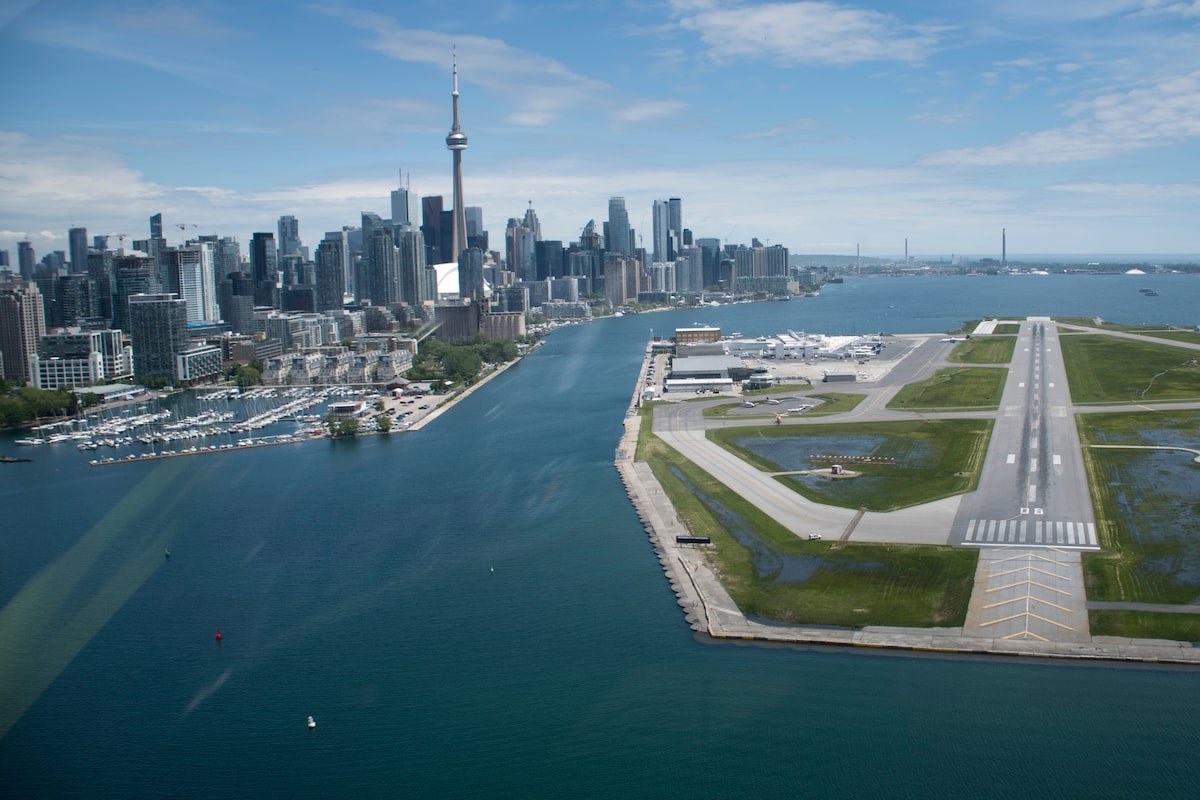
Billy Bishop Airport in Toronto, in June, 2019.Fred Lum/The Globe and Mail
Ontario Premier Doug Ford is vowing to forge ahead with the expansion of the runways at Toronto’s Billy Bishop Airport to allow jets − and a provincial source says his government would consider taking over the city’s stake in the facility if the municipality objects.
Facing reporters at an unrelated event on Monday, Mr. Ford repeated comments he has made in recent days supporting the expansion of the “crown jewel” island airport and allowing jets to land there, instead of the current fleets of turboprop passenger planes run by Porter Airlines and Air Canada.
However, the province is not actually involved in overseeing the waterfront airport, as the facility has long been governed by a decades-old tripartite agreement between the city, the Toronto Port Authority (a federal agency), and the federal government.
This deal bans jets, which have long been contentious along Toronto’s waterfront, where activists have warned of noise, disruption and safety concerns, and the further lengthening of the runways. Landing jets has also been vigorously opposed in the past by Mayor Olivia Chow, a former local NDP MP and city councillor.
A provincial source familiar with internal discussions said that if consensus could not be reached, the province would consider using its powers to expropriate the city out of its interest in the airport and the tripartite agreement, potentially allowing the deal to be renegotiated to allow jets over municipal objections.
Opinion: If Toronto can’t imagine its future, Doug Ford will
The Globe and Mail is not identifying the source, who was not authorized to reveal government deliberations.
Asked to comment on the idea, Grace Lee, a spokeswoman for Mr. Ford, said in an e-mail that more information would be available “once things are final and we have more details to share.”
Speaking on Monday at a health care event in New Tecumseth, Ont., north of Toronto, Mr. Ford was not asked about the notion of expropriating the city’s stake. But he said his idea to allow jets has the support of Prime Minister Mark Carney’s government. Internal government polls, he said, also show public support. And he even suggested Ms. Chow was on board with an expanded airport, but not with jets.
“We’re going to move forward with the Island airport, with co-operation with the federal government. And I know Mayor Chow wants to expand it. She may disagree with the jets, but those jets are coming in there, one way or another,” he said. He also dismissed the small number of people who live in homes on the Toronto Islands as “squatters.”
Mr. Ford said bringing jets to the island would make Billy Bishop a more viable alternative to Pearson International Airport and give travellers more options.
Ms. Chow was not made available for an interview. In an e-mail, spokesman Shirven Rezvany said that a “vibrant waterfront means balancing all uses.” He said city staff, the port authority and Transport Canada were proceeding with a “robust public process” to update the airport’s master plan and that Ms. Chow “welcomes the province’s involvement in that process.”
Airport to park: A bold vision for the Toronto Island
At a separate event on Monday at Billy Bishop to announce new U.S.-customs preclearance facilities, federal Transport Minister Steve MacKinnon said Ottawa is taking a “long look” at the expansion issue alongside its partners, including the city. He didn’t directly answer the question about being in support of Mr. Ford’s expansion plan, but noted the city’s growth and the congestion at the much larger Pearson Airport.
Asked whether the city would have to be removed from the agreement to expand the airport, Mr. MacKinnon replied: “That’s not our decision. We have a partnership with the city. It’s been one that has stood the test of time.”
Mr. MacKinnon later added, referring to the tripartite agreement, that “all of the decisions that are made with respect to this facility, this infrastructure, are made at that table.”
Just last year, the city agreed to allow the expansion of the airport’s runway buffer areas, as required by new Transport Canada rules. The move will see the land extended 150 metres into the lake on each end, to allow the current turboprop fleet to continue landing there. Toronto also approved an extension of the tripartite agreement on the airport to 2045, to allow for the port authority to finance the cost of extension, estimated at around $65-million. It has to be completed by July, 2027.
Norman Di Pasquale, a community activist and the chair of group NoJetsTO – largely dormant since the issue appeared resolved after being raised in 2013 – said in an interview that he is gearing up to restart the fight against jets.
He says expanding flights and allowing jets would “reindustrialize” Toronto’s waterfront, spoiling its island beaches and parks with noise and disruption and putting its redeveloping waterfront under a busier flight path.
Opinion: The only thing holding us back from Toronto’s best park? An airport
“Sailors, boaters and kayakers have less space. There was talk last time of a jet-blast wall, so that the jet blast doesn’t knock your sailboat clean over, and you with it,” said Mr. Di Pasquale, a former school trustee and federal NDP candidate.
Roelof-Jan Steenstra, president and chief executive officer of the Toronto Port Authority, told reporters on Monday that noise and emissions are critical considerations and that it’s important to proceed “in a very responsible manner.” He added that aircraft technology has moved “so far beyond what is was in 1983,” when the tripartite agreement was first signed.
Currently, Porter Airlines flies 70-seat De Havilland Dash-8-400 turboprops, also known as Q-400s, which it boasts meet the world’s most stringent noise standards. Company spokesman Brad Cicero said in an e-mail on Monday that Porter had no “specific information” about plans to allow jets.
But he said the company supports allowing “smaller modern jets that fit the airport’s scale,” citing the Embraer E195-E2 it flies out of Pearson, which he said is among the jets with “noise and emission profiles similar to the turboprop plans already using the airport.”
Claire Pfeiffer, a spokeswoman for the Toronto Port Authority, said in e-mail on Monday that the province has indicated an interest in “the modernization of the operations and governance structure to enable modern aircraft to fly to/from the airport,” but that it was still “very early days.” She said the idea is not for bigger aircraft, but for planes that are “cleaner and quieter” than the current ones.
When the issue of allowing jets last reared its head, via a proposal from Porter in 2013, the airline said it would need an additional 168 metres on each end of its runways and that it was buying Bombardier CS100 jets, which seat 100-125 passengers and are now made by France’s Airbus. Porter submitted a consultants’ report to the city that said these jets have a “similar noise footprint” to the existing turboprops.
While the city, with the Premier’s brother Rob Ford as mayor at the time, launched a study of the plan, the federal Liberal government of Justin Trudeau quashed the idea in 2015.
Critics also say that any expansion would also require a rethink of the foot of Bathurst Street, where access to the airport is flanked by a park and a community centre, with limited parking and pickup-and-dropoff access. Currently, the airport says it handles 2.8 million passengers a year, or an average of 7,600 a day.
Editor’s note: A previous version of this story included the name Ports Toronto as an alternative title for the Toronto Port Authority. The agency announced it was dropping the use of Ports Toronto in January and returning to its official name.