
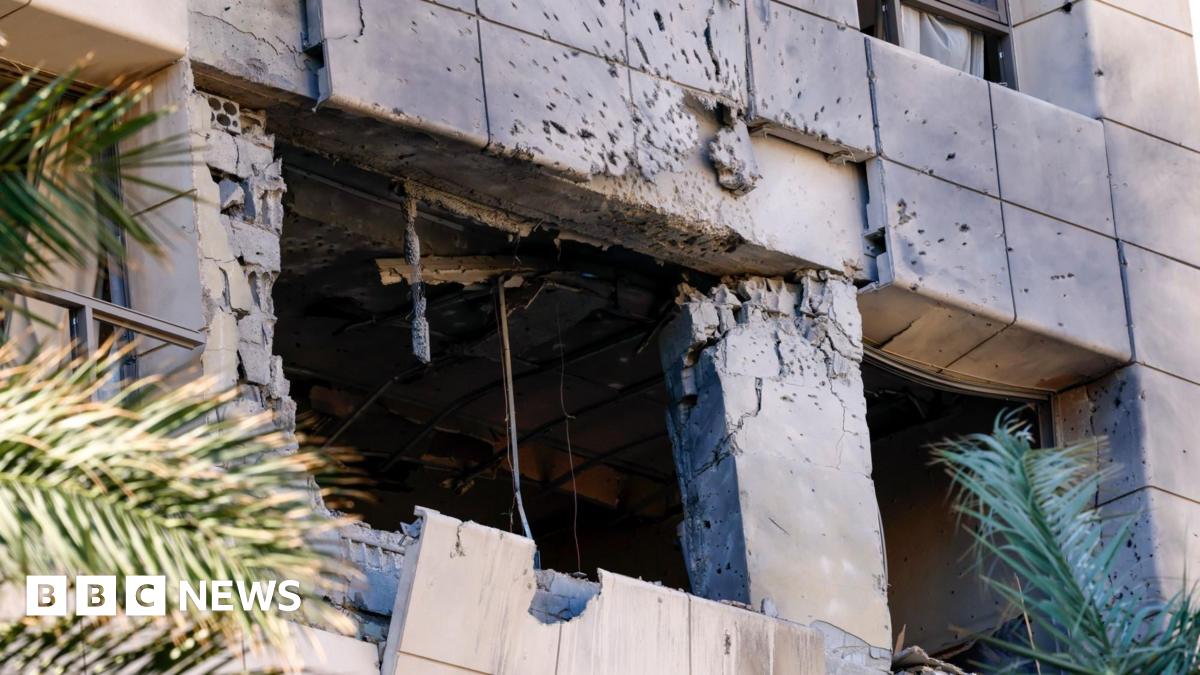
Hotel management said they could not comment.
But one staff member told the BBC that the third and fourth floors had been blocked off for the police investigation, with the displaced people staying on them moved elsewhere. He said the hotel was large and busy, and he and his work friends did not know who had been staying in the specific room that was hit, but had heard the reports.
An official source told the BBC that three Lebanese nationals had booked rooms on the hotel’s third and fourth floors which were used by the men targeted in the strike.
The source said the hotel was hit three times, but two of the munitions did not explode.
In its statement, the IDF said the strike, conducted by its navy, followed “precise IDF intelligence” that senior Quds Force officials – from its Lebanon Corps and Palestine Corps – were “hiding in a civilian hotel”.
It named three “key commanders” it said were killed in the strike as Majid Hassani, described as being “responsible for transferring funds to the [Iranian] regime’s proxies in Lebanon”, and senior intelligence figures Alireza Bi-Azar and Ahmad Rasouli.
Two other Quds Force figures, Hossein Ahmadlou and Abu Mohammad Ali, were also killed, it said.
The IDF said the men’s “elimination constitutes a significant and necessary blow to the Iranian presence in Lebanon and to the Hezbollah terrorist organisation”.
In a letter to UN’s secretary general sent on Thursday, Iran’s permanent representative Amir-Saeid Iravani confirmed that Hassani, Bi-Azar, Rasouli and Ahmadlou were killed.
However, he identified them as the Iranian embassy in Beirut’s second secretary, third secretary, attaché, and a person assigned to the mission, and condemned the strike as a “heinous crime”.
“The targeting killing of four Iranian diplomats while they were serving as official representatives of a sovereign member state on the territory of another sovereign state constitutes a grave terrorist act and a serious breach of international law,” Iravani wrote.