
The Celtic Fans Collective have hit out at Police Scotland’s security measures before, during and after the game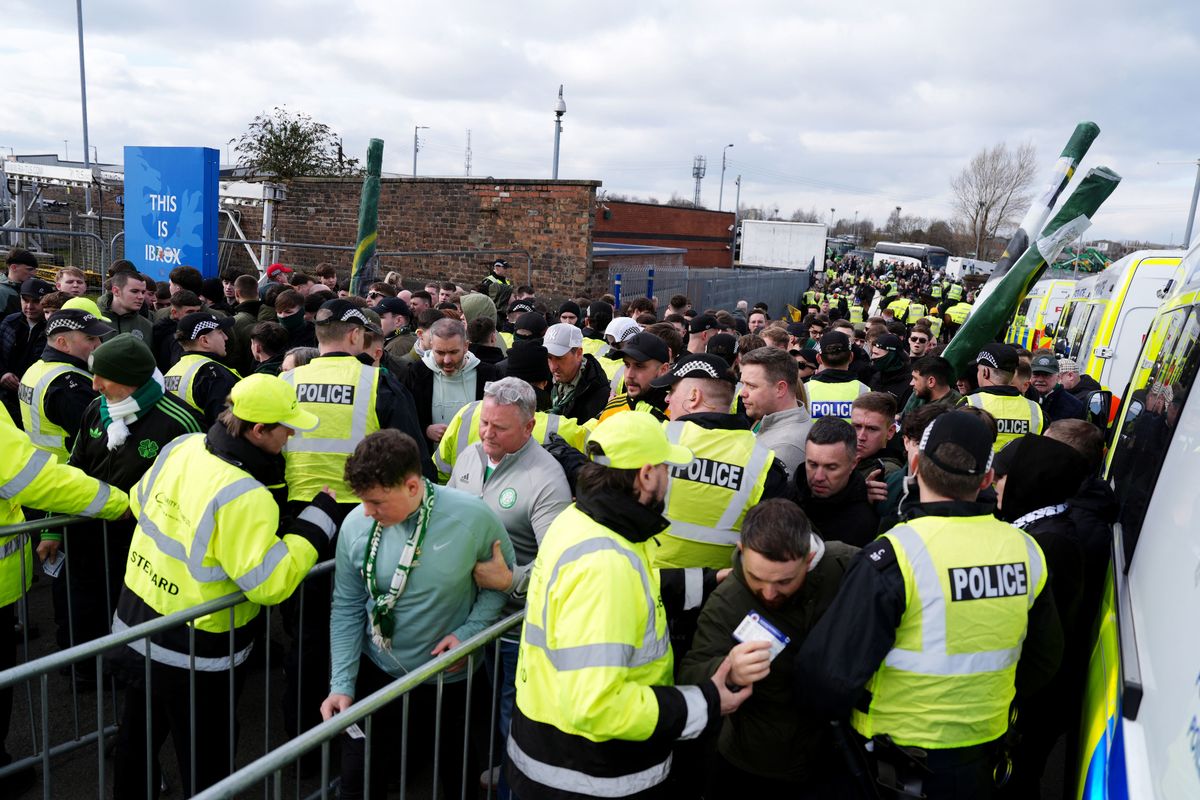
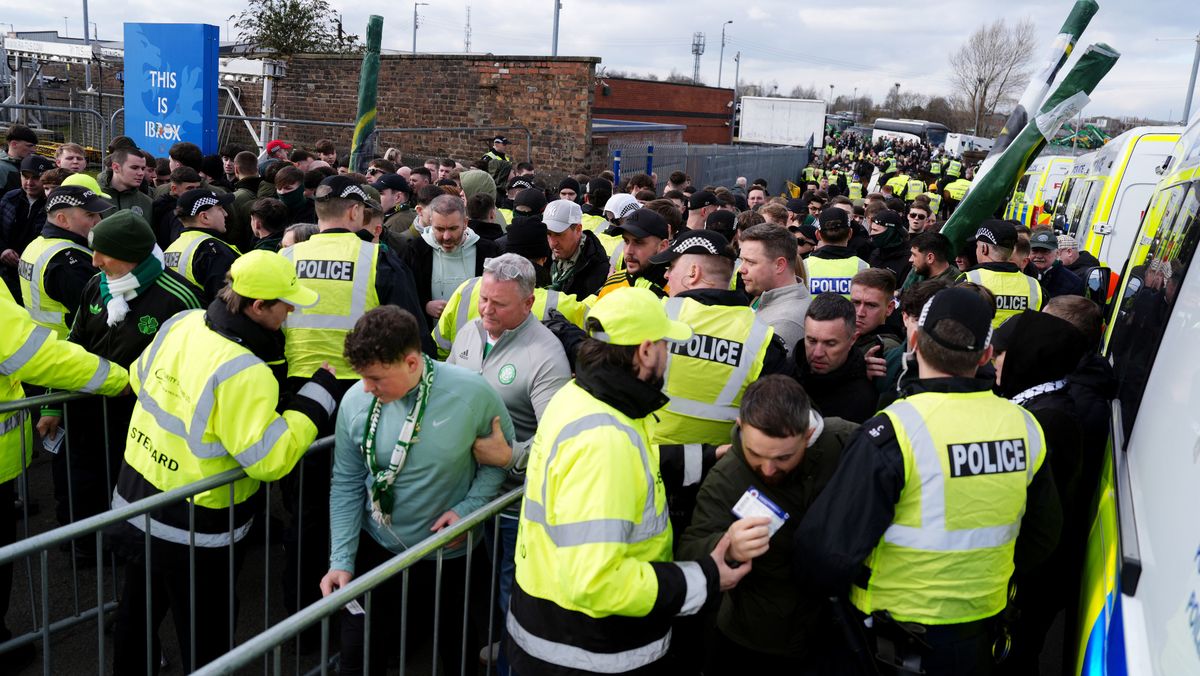
Celtic fans pass the police checkpoint(Image: PA)
The Celtic Fans Collective have issued a damning statement condemning Police Scotland’s handling of Sunday’s powderkeg at Ibrox.
And the influential activist group have demanded answers from Parkhead chiefs – branding the position of security boss Mark Hargreaves as “untenable”.
Around 7,500 supporters packed out the Broomloan Stand for the first time since 2018 after the Glasgow rivals were drawn together in the Scottish Cup. After a goalless 120 minutes, Celts eventually booked their place in next month’s Hampden semi-final with a penalty shootout win.
But the derby was marred by a string of off-field issues – including a violent pitch invasion – with authorities launching a full investigation. Nine arrests have been made so far after both sets of supporters stormed onto the pitch, with a steward being left injured in the chaos, while a member of Hoops staff was also attacked by a Rangers fan.
Three men, aged 54, 23 and 20, have been arrested and charged in connection with a serious assault of a man on Helen Street following the match.
Before the fixture, there were also bottleneck scenes outside the stadium as thousands of punters were gradually funnelled into the ground, passing multiple police checkpoints and causing extreme congestion between Broomloan Road and Loverose Way.
Footage has also emerged online of ticketless Hoops fans storming the turnstiles and forcing their way into Ibrox as they darted past security.
Emma Croft, Greater Glasgow Division Chief Superintendent, warned on Monday that large away allocations at Old Firm games may be unworkable after the weekend’s shameful scenes.
However, the Celtic Fans Collective believes Police Scotland should shoulder their share of the blame for the mayhem that unfolded – insisting supporters require “competent planning and safe crowd management” – not “heavier policing or more restrictive measures”.
A lengthy 664-word statement read: “Amidst the sensationalist headlines and commentary following Sunday’s Scottish Cup match at Ibrox, an important aspect of the day risks being overlooked. While much attention has focused on the scenes after the match, the dangerous conditions experienced by Celtic fans attempting to enter the stadium beforehand also require serious scrutiny.
“Concerns about the policing and management of Celtic supporters are not new. Independent investigations by Fairhurst consultants into incidents in September 2018 and again in March 2025 identified significant failings in the way Police Scotland handled large groups of supporters. As we approach the one-year anniversary of the kettling of Celtic supporters on London Road before the derby at Celtic Park, which prompted one such investigation, supporters are still waiting for the club to take a clear position on the treatment of its own fans.
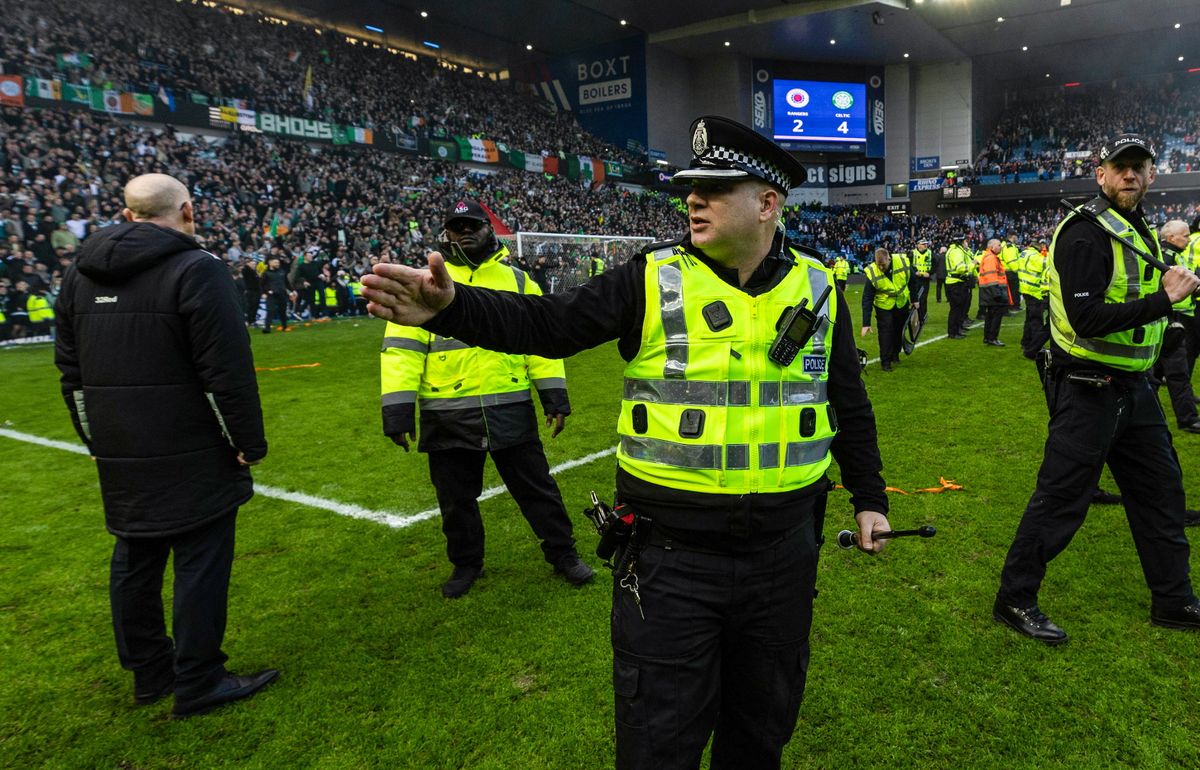
A police officer as fans storm the pitch (Image: SNS Group)
“In the week leading up to Sunday’s fixture, many Celtic supporters and the club’s Supporter Liaison Officers raised concerns about the entry protocols proposed by Rangers and Police Scotland. A stadium approach and entry system that had safely accommodated a full Broomloan Stand allocation for decades was replaced with arrangements designed for around 2,500 supporters.
“On the day, those concerns proved well founded. Large numbers of Celtic supporters were funnelled into a restricted approach route and held there for extended periods before reaching the turnstiles. The result was dangerous overcrowding and prolonged containment in conditions many supporters described as crush-like. Rather than attempting to ease this congestion, Police Scotland deployed officers in riot gear, increasing tension and causing injuries. For many supporters present, this response was reminiscent of the approach taken during the Janefield Street incident in 2018, raising further questions about whether meaningful lessons have been learned.
“Further concerns arose around new instructions for Celtic supporters’ bus parking, which were poorly managed and left travelling supporters exposed after the match.
“Taken together, these events raise serious questions about the planning and execution of the policing and crowd management operation surrounding Sunday’s match. Supporters had raised concerns in advance, yet the arrangements proceeded regardless and the predicted problems followed.
“Celtic Football Club must also address these concerns. In recent months the club has placed considerable emphasis on matters relating to supporter conduct and stadium safety. Given that focus, supporters would reasonably expect to hear from the club and from Head of Safety, Security and Operations Mark Hargreaves on what part he had to play in the matchday operation. Hargreaves was once again inexplicably absent on the day. He lost the trust of many Celtic fans some time ago, and his position is untenable.
“These concerns are particularly relevant as the Green Brigade have been advised that any decision on their re-admission lies with Police Scotland. Should approval be granted, fans in the North Curve will be asked to place their trust in new policing and stewarding arrangements despite having no advance notice of the measures or any input into how the area will operate on a matchday.
“Recent events do little to inspire confidence in Police Scotland’s ability to design and implement such plans, and that concern was only compounded by what took place on Sunday afternoon.
“Supporters do not need another formal review. The issues surrounding the policing of Celtic supporters have already been the subject of multiple investigations. What is required now is meaningful engagement and concrete action from Police Scotland and Celtic Football Club to ensure that the conditions experienced by thousands of supporters at Ibrox on Sunday cannot happen again.
“To be absolutely clear, the position is straightforward. Supporters do not require heavier policing or more restrictive measures, they require competent planning and safe crowd management. Unlike others, we do not need to support that position with ludicrous protestations. Attempts to explain Sunday’s events solely through the behaviour of visiting supporters ignore the reality of what occurred. The focus must remain on the failures in policing, planning and crowd management which created entirely foreseeable unsafe conditions.
“Accountability for what happened on Sunday is now required.”